Zum Inhalt springen
EPP Europe
  • News
  • Products
  • Applications
  • Technology
  • Semiconductor
  • Inspection
  • Company News
  • Events
EPP Europe
  • Technology
  • Inspection (AOI/AXI)
  • Semiconductor Packaging
  • Company News
  • Products
  • Trade Shows & Events
    EPP Europe Newsletter
    The most important electronics-manufacturing news delivered to your inbox.

    Info

    • Impressum
    • Datenschutz
    • Barrierefreiheit
    • Datenschutzeinstellungen

    Kontakt zur Redaktion

    EPP EuropeKonradin Mediengruppe
    Ernst-Mey-Str. 8, 70771 Leinfelden-Echterdingen

    E-Mail: redaktion@konradin.de
    Folgen Sie uns
    EPP Europe
    © 2026 EPP Europe
    Startseite/Technology/Artikel
    Indium's automotive-grade solder paste for enhanced electrical reliability
    Bildquelle nicht angegeben
    Technology

    Indium's automotive-grade solder paste for enhanced electrical reliability

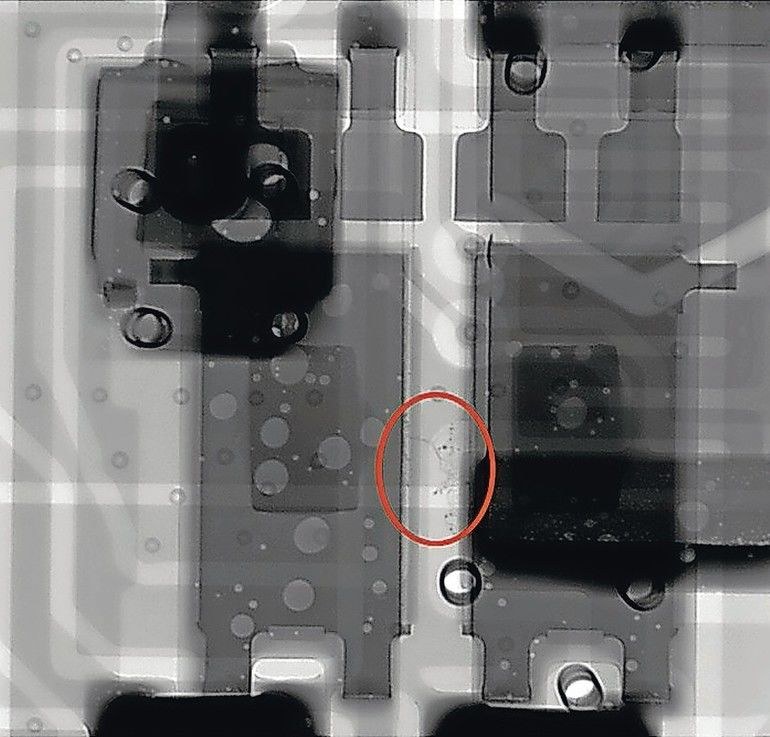
    In a study by Indium Corporation, a Mosfet low-standoff component was assembled with a no-clean solder paste where ionic dendritic growth was observed.
    Veröffentlicht
    28. Oktober 2019
    Lesezeit
    5 Minuten
    Rubrik
    Technology

    Karthik Vijay, Technical Manager, Europe, Africa, and the Middle East, Indium Corporation

    It is critical that the no-clean flux residue does not cause ionic dendritic growth and corrosion under low-standoff power components during the working life of the product. For these reasons, the automotive industry is imposing more stringent Surface Insulation Resistance (SIR) requirements to assess the electrical reliability of the no-clean solder paste flux chemistry, versus the standard J- STD 004B IPC-SIR test requirements. These include increased test voltages, increased test time, reduced space width, upping the minimum SIR threshold, and usage of different test coupons.

    Leakage current and failure of high-power Mosfet

    In a study conducted by Indium Corporation, a power Mosfet low-standoff component was assembled with a no-clean solder paste and subjected to 50 V, 90 % RH for 1,000 hours. In this example, ionic dendritic growth was observed that resulted in leakage current and eventual failure of the assembly. This failure was specific only to the low-standoff Mosfet with no other component failures. With different test vehicles, the company was initiating an attempt to mimic the electrical failure of a no-clean paste for low-standoff components, with the intent to design an automotive-grade no-clean halogen-free solder paste for enhanced electrical reliability.

    Design of automotive-grade no-clean halogen-free solder paste

    No-clean flux characteristically consists of a mix of solvents, activators, resins, and rheological additives. During reflow, with normal volatilization, the activator-solvent system in “dry” flux residue is incapable of undergoing corrosion reaction when encapsulated by solid rosin in the presence of moisture, bias, and temperature. However, with lower standoffs preventing proper venting of flux volatiles, activator-solvent system in the “wet” flux residue are available for corrosion especially with moisture, bias, and temperature. The challenge is to design a flux system with the right rosin-activator-solvent complex that passes electrical reliability, regardless of whether the residue is “wet” or “dry.”

    SIR testing with and without glass slide

    A standard B24 SIR coupon was chosen for testing purposes. Five no-clean solder pastes consisting of four control pastes and the automotive-grade designed paste were tested as per J-STD 004B IPC SIR conditions. To evaluate the electrical performance of the no-clean pastes for low standoffs, a glass slide was placed on top of the printed flux deposits on one half of the B24 SIR coupon.
    Mehr aus Technology

    Weitere aktuelle Artikel aus der Rubrik Technology.

    Alle Technology-Artikel
    IPC-J-STD-002F mandates automatic flux doctor blade for solderability testingFoto: Louis Reed / Unsplash
    Technology

    IPC-J-STD-002F mandates automatic flux doctor blade for solderability testing

    10. November 2026

    The release of IPC-J-STD-002 Revision F introduces stricter, more precisely defined requirements for solderability testing, including a mandatory automatic flux doctor blade on solderability testers. Equipment lacking…

    Plasmatreat PFW10 and PFW20 Static Plasma Jets Target Sensitive PCB Surface TreatmentFoto: Johannes Plenio / Unsplash
    Technology

    Plasmatreat PFW10 and PFW20 Static Plasma Jets Target Sensitive PCB Surface Treatment

    ← Zurück zu TechnologyZur Startseite

    Flux deposits, as opposed to paste deposits, were tested to simulate the worst-case low standoff scenario. B24 SIR coupon was applied with and without the glass slide, in order to mimic the low standoff condition. The solder pastes included a combination of halide and halogen-free fluxes, T4 powder, and SAC305 alloy. A standard Pb-free air reflow profile was used in the process. For the standard SIR testing with no glass slide on top, all of the no-clean fluxes passed the minimum SIR requirement of 100 MΩ. For the test with the glass slide on top, the four control no-clean pastes failed with only the automotive-grade no-clean flux passing. The SIR performance for the five no-clean solder pastes tested on a B24 SIR coupon with and without the glass slide on top. The dendrites for the control pastes were documented with glass slides on top of the B24 SIR coupons.

    Automotive-grade no-clean paste for enhanced SIR conditions

    Now that a correlation had been established between low standoff and an appropriately designed no-clean flux system, the automotive-grade no-clean solder paste was subject to SIR testing for enhanced conditions, as per automotive requirements using a B52 coupon; 10 V and 50 V; 1,000 hours; 0.2 mm space width; 93 % RH; 400 C; and a minimum SIR threshold of 5000 MΩ. The specially designed automotive-grade paste passed this stringent SIR test as well, using the same standard reflow profile as before.

    Summary

    With increased electrification of automotive platforms, the complexities imposed by these systems—higher voltages, higher power components, longer hours of operation, and higher temperatures—on no-clean halogen-free solder pastes used to assemble PCBAs are only going to increase. In the past, the criteria that a no-clean paste had to achieve included standard SIR testing, good printing with response-to-pause, good soldering in air reflow, good coalescence, and the ability to address head-in-pillow defects.

    Now, in addition to these requirements, ensuring the electrical reliability of the no-clean solder paste for low-standoff high-power components for enhanced SIR conditions has become equally if not more important. It is critical, therefore, to specifically design an automotive-grade no-clean halogen-free flux system with the right rosin-activator-solvent complex, that’s electrically safe with no ionic dendritic growth, especially for low standoff high-power components. In parallel, the no-clean halogen-free flux system should be engineered with the required activity to form reliable solder joints in air reflow conditions.

    productronica, Booth A4-214

    www.indium.com

    Zusammenfassung

    Mit der rapid zunehmenden Elektronifizierung der Automobile steigen die Anforderungen an die Zuverlässigkeit der Elektronikbaugruppen weiter an, die selbstverständlich auch unter harten Bedingungen zuverlässig funktionieren müssen. Mit einem verschärften SIR-Test konnte nun die Eignung spezieller halogenfreier No-Clean-Pastenformulierungen zur Bildung robuster Lötstellen in der Automobilelektronik nachgewiesen werden.

    Résumé

    Avec l‘augmentation rapide de l‘électronisation des automobiles, les exigences en matière de fiabilité des assemblages électroniques ne cessent d‘augmenter, qui doivent bien entendu fonctionner de manière fiable, même dans des conditions difficiles. Grâce à un test SIR plus rigoureux, il a été possible de démontrer l‘adéquation des formulations de pâtes spéciales sans halogène et non nettoyantes pour la formation de joints de soudure robustes dans l‘électronique automobile.

    Резюме

    С каждым годом доля электроники в автомобилях возрастает. Требования к надежности электронных компонентов также повышаются — они должны надежно функционировать даже в самых суровых условиях. Благодаря более строгому тесту SIR теперь можно подтвердить пригодность специальных, не содержащих галогенов паяльных паст с флюсом, не требующим отмывки, для формирования прочных паяных соединений в автомобильной электронике.

    28. Oktober 2026

    Plasmatreat's PFW10 and PFW20 static plasma jet systems are designed for selective, high-accuracy surface treatment of sensitive electronic assemblies, including circuit boards, using cold atmospheric-pressure plasma.

    Indium Corporation to Present High-Reliability Solder Pastes at EFX 2026 in StuttgartFoto: Indium Corporation
    Technology

    Indium Corporation to Present High-Reliability Solder Pastes at EFX 2026 in Stuttgart

    30. September 2026

    Indium Corporation will exhibit three solder paste technologies at Expo for Electronics Manufacturing (EFX) 2026 in Stuttgart, Germany, addressing thermal cycling performance, low-temperature step soldering and…

    Europlacer: Software as the Core Performance Driver in High-Mix SMTFoto: Brecht Corbeel / Unsplash
    Technology

    Europlacer: Software as the Core Performance Driver in High-Mix SMT

    24. September 2026

    Europlacer makes the case that traditional SMT software was not designed for the demands of high-mix, short-run production, and that the resulting performance gap is increasingly visible on the shop floor.