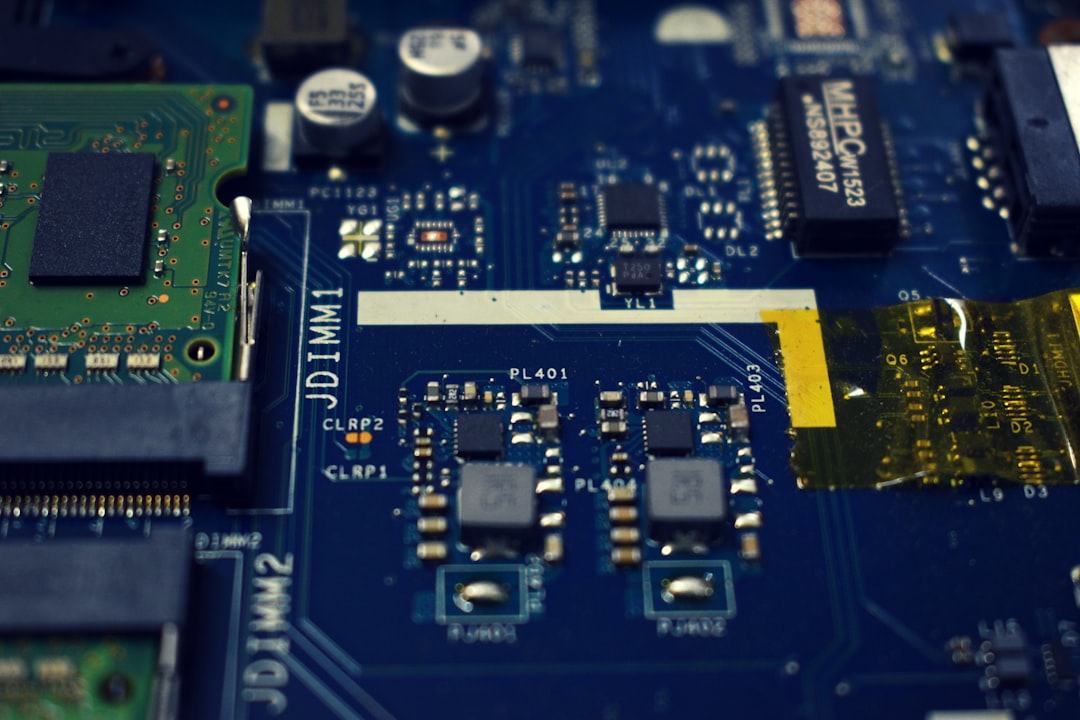
In surface-mount and advanced packaging workflows, dispensing describes the controlled deposition of viscous or semi-viscous fluids onto a substrate or component surface. The range of applicable materials is broad — from low-viscosity underfills and flux pastes to high-viscosity silicones, epoxy adhesives and potting compounds. Each application imposes specific demands on the dispensing system regarding volume accuracy, placement repeatability, bead geometry and process speed. As component densities increase and package footprints shrink, dispensing has evolved from a relatively straightforward peripheral process into a precision operation with direct implications for product reliability and yield.
Unlike stencil printing, which deposits paste in a single parallel step across an entire board, dispensing operates sequentially: each dot, bead or filled area is applied individually. This makes it inherently flexible but also more sensitive to parameter drift over time. A thorough understanding of the governing physical principles is therefore prerequisite to achieving stable, repeatable results at production volumes.
Dispensing Technologies: From Time-Pressure to Jetting
The most widely established dispensing principle is time-pressure dispensing, in which a regulated air pulse acts on a fluid reservoir — typically a syringe — to push material through a needle tip onto the target surface. Deposit volume is controlled by adjusting air pressure, pulse duration and needle geometry. The method is cost-effective and adaptable, but highly sensitive to fluid viscosity changes caused by temperature variations or ageing. For production environments demanding tight volume tolerances, time-pressure systems require active temperature control of the syringe and regular calibration routines.
Positive-displacement pump systems — including auger-screw, piston and gear-pump variants — decouple deposit volume from upstream pressure fluctuations by metering a defined fluid volume per actuation cycle. Auger-screw dispensers rotate a helix-shaped screw within a barrel to advance material; deposit volume is proportional to the number of rotations. These systems offer superior volume consistency for high-viscosity materials such as thermal pastes or filled epoxies and are less susceptible to viscosity drift.
Jetting technology represents the most significant development in dispensing over the past two decades. A jetting valve uses a rapidly actuating needle or ball to eject discrete droplets from a nozzle without contact between the dispenser tip and the substrate. Because the nozzle never touches the board, jetting eliminates the retraction artefacts that can distort deposits in contact-based methods, and the non-contact nature enables deposition onto pre-populated boards with tall components. Jetting speeds — typically several hundred to over a thousand shots per second — allow it to approach the throughput of stencil printing for certain dot-pattern applications. The trade-off is a narrower process window for materials with high filler content or extreme viscosity.
Material Rheology and Its Impact on Process Stability
The rheological profile of the dispensed material is the dominant factor governing process behaviour. Most electronic fluids exhibit non-Newtonian characteristics: their apparent viscosity changes under shear stress. Thixotropic materials — such as solder paste carriers, many epoxies and some silicones — thin under shear and recover viscosity at rest. This property is beneficial in stencil printing but can cause inconsistencies in dispensing if the applied shear rate varies between shots. Pseudoplastic materials behave similarly but without the time-dependent recovery component.
Viscosity is also strongly temperature-dependent. A material that dispenses reliably at 25 °C may behave very differently at 20 °C or 30 °C, particularly in time-pressure systems where the driving force is fixed. For this reason, many production dispensers incorporate syringe heaters or Peltier-based temperature control to hold the fluid within a defined operating window. Datasheets from material suppliers typically specify viscosity as a function of temperature and shear rate, expressed in Pa·s or mPa·s, and these figures should be referenced directly when programming process parameters.
Filled materials — such as thermally or electrically conductive adhesives containing silver flakes or aluminium oxide particles — introduce additional complexity. Particle settling during storage or extended machine idle time can cause viscosity gradients within the syringe, leading to deposit-volume drift. Regular agitation protocols or the use of pre-mixed, single-use cartridges are common countermeasures in high-reliability production environments.
Key Process Parameters and Their Interdependencies
For contact-based dispensing, the stand-off distance between the needle tip and the substrate surface is a critical geometric parameter. If the tip is too close, the deposit is compressed and may spread beyond the intended footprint; too far, and the fluid string may break before the deposit is fully formed, causing tailing or satellite droplets. Stand-off distance must be matched to needle inner diameter, fluid surface tension and target deposit height.
Z-axis speed during retraction also influences deposit shape. A slow retract draws a longer fluid tail, increasing the risk of stringing. Snap-back speed — often configurable in modern dispensing controllers — should be optimised empirically for each material and deposit geometry. For jetting, the equivalent parameters are needle or ball stroke, spring preload and actuation frequency, which together determine droplet volume and velocity.
Deposit weight or volume verification is typically performed gravimetrically during setup — the dispenser deposits a defined number of shots onto a tared balance and the average mass per shot is calculated. In-line 3D measurement systems, analogous to solder paste inspection (SPI) equipment, are increasingly used to measure dispensed-dot height, diameter and volume in real time, enabling closed-loop feedback to the dispenser controller.
Application Areas: Underfill, Adhesive Bonding, Encapsulation and Beyond
Capillary underfill — the deposition of a low-viscosity epoxy along one or two edges of a flip-chip or BGA package, which then wicks under the component by capillary action — is one of the most demanding dispensing applications. The process requires precise bead placement at a defined stand-off from the component edge, correct fluid volume to achieve complete underfill without voids or overflow, and substrate pre-heating to control wetting behaviour. Flow time, fillet geometry and void content are all sensitive to dispensing parameters.
SMT adhesive dispensing — used to bond components to the bottom side of boards before wave soldering — demands dot geometry consistency to ensure reliable component retention through the soldering process. Dot height must be sufficient for adhesive to contact the component body after placement, without spreading onto the pads. Dam-and-fill and glob-top encapsulation for bare-die or sensitive devices impose requirements on bead-overlap patterns and total volume accuracy to achieve complete coverage without voids or bleed.
Thermal interface material (TIM) dispensing for power modules and RF components has become increasingly important as heat dissipation requirements intensify. Here, the goal is typically to achieve a defined layer thickness with high coverage uniformity and minimal entrapped air — objectives that favour area-pattern jetting or spiral-bead dispensing strategies over simple dot deposits.
Process Control, Qualification and Industry Standards
Process qualification for dispensing generally follows a design-of-experiment (DOE) approach, in which the most influential parameters — pressure or pump speed, temperature, stand-off distance and retract speed — are varied systematically to identify a robust operating window. IPC standards, particularly IPC-7527 (Requirements for Soldering Fluxes) and IPC-A-610 for workmanship, provide reference criteria, though dispenser-specific qualification is largely governed by internal process specifications and material supplier recommendations.
Statistical process control (SPC) monitoring of gravimetric or optical deposit measurements allows production teams to detect drift before it translates into yield loss. Traceability requirements in automotive and medical electronics increasingly mandate that dispensing parameters and in-line measurement data be logged per board or per unit, integrating the dispenser into the broader MES infrastructure. Modern dispensing platforms support direct data exchange via standard interfaces, enabling this integration without manual data entry.
As package miniaturisation continues and new material systems — including anisotropic conductive adhesives and bio-compatible encapsulants for implantable devices — enter production, dispensing technology faces growing demands on accuracy, repeatability and material compatibility. The convergence of high-speed jetting, closed-loop measurement and digital process documentation positions dispensing not as a peripheral step but as a core precision process within the connected smart factory.