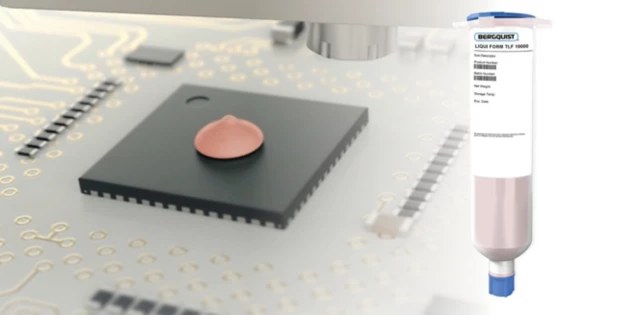
Key benefits, according to Henkel, include:
- Thermal Conductivity, ASTM D5470, 10 W/(m-K)
- Excellent thermal cycling performance & dispense properties
- Low thermal impedance
- Dispensing speeds as fast as 22 g/min. with excellent flow rate stability for high volume manufacturing
- Very low assembly stress reduces opportunities for component damage
The company says its unique formulation assures a balanced mix of high thermal conductivity, good dispensing efficiency and high thermal reliability.
“Larger, higher-power devices such as ASICs and FPGAs are the norm in 5G telecom infrastructure gear, data center switches, routers and servers, as well as electric vehicle (EV) infrastructure and industrial automation electronics,” the company said. “As component density and complexity increase in response to faster data processing and digitalization requirements, higher wattage thermal output must be controlled to deliver dependable performance.”
According to IDTechEx Senior Technology Analyst, Dr. James Edmondson, process-friendly, high thermal conductivity materials are a necessity to bridge production and performance expectations: “The push toward digital, data-driven control across market sectors has given rise to high power density component designs that can deliver exceptional processing speeds,” he says. “This includes many applications – from 5G baseband units to small cells and Wi-Fi 6E devices in urban areas to EV mobility to AI and robotic technologies—and they all require reliable thermal management solutions that are rugged enough to withstand dynamic environments, positioning uncertainty and high wattages. Our market research confirms the need for dispensable, high thermal conductivity TIMs that can meet today’s performance and volume processing demands and thermal gels have proven to be an effective solution.”