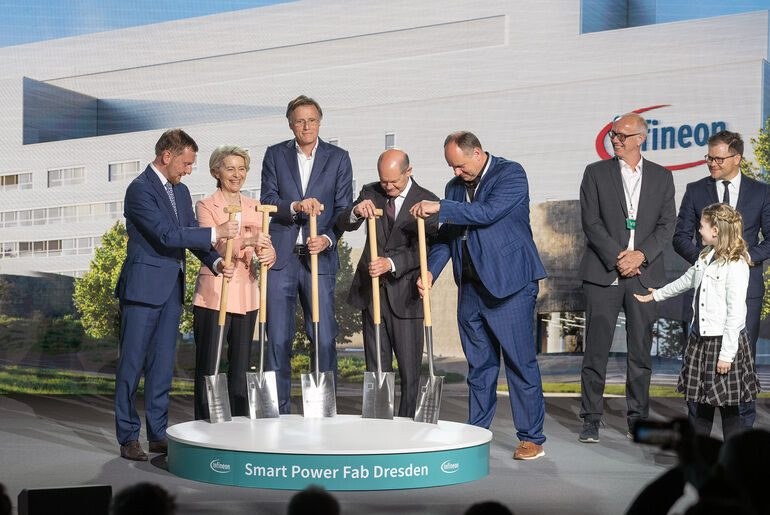
In February, the German Federal Ministry for Economic Affairs and Climate Action (BMWK) approved an early project launch, meaning that construction can begin before inspection of legal subsidies has been completed by the European Commission. Subject to the European Commission‘s state aid decision and the national grant procedure, the project is to be funded in accordance with the objectives of the European Chips Act. Infineon is seeking public funding of around one billion euros.
Preparatory construction measures are now taking place at the site of the new plant; with shell construction planned to begin in autumn 2023. Manufacturing activities are planned to begin in fall 2026.
The new manufacturing complex for power electronics will be based on highly efficient 300-millimeter technology and will increase efficiency levels, giving Infineon additional flexibility in order to supply its customers faster. It will be closely linked with the company’s existing Villach site which currently produces 200mm and 150mm silicon lines, as “One Virtual Fab”.
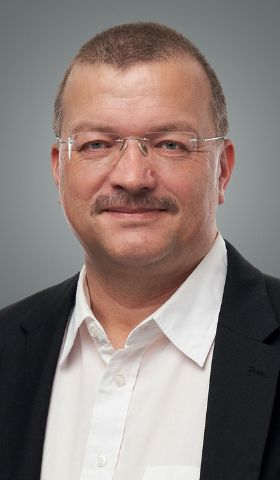
“With this groundbreaking, Infineon is launching an important contribution to the green and digital transformation of our society,” said Hanebeck. “Global semiconductor demand will grow strongly and persistently in view of the high demand for renewable energies, data centers and electromobility. Our new plant will serve our customers‘ demands in the second half of the decade. Together, we are driving decarbonization and digitalization.”
”In times of increasing geopolitical risks, it is great news for Europe that Infineon is investing massively in semiconductor manufacturing in Dresden”, said von der Leyen. ”We need more such projects in Europe as demand for microchips will continue to rise rapidly. The EU Commission and member states are mobilizing 43 billion euros over the next few years under the European Chips Act to create a stronger and more resilient Europe in the digital domain.”
“Chips are the basis of any essential transformation technology – from wind farm to charging station. We welcome Infineon‘s continued investment in Germany and thus further strengthening our country as one of the world‘s most important semiconductor locations,” Scholz emphasized. “Chips made in Dresden help secure jobs and make our industry – from midsize companies to large corporations – more resilient. Dresden is where the components are created, that are needed for upcoming investments in green technologies.”
“Infineon‘s investment will strengthen Europe, Germany and Saxony as an economic location,” says Kretschmer. “The construction of the new plant will both secure and create high-value jobs in Dresden. At the same time the attractiveness of Silicon Saxony as a center of expertise for the global semiconductor industry is increasing. For years, the state of Saxony has been supporting this unique ecosystem by investing in science.”
In addition, the investment by Infineon strengthens the manufacturing basis for the semiconductors that drive decarbonization and digitalization. Analog/mixed-signal components are used in power supply systems, for example in energy-efficient charging systems, small automotive motor control units, in data centers and in applications for the Internet of Things (IoT). The interaction of power semiconductors and analog/mixed-signal components makes it possible to create particularly energy-efficient and intelligent system solutions.