Jürg Müller, Product Manager, Pawo Systems AG (Schleuniger Group)
Localizing, finding and repairing a defective electrical connection can be very time-consuming and expensive. In most cases an entire cable assembly or component is replaced, as this is usually less costly and quicker. However, in mass production, such as automobile manufacturing, the costs incurred quickly amount to enormous sums – not even considering the damage the recall of a product has on company image and future sales figures.
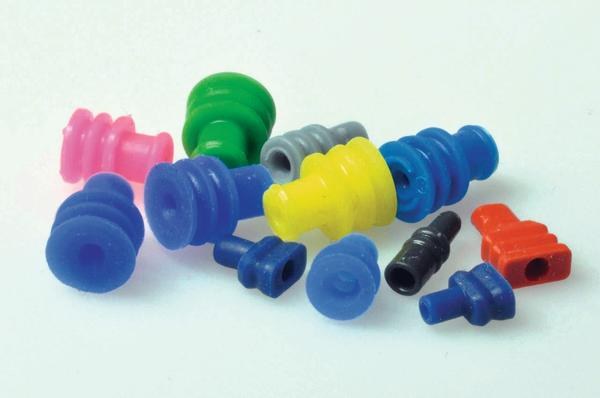
A weather seal – commonly called a „seal” – is a silicon ring with multiple shoulders that is applied to the insulation of a wire to seal off a crimped terminal once it has been plugged into a connector housing. The seal fully protects the electrical connection from any moisture or dirt. To reliably attach a seal to a crimped connection, the insulation crimp zone of the terminal must be matched to the outer diameter of the seal.
The main challenge in seal processing (or sealing) is to reliably sort and position the loose seals without damaging them, so that they can be easily applied to a stripped wire. A vacuum system brings the loose seals to a vibrating feed track. This track transports the seal to the application area and is specifically designed in such a way that each seal is automatically fed in the correct position and orientation. Before positioning the seal on the stripped wire, it is temporarily expanded to prevent the individual wire strands from being bent or brushed open during application. If the material of the seal is not elastic enough to be stretched during widening without permanently damaging the seal (e.g. hard-shell seals or mini-seals), the seal is applied to the wire prior to stripping instead.
Semi-automatic machines such as the Schleuniger SealCrimp 210 B can typically process a wide variety of seal types, sizes and shapes – from round, oval and square to hard-shell seals and miniature seals. Typical cycle times for the entire sequence (strip/zero-cut/seal/crimp), is less than 1.5 s. For applying the seal only, the cycle time of an automatic station like the SLU 3000 is only 300 ms. Besides short cycle times, the time needed to change over from one seal to another is a key factor for efficient production. Quick-change seal kits include all tooling required for a specific seal and can be easily exchanged without using any tools. The same seal kits can typically be used on both the benchtop machines and fully automatic systems, reducing tooling costs.
Quality assurance systems are available to check whether a seal is present (for fully automatic systems) or to assure correct seal orientation and detect pierced seals. Some seals require cleaning prior to processing. Very oily seals quickly lead to sticky residue on the vibrating feed track while seals without any oil can also jam the feed track. For both cases, equipment is available to dry oily seals or to apply a thin and consistent layer of oil.
Although there are alternative technologies under development, the use of weather seals will remain a proven and cost-effective method to protect crimped connections from all types of moisture and dirt. Advances in processing technology will further reduce production costs, but the core principle of sealing will remain the same for years to come.
Selbst ein kleiner Fehler in einer elektrischen Verbindung kann zu instabilen elektronischen Systemen oder im schlimmsten Fall zu lebensgefährlichen Situationen aufgrund ausgefallener Sicherheitsfunktionen führen. Verbindungen, die Luftfeuchtigkeit oder Nässe ausgesetzt sind, wie ABS-Sensoren in Fahrzeugen, erfordern spezielle Schutzmaßnahmen. Der Einsatz von Dichtungen vor dem Crimp-Prozess garantiert, dass weder Nässe noch Schmutz nach dem Verrasten mit dem Stecker in das Tüllengehäuse eindringt.
La moindre erreur dans une connexion électrique peut entraîner l’instabilité de systèmes électroniques, dans les cas extrêmes, des situations de danger vitales. Les connexions exposées à l’humidité de l’air ou à l’eau, telles les capteurs des systèmes ABS sur les véhicules, nécessitent des mesures de protection supplémentaires. L’utilisation de joints appropriés avant l’opération de sertissage permet de garantir que l’humidité et les salissures ne pénètreront pas dans le boîtier de la douille après son raccordement.