Filling and wetting processes in e
The field of e-Mobility is ever-changing and subject to a rapid rate of development. Lithium-ion battery manufacturers and OEMs are aware that – even when the technical parameters are constantly changing – one element always has to stay the same to compete on the international market: cell quality. This is by no means an easy task as electrolytes are a complicated material.
Gigafactories are managing to produce cells in ever-shorter cycle times – 40 cells per minute is now not uncommon. Against this backdrop, companies are forced to focus on the filling and wetting processes in particular as both of these process steps are among the most critical in terms of time and quality when assembling the cells.
‘Filling’ is the process whereby electrolyte is filled into the battery cells under a vacuum, and ‘wetting’ is when the electrolyte penetrates into the porous structure of the electrode and separator – resulting in electrical contact when ions migrate.
The electrolyte in a lithium-ion battery cell consists of a solvent such as ethylene carbonate, propylene carbonate, or dimethyl carbonate, to which lithium salt is added. The most commonly used lithium salt is lithium hexafluorophosphate (LiPF6). It is an important element in the electrolytes of different Li-ion batteries, and makes up around 43% of the overall costs. Compared to other electrolytes, lithium hexafluorophosphate has better solubility, conductivity, safety, and eco-friendliness in organic solvents, and is currently the most popular lithium salt for electrolytes.
Dosing technology
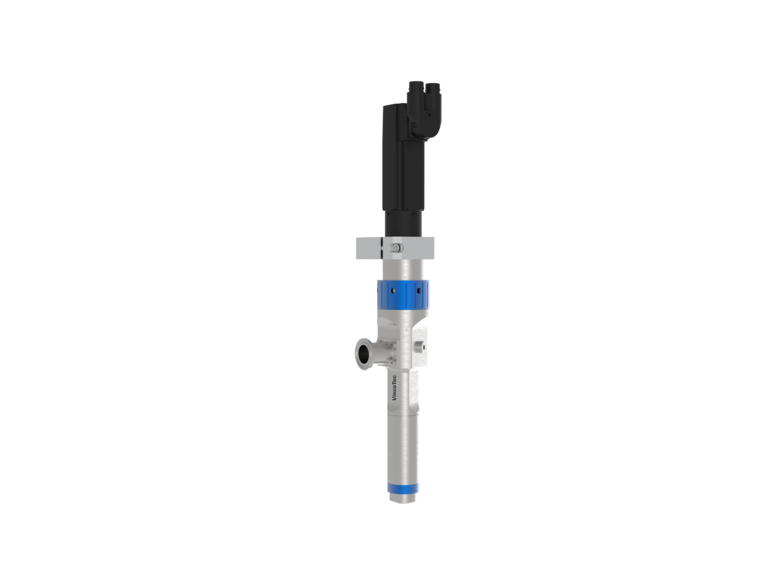
ViscoTec has designed dosing technology, including the vipro-PUMP for electrolyte dosing, specially for this electrolyte with a viscosity of ~ 100 – 250 mPas @20°C and a density of ~1.1 – 1.3 g/cm³, only using materials compatible with the process and which guarantee a long service life under tough conditions.
This is particularly important as the electrolyte does have its disadvantages. It undergoes a reaction even when the air humidity is low, forming deadly hydrofluoric acid. As this is lipophilic, it can cause almost instant death if the skin or mucous membranes are exposed to it, even for just a brief moment. Calcium fluoride and magnesium fluoride (neither of which are readily soluble) form deep in the tissue and cause huge damage to the electrolyte balance in the body.
This is why the electrolyte filling process is carried out in dry rooms, as the dry air generated here removes the humidity from the materials. These rooms are extremely complex to design and, thus, very expensive to build. It is therefore essential that, when designing the plant, the dosing technology chosen can guarantee process stability and a long service life. These considerations are equally important for the overall process, as the dosing technology can have a considerable impact on the quality of filing and wetting processes.
Filling hardcase cells
Filling hardcase cells has a critical element, and that is time. With a metal casing, the dosing speed is restricted so as to avoid excessive dosing pressures as these can destroy the wound cell structure. This is different in pouch cells – increasing the speed here expands the case for just a brief moment. When planning production lines, machine builders should therefore factor in concepts for filling metal casings either in parallel using several units or using just one unit supplying several stations.
Wetting
Wetting is no less critical in terms of time. Due to the porosity of the electrodes and the separator, a large surface has to be completely wetted in a short space of time. Depending on the cell size, this process can take between 10 and 45 minutes, or even more (for larger prismatic or pouch cells). Cell manufacturers are therefore designing separator materials which absorb the electrolyte more quickly.
Both the filling and the wetting processes impact the performance of a battery. If areas are not completely wetted, the charges cannot be exchanged and areas are therefore inactive, resulting in quality issues. Not forgetting the safety risk here, too – different currents will flow in the cell due to the unwetted areas. The result is dendritic growth, which can cause short circuits and destroy the cell.
On the basis that the demand for cells will continue to increase, dosing specialist ViscoTec intends to continue expanding its technologies. The aim is to help OEMs and cell manufacturers produce Li-ion cells more safely and more efficiently, whilst ensuring the highest level of quality throughout.