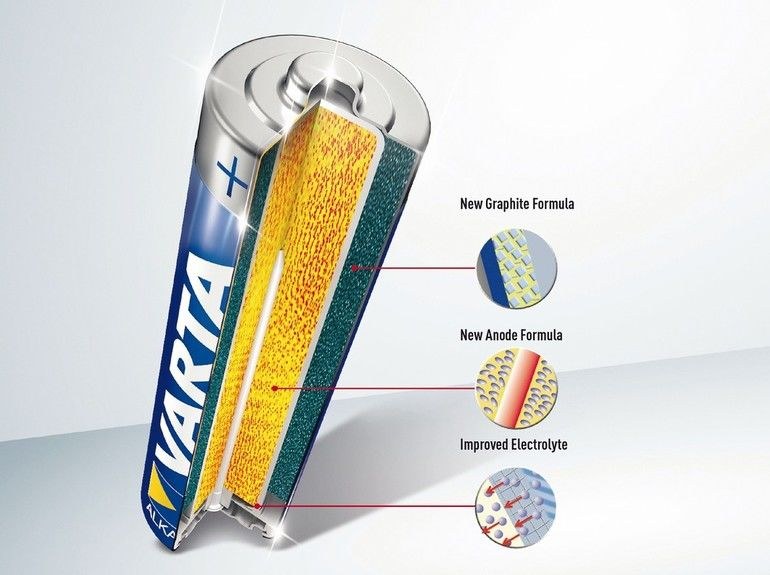
Varta is an acronym of the German “Vertrieb, Aufladung, Reparatur transportabler Akkumulatoren“ (distribution, recharging and repair of transportable accumulators), and their success story began in the Swabian Alps. When a consumer sees the blue square with a yellow triangle, they immediately recognise the brand — and this is not unique to Germany and Central Europe. For more than 130 years, Varta Consumer Batteries has been synonymous with reliability, innovation and progress „Made in Germany“.
For branded batteries, reliability is key
To keep up with consistently high demand for “mobile power“, around 1.6 billion alkaline batteries are produced with the „Made in Germany“ seal each year at the company‘s production plant in Dischingen, Germany. Varta Consumer Batteries also produces a number of other high-quality, innovative products, including rechargeable batteries, chargers, lamps and power banks. The company is therefore able to provide retailers with impressive sales displays with a full range of products — all of which must meet the highest standards of quality.
At their QA laboratory in Ellwangen, six employees are responsible for performing various tests, including a vital safety test in which a metal lug or wire is welded to both poles of the battery to create a short circuit. The welding machine that had been used for these tests for years was due to be replaced by a more modern, compact model. This upgrade was overseen by engineers, Matthias Dörrer and Jürgen Balle, who were first made aware of the resistance welders from Japanese manufacturer, Avio, at a local conference.
The company requires two leads to be welded to approximately 100 batteries per week. Forming an optimum connection and being able to reproduce the results of the process reliably are important factors for the company. For the actual test, the short-circuited cells are stored in special containers and cabinets for 24 hours. The batteries must not explode, as is sometimes the case with cheaper products. All tests are carried out in accordance with a comprehensive, internationally valid set of rules and are carefully documented according to production batch. Performing multiple tests on the batteries ensures that no serious damage is caused when the batteries used under the most demanding conditions or if the batteries are used incorrectly.
Impressive test results
Two key expectations the company had of the supplier were that the right solution should be delivered as quickly as possible and that good after-sales support must be guaranteed. In one of the initial conversations, the performance requirements and the previous process were discussed. It quickly became clear that if Axel Tschumi was looking for a more powerful device, the NRW-DC150 plus with NA-142 welding head would be the perfect solution for meeting all customer requirements.
In order to form their own opinion, the Varta project managers gladly took Avio up on the offer of trying out the devices with their own cells and connectors at the Hilpert demo centre in Baden-Dättwil, Switzerland. In one day of testing, the company used the equipment to produce a range of welded connections. A subsequent evaluation in the laboratory showed positive results in favour of Avio and Hilpert electronics.
The desired result with minimum effort
The welding device was installed within two weeks of the order. The plug-and-play design and easy handling meant that the device could be commissioned immediately and with no need for additional training. The processes for day-to-day use in the field were quickly adjusted using initial pull-off and shear tests and could easily be adapted to specific requirements. When asked, an operator stated that she very much appreciated the new device. It is easy to operate, compact and features a practical base that allows the same process to be adopted for different types of battery.
The first step of the process is to insert the battery into a fixture. The connector is then placed on the pole by hand and a foot pedal is used to apply a defined pressure to the electrode. The welding process is triggered automatically when the set pressure is reached. The cell is then rotated 180 ° and the process is repeated for the other pole. Once all test objects have been prepared, the metal lugs are twisted, and the cell is placed in the test container.
Both Dörrer and Balle felt that they received good advice from Hilpert and that the company had expertise in the field. They were especially impressed by the opportunity to test different resistance welding generators using different profiles at the Hilpert demo centre, as this helped them make their decision. The cost-benefit ratio of the NRW-DC150 was also a deciding factor. Customers may also carry out tests using their own material free of charge at any time — and they can come back and seek out the expertise of the Avio application specialists for new applications.
Even the distributor is impressed. According to Axel Tschumi, product expert, “It‘s always good and helpful for a customer to take advantage of the free trial at our demo centre. Specific tests can be carried out under realistic conditions using their own sample parts and with the help of an experienced technician. This benefits all parties involved, as a customer-specific system configuration and suitable parameter settings can be defined before the customer invests in the technology. This makes it very rare for the planned solution to be unworkable at the customer‘s premises. This knowledge of the customer‘s requirements minimises subsequent complaints and dissatisfaction. We are very pleased to be able to count another global player among our satisfied customers and thank Varta Consumer for this successful collaboration“.
www.hilpert.ch; www.varta-consumer.com
Zusammenfassung
Verbraucher erwarten, dass batteriebetriebene elektronische Geräte auch unter anspruchsvollen Bedingungen zuverlässig funktionieren. Um diese Anforderungen zu erfüllen, setzt ein Batteriehersteller Widerstandsschweißgeräte zur Qualitätssicherung ein.
Résumé
Les consommateurs attendent que les appareils électroniques alimentés par piles fonctionnent de manière fiable, même dans des conditions difficiles. Afin de répondre à ces exigences, un fabricant de batteries utilise des équipements de soudage par résistance pour garantir la qualité.
Резюме
Потребители ожидают, что электронные устройства, работающие от аккумуляторов, не подведут даже в сложных условиях. Для выполнения этих требований производитель аккумуляторов использует оборудование контактной сварки, позволяющее обеспечить высокий уровень качества.