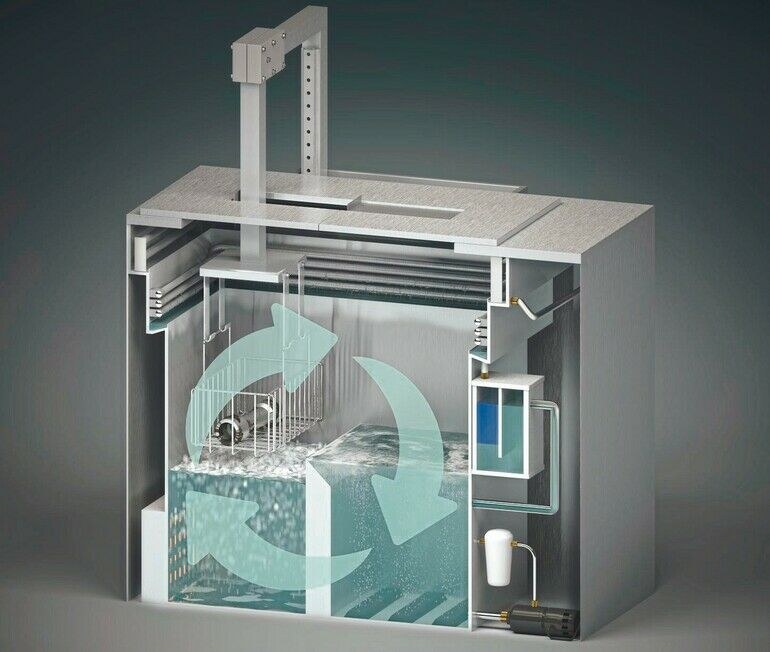
Demand for sophisticated, complex electronics is rising. But the intricate nature of these assemblies, which include delicate semiconductor wafers, can cause a reliability risk if post-etching cleaning is not performed well. Contaminants must be removed without damage or alteration to the wafers. Failure to remove these impurities could cause etching, corrosion or pitting, resulting in poor semiconductor operability and reliability,
Cleaning semiconductors
Semiconductor manufacturing typically takes place in cleanrooms to protect the complex chips from contamination. But almost all semiconductor wafers need some cleaning during manufacture to remove contamination resulting from the manufacturing process. Contaminants come from many sources including chip transport, handling, storage and manufacturing. Soils vary and can include dust, fingerprints, oils and water.
One of the most common semiconductor contaminants is particulate. This comprises dust particles, skin flakes, fibers and other process contaminants. Particulate contamination comes from the air, from the abrasion of moving parts, from clothing, or from dirty, unfiltered etching fluids. These particles either electrostatically bond to the substrate or they get trapped in the wafer substrate geometry.
Particulate impacts wafer performance in different ways. For example, as particulate accumulates on the wafer surface, it can interfere with and degrade deposited films that come later. It can also cause shadowing during lithography, reduce contact exposure resolution or create an uneven surface that could result in cracking during exposure.
Particulate is also a common contaminant found on FOUPs (Front Opening Unified Pods) used for wafer transferring. So, the FOUPs should also be cleaned to prevent FOUP-to-wafer contamination.
Particulate is not soluble in traditional cleaning fluid, so it must be removed by either chemical or mechanical means. There are various ways to clean semiconductors and FOUPs. One is via vapor degreasing with specialty particulate displacement fluids.
What is vapor degreasing?
Vapor degreasing is a closed-loop system with two components: a vapor degreaser and particle displacement fluid. Most vapor degreasing systems are top-loading batch-style cleaning machines with two compartments: the boil sump and the rinse sump. In the boil sump, a batch of parts including FOUPs, MOSFETS (Metal Oxide Semiconductor Field-Effect Transistors) or other semiconductor components are immersed in the heated fluid for cleaning. Often, agitation helps enhance the cleaning fluid’s effectiveness. This is done by leveraging the boiling action of the cleaning fluid, adding vibrating ultrasonic energy or using a spray wand to loosen the particulate off the substrate. Once cleaned, the parts mechanically transfer to the rinse sump. The parts rinse in pure, uncontaminated fluid or inside the fluid vapors themselves. The components come out cool so they are immediately ready for use or for the next stage of processing. Unlike the commoner aqueous cleaning, vapor degreasing combines cleaning, rinsing and drying in one step to maximize takt time. It takes as little as 6–20 minutes per batch.
Moreover, vapor degreasers typically have a smaller footprint than aqueous cleaners. The systems take up less valuable production space and, because vapor degreasing cleaning is a simple, predictable and repeatable process, it is easy to qualify and validate for cleanroom use.
Good particle displacement
The displacement cleaning fluids used inside vapor degreasers have chemical and physical properties that are advantageous to particle displacement and help accelerate the cleaning process. Small particles can be difficult to remove from wafers since strong electrostatic forces exist between the particles and the wafer substrate. A particle adheres to the substrate through adhesion forces, whether it is an electrostatic charge or Van der Waals force. This adhesion creates a friction force parallel with the surface: static friction if the particle is not moving, dynamic friction if it is. To remove the contaminant, the cleaning fluid must reduce the thickness of the laminar boundary layer, break the bond and allow the particles to release from the substrate.
Some displacement fluids are a mixture of hydrofluoro-olefin (HFO) and ethanol that removes fine particulate down to the micron or even sub-micron range. The alcohol component forms hydrogen bonds at the fluid-substrate interface, reducing the intermolecular forces between the particle and the substrate. This allows the particulate to lift more easily from the substrate.
Plus, the fluorocarbon-based fluids are synthetically derived, allowing for a higher purity level than traditional hydrocarbon-based cleaning fluids. These ultra-pure fluids dry quickly and completely without leaving spots or residue behind.
High density & low viscosity
Particulate displacement fluids are dense: typically, 20–40% heavier than water and 50% heavier than alcohol. They also have a lower viscosity than IPA (Isopropyl Alcohol), water or water with surfactant additives. The combination of the higher density and the lower viscosity of the hydrofluoro-olefin fluids results in greater drag forces acting on the particles. This makes it easier to dislodge the particulate from the substrate. The particles push away from the substrate and wash away, dispersing into the cleaning fluid.
Low boiling point
Particle displacement fluids are low-boiling with typical boiling points between 40˚C/105˚F and 65°C/165°F. This minimizes the risk of damage to wafers and other delicate components. Vaporization displacement fluids (below 100°C) are aggressive enough to remove the particles, yet won’t damage the substrate, including composite materials. They are compatible with most hard plastics, ceramic, glass and metal.
Low boiling fluids also allow the vapor degreaser to run more efficiently. And since vapor degreasing cleans and dries in one step, there is no need for blowers, air knives or any other drying method that uses power. This translates into less fossil fuel consumption, lower carbon emission and reduced greenhouse gas output. All with the added benefit of energy cost savings.
Environmentally friendly
Environmentally-friendly HFO-based displacement fluids replace higher GWP (Global Warming Potential) hydrofluorocarbon (HFC) and hydrofluoroethers (HFE)-based fluids. They also are better for the environment than high ODP (Ozone Depleting Potential) solvents like CFC-113, HCFC-141b, HFC-225 and 1,1,1 trichloroethane. They meet strict regional air quality regulations and many are not considered HAPs (Hazardous Air Pollutants). Many fluids are accepted by key environmental and governmental regulatory agencies in the United States and most countries around the globe. They meet global environmental directives including the European F-Gas and REACH (Registration, Evaluation, Authorisation and Restriction of Chemicals) legislation.
Environmentally sustainable
Vapor degreasing with particle displacement fluids uses no water, conserving this precious non-renewable resource. In addition, the process doesn’t produce wastewater that requires specialty filtration or treatments before disposal.
Another environmental benefit of particle displacement through vapor degreasing is its suitability for recycling. The displacement fluid is used for hundreds of cycles before it requires refreshing or replacing. Additionally, the vapor degreaser concentrates the contaminants as it works. This reduces waste generation and lowers hazardous waste disposal costs.
Wrapping up
Particle contamination is detrimental to intricate semiconductors and silicon wafers. Removing contamination is essential to ensuring their performance. Vapor degreasing using particle displacement fluid not only ensures semiconductor cleanliness, it also addresses environmental and regulatory concerns.
Companies looking for help with displacement cleaning should partner with an expert that has displacement fluid and vapor degreasing expertise. They can conduct on-site audits or perform in-lab tests with sample wafers to ensure cleaning success. Based on the wafer substrate and the particulate, these specialists can recommend, or engineer, the fluids and processes that achieve the best results.