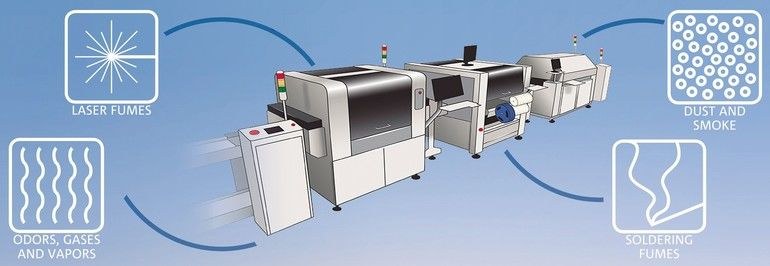
Airborne pollutants are a collection of particles of different size and composition, each with different chemical and physical properties. The example of soldering fumes will be used to demonstrate their influence on the environment.
Solder fumes consist mainly of decomposition products of fluxes, soldering materials and residues of cleaning agents, which can combine to build sticky aerosols. They not only have a negative impact on the health of employees but can also build up firmly adhering layers of dirt and thus contaminate production equipment, which has a lasting negative impact on manufacturing quality. If, for example, manufactured electronics assemblies are contaminated with sticky dust, this may lead to corrosion of conductive paths, which could result in partial or even complete failure of functionality.
Reason for extraction and filtration
Airborne pollutants are classified according to particle size. This classification focuses primarily on the influence of emissions on human organism. Thus, airborne pollutants are not only differentiated, whether they are brain-, nerve- or respiratory tract -damaging. A distinction is also made, whether they are inhalable (I-fraction) or alveolar (A-fraction). Therefore, statutory limit values are defined in DIN EN 481. As an example: according to German Technical Rules for Hazardous Substances 900 (Technische Regel für Gefahrstoffe (TRGS)), the limit values are 10 mg/m3 for the I-fraction and 1.25 mg/m3 for the A-fraction. The legal regulations of Technical Instructions on Air Quality Control (Technische Anleitung zur Reinhaltung der Luft, (TA Luft)) limits the total dust mass concentration including fine dust to a maximum of 20 mg/m3. However, this only applies to dusts that are harmless to health and does not include the so-called CMR substances (carcinogenic, mutagenic, toxic to reproduction). For sure, there are similar regulations in many countries.
Common air pollutants and their ideal filtration
Airborne pollutants can be found at a wide variety of places in electronics manufacturing.
Soldering fume
Soft soldering methods are used to a large extent in the manufacturing process, including wave, reflow, vapor phase, laser, or manual soldering. This produces a variety of hazardous substances, e.g., organic tin compounds, hydrogen chloride, formaldehyde, acetaldehyde, acrylaldehyde or butyraldehyde. The following solder fume concentrations were re corded during hand soldering:
- Concentration with leaded solder: approx. 1.0 mg/m3
- Concentration with lead-free solder: approx. 1.3 mg/m3
The percentage and quantities of these compounds depend on the composition of the solder and the soldering temperature.
Due to the mix of pollutants in the solder fume, combined filters are utilized for optimal filtration. These are made up of a combination of resublimation filters, particle filters in several stages and adsorption filters.
In larger wave soldering systems, separate filtration of flux and solder wave is executed. When flux containing solvents are used, fans equipped for potentially explosive atmosphere are applied to prevent explosion or fire.
Gases and vapors
Gases and vapors are released during e.g., printing, potting, painting, gluing or cleaning. Typical pollutants are isopropanol, toluene, acids, butanol, or r esins.
Relevant substance data is determined based on the respective material safety data sheets (MSDS). As a result, the type of filtration is determined. Sorption technologies are used, i.e., adsorption by means of activated carbon or chemisorption by means of chemically modified adsorbents. The MSDS also provides information on explosion limits. If the lower explosion limit cannot be safely undercut, explosion-proof fans must be used in the extraction system.
Dust
Dust is generated in electronics manufacturing, for example, during cutting, milling, grinding, polishing, or decanting. Typical pollutants are coarse dust, fine dust, and odors. Dry dusts are usually separated through cartridge filter systems. The filter cartridges can be cleaned and hence utilized for a relatively long period of time. All dusts must be checked for flammability before they are extracted and filtered, as in such case explosion-proof systems must be used in order to comply with occupational health and safety and explosion protection.
Laser fume
Laser fume is mainly generated during marking, separating, decoating or structuring. Typical
pollutants are often nanoscaled particles, but also aerosols and gases.
During laser processing, a material transformation takes place through pyrolysis, oxidation, reduction, or polymerization. This requires special filter combinations. Furthermore, the composition of the laser smoke is determined by the type of laser source and, therefore, the energy input.
Due to the combination of pollutants in laser fume, combined filters are often utilized for ideal filtration. As in the case of soldering fume extraction, these are made up of a mix of resublimation filters, particle filters in several stages and adsorption filters.
Due to the diversity of laser fume, filter geometries and their gradations are adapted to the application. Cleanable filter systems are also utilized. The addition of filter aids increases the separation quality and thus the filtration performance.
Capturing of air pollutants
Capturing the airborne pollutants is a significant aspect of air purification. This is usually done via capturing elements, extraction arms and connected accessories. Size and type are determined by the pollutants themselves, their thermal properties and other air movement influences.
The level of capture and separation efficiency is essential for the efficiency or filtration performance of the respective extraction system. Proximity to the source of emission is crucial – the closer, the better. Not only in terms of capturing the majority of all particles before they can spread, but also to minimize economic expenses. There is a rule of thumb that twice the distance between the emission source and the capturing element requires at least four times the suction power of the extraction and filtration system.
The use of the optimum capturing element, extraction arm or extraction hose is determined by the application. In production lines, extraction and filtration systems are often integrated directly into processing equipment, e.g., laser markers or soldering systems. Accordingly, the pollutant capturing takes place in the encapsulated system and serves primarily to protect the plant itself as well as the manufactured product. Different variants are available for manual workplaces.
Thus, a filtration unit can be used as a central extraction box. The respective workstations are equipped with collection elements that are connected to the system via pipes or hoses. The exhaust air flow is activated or deactivated via damper flaps.
Depending on the amount of pollutants produced, each manual workstation can likewise be equipped with an extraction system. In this case, mobile systems are primarily utilized, which are particularly suitable for changing workplaces.
Individual design
In electronics manufacturing, while many procedures are standardized, the variety of materials used and to be processed often requires an individual analysis of the pollutant situation. The use of different organic, inorganic, or toxic substances up to the use of precious metals, the recycling of which must be taken into account when selecting filters, are just a few examples of the “normal abnormal”. Standard solutions are of no help here. The respective production situation must be assessed individually, and a corresponding special solution is to be engineered.
In addition to the extraction and separation performance of a filter system, other parameters such as noise level, robustness or floor space requirements also come into play. In addition to enjoying purified clean air, employees do not want to be disturbed or hindered in their daily tasks.
ULT AG
Am Göpelteich 1
D – 02708 Löbau, Germany
Tel.: +49 3585 41 28 0
E-Mail: ult@ult.de
Website: www.ult.de
Die beim Herstellungsprozess von Elektronikbaugruppen entstehenden Luftschadstoffe können zum Teil erhebliche Auswirkungen auf Mitarbeiter, Fertigungsanlagen sowie Produkte haben und müssen daher durch optimale Luftabsaugung und -filtration effektiv und effizient entfernt werden.
Les polluants atmosphériques générés durant le processus de fabrication des modules électroniques peuvent avoir, dans une certaine mesure, un impact significatif sur les collaborateurs, les installations de production et également les produits et doivent donc être éliminés de manière efficiente et efficace par une extraction et filtration optimales de l’air.
Загрязнители воздуха, образующиеся при изготовлении электронных узлов, могут иногда оказывать значительное влияние на работников, производственные мощности, а также на саму продукцию. Поэтому крайне важно обеспечить эффективный и оптимальный забор и фильтрацию воздуха.