Dr. Jörg Schambach & Philipp Drechsler, Goepel electronic
With costs rising, the call for flexible and
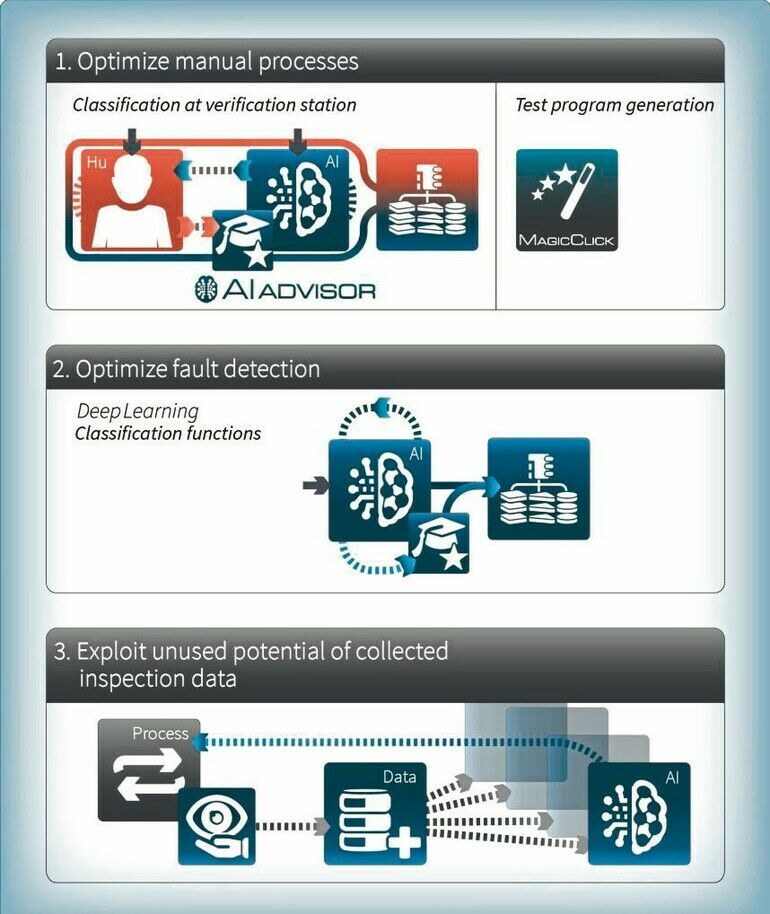
autonomous automation solutions will only get louder. This is especially true for inspection systems that are standard in modern production lines. AI is certainly an important element in this shift towards automation. AI innovation in the area of inspection systems is often focused on automating manual processes such as the creation of inspection programmes or the classification of defects at the verification station. With this in mind, the software used in Goepel electronic’s AOI systems was
expanded at an early stage to include an AI-based expert system for automated test programme generation. With the software module ‘MagicClick’, test programmes can be created and optimised automatically. Without any library entry, a production-ready test programme, including component library, is
generated in just a few minutes. The parameters are also automatically adjusted, taking into account real process fluctuations. Having succeeded in creating an AI solution in this area, Goepel electronic has now developed an AI-based solution to the classification of defects at the verification station.
From assistant to decision-maker
Automated optical inspection (AOI) or automated X-ray inspection (AXI) are an essential part of standard quality assurance processes in production lines for both SMD (Surface Mounted Devices) and THT (Through Hole Technology) assemblies. The systems inspect PCBs for correct component placement and soldering, and any defective assemblies are rejected. When an assembly is rejected, the defects detected by the inspection system are usually assessed and classified by human operators at a verification station. This visual evaluation is a monotonous task and is subject to human error because, for instance, the operator is tired. The risk of incorrect classification is increased when complex defect patterns need to be assessed with changing process
parameters. These wrong decisions can be fatal when an AOI or AXI system has detected an actual defect, but this defect is subsequently classified by a human operator as a ‘pass’. In this case, we speak of a ‘false-positive classification’, which can, in turn, lead to an escape. The defective PCB is processed further and, in the worst case scenario (if the subsequent electrical tests also do not detect a failure), ultimately
delivered to the customer.
This is where the AI advisor software module, newly developed by Goepel electronic and integrated into the PILOT Verify verification software, comes in. For each error detected by the AOI or AXI, the AI-based function forms its own opinion. In the first stage (level 1), the software provides the user with this additional information. This means that, analogous to the four-eye principle, there are two independent opinions for each error found: that of the operator and that of the AI. If the AI comes to a different conclusion than the operator, a message is displayed and the user is asked to review their decision again.
The AI advisor assistance function utilised in the first stage (level 1) ultimately ensures that incorrect decisions are prevented during defect verification and that no detected defects are subsequently classified as ‘pass’. By constantly adding further data during operation and other training processes, the AI advisor becomes better and better at making classification decisions. At level 2, it has been trained to such an extent that all possible defects are reliably recognised, and verification can take place automatically. The AI advisor makes decisions and classifies defects independently. Verification by the operator is then only necessary in exceptional situations, namely when the AI cannot make a safe classification decision. By enabling automated classification of almost all faults at level 2, the AI advisor significantly reduces an operator’s workload at a verification station.
Good training as a basis
Deep Learning (DL) can also be applied in other areas. In industrial applications of DL methods, it is essential to create a balanced and valid training
database. This training database should also be constantly expanding during the system’s life cycle with new examples from ongoing production processes.
As such, the AI advisor concept is flexible. Users can, on the one hand, start with a predefined database after installation, which is retrained during
operation as it is supplemented with additional image data from the subsequent user decisions. The second option, however, is to develop a model without the use of a predefined database, and using only the classification decisions stored in the inspection system’s database. In this instance too, after initial training, image data attained from the relevant user decisions made throughout productive operation, are used to retrain the advisor.
During operation, the AI software receives data from the inspection system, assigns it to the respective AI models, performs the inference and transmits its decisions to the verification software.
Goepel’s AI software has been designed in such a way that models are created using failure images in a rule-based and thus completely autonomous manner. To ensure that a valid training basis is
generated in this autonomous process and that it
remains valid throughout the life cycle, various mechanisms have been integrated. These range from the monitoring or exclusion of image data too
similar to that already present in the training set, to
additional expert interviews (active learning) to train the system in individual new image data.
The AI software ecosystem also includes an AI framework for the distributed training and delivery of Deep Learning models and their instances. This tool, which has a web-based, system-independent interface and can be accessed via a web browser, makes it possible to manage defect instances with the error images (samples) and their assignment (labels) or, if necessary, to delete samples from the training set.
Integration into production
AI solutions that are to be integrated into industrial production processes must fit seamlessly into the corresponding IT infrastructure. In many cases, production processes are completely sealed off from the outside world for security reasons, as a loss of sensitive data or manipulation of the production systems could cause enormous damage. Cloud solutions are often not possible and edge-based AI solutions are the only option.
For this reason, the backend architecture of the AI advisor software covers all possible use cases. For electronics manufacturers who have only one production line, all AI software modules can be installed on the same PC as the verification station software. If, meanwhile, production consists of several lines, the AI can run on the company network on a
separate AI PC. For users who do not want to install additional computing power, however, a cloud-based solution can also be provided.
In the area of automated optical and X-ray inspection, AI can enable inspection systems to make better decisions or to simplify manual processes. It can also optimise production processes based on the data collected.
Goepel electronic’s newly-developed AI advisor software module provides an AI-based assistance function for its PILOT Verify verification software, which ensures that incorrect decisions are prevented during failure verification and that no detected defects are subsequently classified as ‘pass’. Via the interaction of humans with AI, the classification process is optimised and the human workload lightened.
As the AI model further develops, it becomes the decision maker, able to classify defects independently. Verification by the operator is only necessary in exceptional situations when the AI cannot provide a clear result. This automatic classification of almost all defects further reduces the operators’ workload.