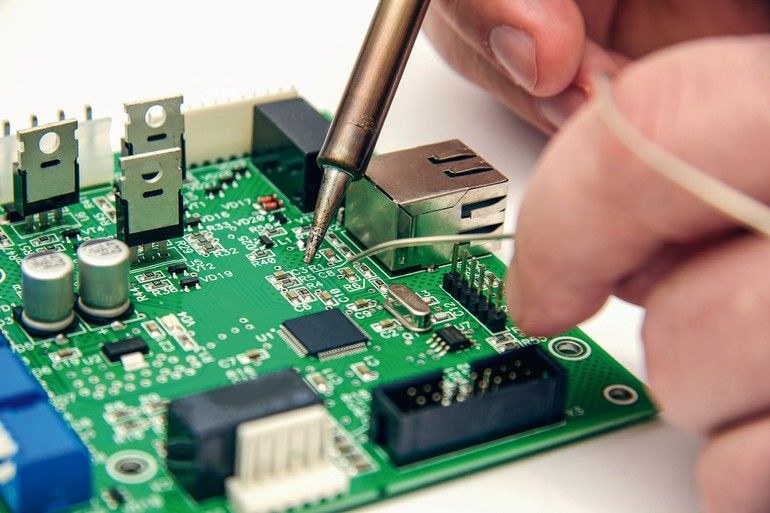
Today, Printed Circuit Board (PCB) fabricators have three choices when it comes to component soldering operations: hand soldering, wave soldering or selective soldering.
Hand soldering
Hand soldering, also known as manual soldering, allows fabricators to get into places that are difficult to access on the PCB. It is useful for one-off soldering or for repairing individual solder joints. Manual soldering is, however, challenging because it is difficult to control soldering consistency and repeatability. Moreover, since boards are soldered one at a time, cumbersome hand soldering can be a slow and expensive process.
Wave soldering
On the opposite end of the spectrum is wave soldering. Wave soldering is ideal for fast, high-volume PCB production. An automated standing wave of solder flows over batches of entire boards all at once for high output and efficiency. The wave coats the PCBs in just one pass. Wave soldering is done inside a protective nitrogen gas atmosphere which helps reduce solder defects. Joints come out consistently strong and reliable. However, wave soldering equipment can be expensive to run since it is electrically intensive and uses large volumes of both nitrogen and flux.
Selective soldering
The third option, selective soldering, is a variant of wave soldering that combines the advantages of both hand soldering and wave soldering processes. Selective soldering is flexible. It allows fabricators to choose or select, by way of a computer program, the specific components or areas where the flux and solder get applied. They can set different profiles for each individual component on the PCB or target specific zones on each board. The solder and flux are applied only to the components that are selected. Selective soldering is especially good for soldering double-sided PCBs or those made with tall, densely-populated and tightly spaced through-hole components. It combines the precision of hand soldering with the speed, repeatability and consistent joint quality of automated wave soldering.
The ‘missing’ fourth step
According to experts, selective soldering involves three steps. Firstly, the application, usually spraying, of a layer of liquid flux to prepare the components and remove impurities. Secondly, preheating the PCBs to ensure the boards don’t suffer thermal shock. And thirdly, soldering the components with a site-specific solder fountain or nozzle. There is, however, an additional fourth step that must not be overlooked to ensure PCB reliability and performance: cleaning. Selective soldering uses substantially less solder paste and flux than wave soldering. But because selective soldering applies heat only to one spot on the board, there is the risk that all the flux may not completely activate, which may allow flux residue to spread to other parts of the PCB. Contaminants inside the flux residue, if not completely removed, may cause problems later on in the board’s lifecycle. Dirty PCBs are vulnerable to many problems including parasitic leakage, electrochemical migration, shorting and dendrite growth. Today, the need to clean off flux residue is no longer optional; it is essential for long-term performance, functionality and reliability of the PCB.
The problem of ‘no-clean’ fluxes
There are a number of different solder pastes and fluxes that fabricators tend to use inside a selective soldering machine. Some use leaded versions while others opt for no-clean solders and fluxes. ‘No-cleans’ are supposed to reduce both production time and labour by eliminating the need for cleaning after selective soldering. They are expected to stay on the PCBs indefinitely without negatively impacting PCB lifespan or performance. Fabricators are nonetheless finding that when the salt activators in the ‘no-clean’ solders and pastes come in contact with heat or other chemicals, they often leave behind a hard-to-remove white residue. The residue may corrode fragile circuits, interfere with signal transmission or create noise on the board, especially on high-voltage systems. The residue must therefore be removed but, ironically perhaps, no-clean fluxes produce one of the most stubborn and difficult contaminants to clean.
Three ways to clean
PCB fabricators have a number of options when deciding how to clean their no-clean flux residue. Three of the most popular are: manual benchtop cleaning, aqueous cleaning and vapor degreasing.
Benchtop cleaning uses an aerosol no-clean flux remover and a brush. Aerosol no-clean flux removers are available in a variety of strengths. Fabricators should choose one by carefully matching the flux remover to the contaminant. In addition, the cleaning fluid should be compatible with the PCB substrate and other materials on the board. It should be strong enough to effectively remove the flux residue, yet not cause damage to soft plastics or coatings. When possible, PCB fabricators should opt for a nonflammable, flux remover for facility safety. Also, using a complementary cleaning fluid dispensing tool minimizes the amount of cleaning fluid used and the fumes released into the air.
Aqueous cleaning typically uses heated deionized water and a detergent in a series of washing and rinsing cycles which takes place in large machines. A second operation, using heat or air, dries the PCBs. Aqueous systems are considered by many to be environmentally friendly, however, they consume relatively large amounts of electricity, require continuous water monitoring and stringent wastewater management. As a result, operating costs can be high.
Vapor degreasing is an efficient and effective cleaning processes available to clean PCBs. Vapor degreasing offers excellent performance when cleaning miniature components and uses an environmentally sustainable cleaning fluid, instead of water.
Vapor degreasers are closed-loop systems that require two elements: a specially-designed cleaning machine; and a specific low-boiling, non-flammable fluid as the cleaning agent. Vapor degreasers generally contain two chambers: the boil sump and the rinse sump. In the boil sump, the cleaning fluid heats, and the PCBs are immersed and cleaned in the fluid. Once cleaned, the PCBs mechanically transfer to the rinse sump for final rinse in a pure, uncontaminated fluid. The PCBs come out clean, dry, and cool enough for immediate coating or packaging. Because vapor degreasers recycle and reuse their cleaning fluid for hundreds of hours before the fluid needs to be refreshed, they make for a cost-effective and environmentally sound cleaning method.
No matter which cleaning method is chosen, it is recommended that PCB fabricators follow the suggested best practice for successful no-clean flux removal results.
Plan ahead for best results
A PCB fabricator should always test the cleaning methods and fluids before production begins to determine which option is the best. Even before decisions about coatings, solder pastes and other materials should be finalized. Otherwise, PCB manufacturers might be left with boards that can’t be cleaned. Many cleaning fluid manufacturers offer cleaning trials where they can test clean the PCB substrate, the contamination encountered and the method used. After small-batch pilot testing, they can make recommendations for changes that will ensure PCB cleanliness along with materials compatibility, before the fabricator scales up into full production mode. Through this small-batch pilot testing, fabricators minimize surprises and ensure better PCB cleaning before it becomes a major headache.
Check compatibility of materials
No-clean flux removers are available in a variety of strengths. Fabricators should choose a cleaning fluid by carefully matching the fluid to the contaminant to be removed. In addition, the cleaning fluid should be compatible with the PCB substrate and other materials on the board. The cleaner should be strong enough to effectively remove the flux residue, yet not cause damage to metal, plastics or coatings.
Choose tools for safety
When possible, a PCB fabricator should choose a non-flammable no-clean flux remover to ensure workplace safety. Also, when benchtop cleaning, use a cleaning fluid dispensing tool to easily scrub away contaminants. It also helps boost worker safety to regulate and minimize fluid and fume exposure.
Keep options open
If a PCB fabricator is still having trouble with a no-clean residue, it might be time to try a different cleaning fluid or even a different no-clean solder paste. They could try a paste with fewer solids or resins in the flux. The lower the solids content, the less flux residue left on the board, making it easier to clean. Also, a no-clean flux with fewer halides may be easier to remove. If all else fails, they may consider switching to a different solder paste that is more cleanable. There are manufacturers that can provide cleaning fluids for a number of flux residues including water-based and lead-free to R, RA, RMA, OA and SA fluxes.
Work with a partner
Fabricators looking for help in choosing the correct cleaning fluid or method for their post selective soldering cleaning should consult with a critical cleaning fluid supplier that specializes in removing flux residue and other contaminants. Some cleaning fluid suppliers have field engineers that run on-site audits to evaluate current cleaning methods. Some suppliers can also conduct comprehensive in-lab cleaning tests with some of the industry’s most popular solder pastes and fluxes to ensure post-soldering cleaning success. Rely on those suppliers to recommend the cleaning fluids and methods that will work best.
SMTconnect, Booth 4.531