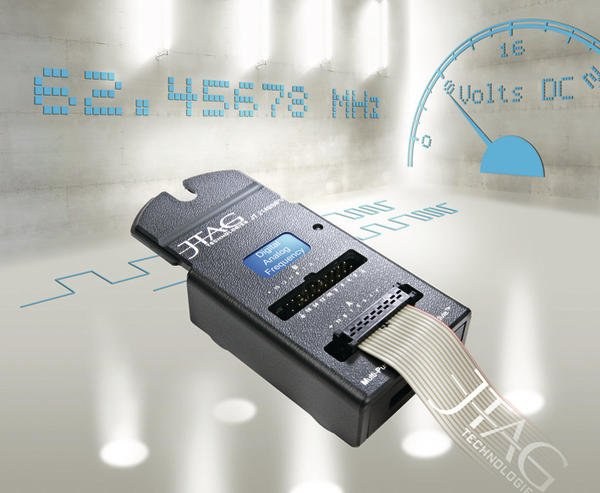
Peter van den Eijnden, the Managing Director sees the following advantages in using this new module: it provides a host of features in a very compact format, ideal for system builders looking to add analogue capabilities into a JTAG/boundary-scan test system. Quite often test engineers wish to check out some circuit fundamentals, such as voltage rails and clock frequencies, before undertaking more stringent boundary-scan based structural and functional tests. The JT 2149/DAF is perfect for this application and helps the system builder who might ordinarily use an extra piece of test equipment. The JT 2149/DAF can be controlled through an interactive panel (virtual instrument) within JTAG ProVision as well as through Python scripts. A full Python API is included as part of JTAG Technologies current ProVision releases.
The latest extension to our line of high-performance boundary-scan IEEE Std. 1149.1 controllers will also be a highlight at the show. Known as the DataBlaster JT 37×7/PXIe the new unit offers support for the increasingly popular PXIe/Compact PCI-express slot format that now features in some of the latest Automatic Test Equipment based on the PXI(e) standards. The company has developed the new boundary-scan controller to satisfy the growing requirements for high-speed In-System Programming (ISP) of flash memories, serial memories and CPLDs as well as complex digital circuit testing. The new DataBlaster JT 37×7/PXIe offers users sustained test clock speeds of up to 40MHz by use of JTAG Technologies’ proprietary ETT (Enhanced Throughput Technology) system and features an on-board flash image buffer memory. Supplied with the complementary QuadPOD system, the new DataBlaster/PXIe offers four synchronised TAPs (Test Access Ports) able to support multi-TAP test targets (UUTs) or gang programming of four single TAP targets. QuadPOD can also house the full range of JTAG Technologies’ SCIL modules, allowing the user to deploy custom test interfaces (BDM, I2C etc..) or the mixed signal DAF (Digital, Analog Frequency) measurement module.
The company is also using the show to present Autobuzz, a tool that learns a connectivity signature of all boundary-scan parts within a design from only the BSDL models of those parts. Autobuzz expands the „seek and discover“ mode of BuzzPlus and automatically gathers circuit data of a known good board and then performs a full connectivity compare against the faulty circuit.
Autobuzz is a useful tool for repair and rework technicians, especially when design data is missing
or incomplete.
Electronica, booth A1.221