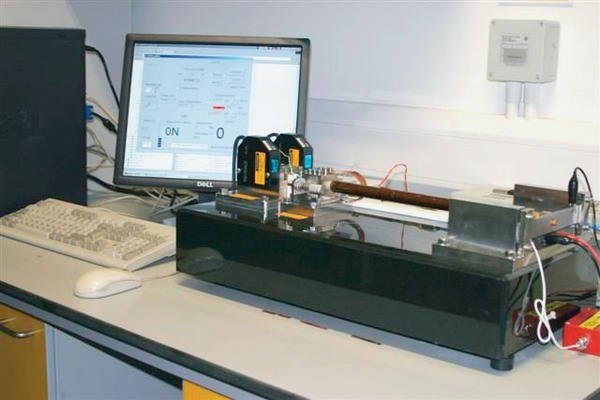
The instrument can also accommodate various solder alloys and surface coatings, and allows direct microscopic examination during the test at temperatures between – 55 to 125 °C. A 4-point measurement system for resistance monitoring has also been embedded and found to correlate well with structural degradation recorded during fatigue testing of solders. The resistance measurement is directly related to the development of a crack, and hence resistance data can be used to predict crack growth rates. The results indicate that lifetime can be measured using the load decrease and/or the resistance increase. Measuring these parameters directly, for different solders and conditions, and relating them to real assembly performance, will greatly aid modelling of lifetime prediction for lead-free solders. NPL has developed this new approach to the gathering of data such as strain and stress necessary for FEA modelling of lifetime prediction for new lead-free solder joints. Although the mechanical behaviour of lead-free joints is known to be different from that of conventional SnPb joints, there is a lack of credible data suitable for modelling purposes. This is a cause of concern for the industry, especially the high reliability sector, which is changing to lead-free soldering materials and processes. Hence the need to generate such data to evaluate likely lead-free solder performance has assumed some urgency.
For more information contact: Dr. Chris Hunt 0208 043 7027; e-mail: chris.hunt@npl.co.uk
EPP Europe 427