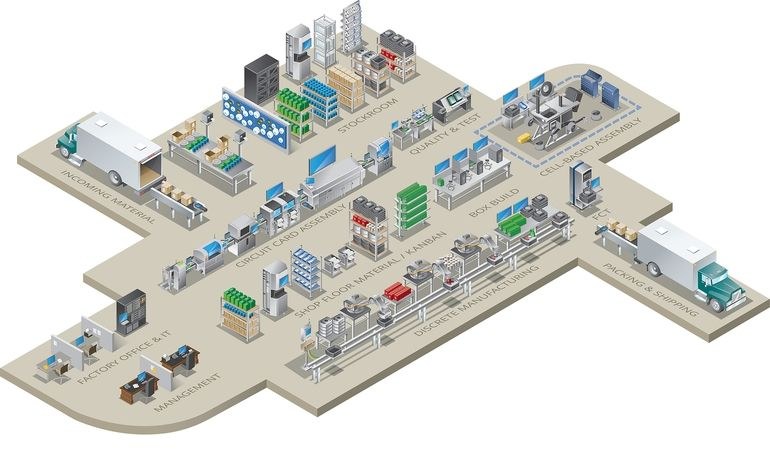
The first is to understand the real need of the business, current and future. Optimization of the sub-assembly factory operations represents the worst-case scenario in the industry. Safety critical assemblies require in-depth quality, process and engineering management. With a very high-mix, and often small work-order quantities, changes are continuously required in the factory flow, with each configuration change needing to be qualified against the required standards. There is little compensation for this, as the pricing in automotive is very sensitive indeed. A typical automotive sub-assembly provider needs to be aware of these constraints of doing business and create a production model that is optimized for such, developed in a way that all hidden losses are exposed and therefore addressed as part of the model. The exact same process applies to all types and sectors of electronics and assembly manufacturing in general. Creating the optimum operation however is not as simple as it used to be. Industry 4.0 was created in order to address these new operational paradigms, the software-based automation layer above the increasing number of automated processes which the older Industry 3.0 represents.
The German reports are looking for Industry 4.0 results but are based on Industry 3.0 activities. It is time to create some real Industry 4.0 tools, which is the second thing that needs to be addressed. Industry 4.0 is the optimization of every aspect of the manufacturing process, using live data. Whether this is lines of machines talking to each other, the management of Lean materials, adaptive planning and assignment of products to line configurations, as well as digital-twin based assembly process engineering, the reality is that the solution for each factory taking Industry 4.0 on board is going to be a little different, depending on the business need. It is not practical however to develop individual bespoke Industry 4.0 software that would drive these factory processes, as the cost quickly becomes prohibitive and non-sustainable.
Standardization needs to happen at a level that promotes the use of standard digital platforms that in turn deliver values, based on the use of IIoT (Industrial Internet of Things) technology specifically for manufacturing. This technology is a distinct paradigm shift from legacy data collection. Through the inclusion of data flow between every operational process, a live, digital and detailed holistic view of the shop-floor, with a scope that is inclusive of every manufacturing and dependent event, with a deep and well-defined level of detail, is available at all times. Unacknowledged losses are no longer out of sight and can be included in any activity related to performance improvement, optimization and operational decision-making, all in line with the goals of Industry 4.0. Effects of decisions made, and changes executed can be seen, measured, and continuously refined, but in this case, directly contributing to the overall productivity of the factory.
At the Apex show in 2018, the first demonstration of CFX (Connected Factory Exchange) took place. Though machine communication is nothing new, the fact that data from any type of machine from any vendor could be viewed on demand by visitors on their mobile phones, without any installation or configuration of software, showing key metrics, was an eye opener. The barriers of having different communication methods, as well as different levels of data content from machines, had been eliminated.
At Apex 2019, just one year later, the published CFX standard was put into action, in terms of the supported scope and depth of communication, gathering data for use in dashboards as well as for AI decision-making and factory optimization. Whatever the software tools of choice are for manufacturing, the ability to have visibility of the status and performance of every event that takes place on the factory floor, provides the opportunity to see and understand where time and opportunity is being lost. Software tools at the factory level can then utilize this information to optimize the entire factory in real-time. Machine vendors can also get more data about the environment in which their machines are working, seeing materials and planning information, with which to further automatically optimize their operations
CFX is the definition of how data is exchanged as well as the exact language and meaning of that data. The adoption of CFX is now being made into software tools, provided by machine vendors on the machine or line level, as well as by solution providers across the factory. The paradigm of MES changes as a result. Legacy MES systems that simply gather data, save it into a series of databases, and then provide reports, will not be able to process IIoT data in real-time and will be limited when it comes to live optimization and decision-making support. A new breed of digital MES systems, specifically designed for the IIoT / CFX environment deliver the most value, offering a single standard digital platform. Bespoke extensions to the platform can be easily added by local IT developers, simply by creating the required interface.
Technology shown by the many participating vendors at this year’s Apex show, represents the key turning point, to reverse the productivity paradox, enabling new automation management techniques and digital best practices to be established that address the long-standing hidden, ignored, or unavoidable causes of lost productivity. Full visibility and control of even the most complex of factory operations is restored, providing the intelligence with which to identify and eliminate causes of losses, which then provides opportunity for increased flexibility, whilst also increasing productivity, quality, on-time delivery and a reduction of material related costs.