Mattias Andersson, CEO & Founder MTEK Industry AB
When going from prototype to mass production, manual labor has been the answer in many processes, instead of automation. That is until now. Flexible automation is now readily available and will be a game changer for manufacturing automation.
Defining automation
The Product or Technology Life Cycle (TLC) is a methodology used in high-tech industries to recognize changing manufacturing and market conditions triggered by the maturation of a product and of the technologies it uses. When the technology of a product evolves, so will the requirements in terms of product features, design, price and service. This impacts supply chain and operations strategies. The TLC is therefore an important concept to consider when defining business and automation strategy.
Considering the right automation throughout the TLC is key to creating the most cost-efficient production process. In the past, the alternative to automation was manual work. Manual labor’s advantage over traditional automation is that it is flexible and configurable. It is relatively easy to assign new tasks and move operators as demand is shifting. This is not the case with traditional automation, which is by nature rigid, inflexible and hard to redeploy, not to mention capital intensive.
Flexible automation
Today, with the emergence of collaborative robots and software defined robotics, there is an alternative to both traditional hard automation and manual labor, and that is flexible automation. Using this in the right way allows manufacturers to cost-efficiently automate from prototype to mass-production. This shortens the development cycle of the product and removes the need to redesign the product as it enters the later stages in its life cycle, since design for automation (DfA) has been applied already from the start.
Flexible automation has many of the benefits that manual labor provides. If deployed in the right way, it will be simple to move the robot to the line and the position where it is required for the shift, and support tasks previously undertaken by an operator. What’s more, a software defined approach, allows new tasks and new configurations to be downloaded to the robot instantly. This is very different to how hard automation is working today and much more like an operator taking updated work instructions. The robot becomes the physical representation of the software model and can immediately start the task it has been requested to execute. Collaborative robots are not delivering on this promise today, but with added functionality for adaptability to new tasks and increased flexibility, they become a hybrid of traditional automation and the manual operator, all with the efficiency and lower cost of an automated solution.
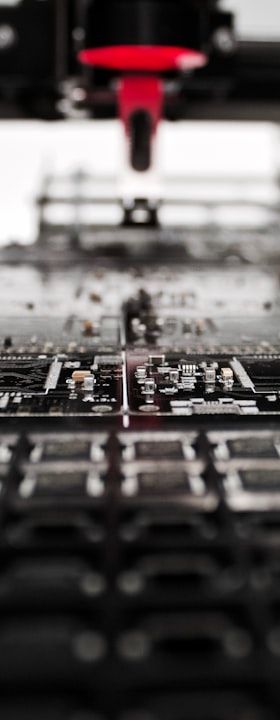
As an example, the insertion of odd shape components, such as capacitors, relays, and terminal blocks, is usually carried out manually in the electronics industry. The shape and form of the components as well as the relatively high mix of products makes it hard to automate using standard solutions. But flexible automation, a collaborative robot and a software defined approach, would allow this task to be automated. This provides a route to efficiently automate very early in the product life cycle when volumes are lower and there are often changes to the products. It also allows for that automation to scale-up during the later phases of the product life cycle as volumes grow.
Approach for automation
An important aspect to the success of flexible automation is to simplify and empower the organization to use the full capabilities of the solution, to adapt it to the changes that happen as product mix and volumes change. Proprietary knowledge is an inhibiting factor for digital transformation and solutions which fail usability and ease will not be successful.
In an increasingly connected world, last mile connectivity to the factory floor is essential. This is not only important for performance and configuration, but also to secure the product and process data feedback loop in the early stages to secure optimal use of solutions in the later stages. Finding deviations early in the various process steps provides insight into the changes required in products or processes for a successful scale-up.
Flexible automation is a contemporary approach for automation. It adds value early in the product life cycle when mix is high, and volumes are lower, and it provides a method to scale as demand increases and products mature later in the product life cycle.
MTEK INDUSTRY AB
Norra Ösavägen 12D
822 40 Alfta Sweden
E-Mail: info@mtek.se
Website: www.mtek.se
Flexible Automatisierung schafft einen Mehrwert zu Beginn des Produktlebenszyklus bei hohem Produktmix sowie geringem Volumen und sie bietet eine Methode zur Skalierung bei steigender Nachfrage, wenn die Produkte im Produktlebenszyklus später marktfähig werden.
L’automatisation flexible apporte une valeur ajoutée au début du cycle de vie du produit en présence d’un assortiment important et d’un faible volume et offre une méthode d’évolution à mesure que la demande augmente, lorsque les produits arrivent à maturité plus tard dans leur cycle de vie.
При большой комбинации продуктов и малых объемах гибкая автоматизация создает дополнительные преимущества в начале жизненного цикла продукта и предлагает метод для масштабирования по мере увеличения спроса, когда продукты созревают на более поздних этапах их жизненного цикла.
MTEK releases a factory intelligence system