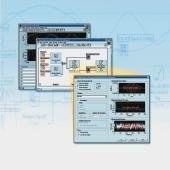
National Instruments’ LabView 7 Express, a major upgrade to the entire software family, is claimed to be a culmination of years of engineering effort: it dramatically simplifies the creation of measurement and automation applications and extends the package to a wider range of targets, from embedded FPGAs to Palm OS and MS PDAs. Reportedly, the innovation behind the tool is astonishing, since it delivers a large productivity leap in a single version upgrade. Not only do features such as Express VIs and the framework help to reduce development time, they have made it also easy for those who have never used LabView before. Designed to reduce development time, more than 40 VIs encapsulate measurement functionality in interactive virtual instruments for common measurement and automation applications, ranging from data acquisition to signal analysis to file I/O, delivering advanced measurement functions requiring little or no programming, just answering a dialog. Before LabView, users had to find a tradeoff between the power, flexibility and scalability of traditional programming languages and the ease-of-use and interactivity of configuration-based tools. Now, with this release, NI is closing the gap between easy and powerful, bringing a high level of productivity and performance to uses at all experience levels and in all areas of measurement and automation. Acquiring real-world data is at the core of most measurement and automation systems. While LabView has simplified the process, this version redefines how to make measurements and analyze data. With a redesigned driver framework and two interactive assistants for data acquisition and instrument control, the tool makes measurements and obtaining meaningful information easier and faster. The DAQ assistant helps users configure and define sophisticated data acquisition tasks. For GPIB (IEC Bus), serial, VXI and other standards, the instrument I/O assistant delivers prototype control systems, takes quick measurements and provides simple instrument drivers. This version includes the LabView base, full and professional development systems as well as the following modules: FPGA module – for designing applications to run in FPGAs on NI reconfigurable I/O hardware; PDA module – for creating portable measurement and control applications on MS Pocket PCs or Palm OS PDAs; upgraded real-time module – for developing deterministic, real-time and embedded applications; upgraded data logging and supervisory control module – for designing distributed monitoring and control applications. LabView is available on Windows, Macintosh OS X, Sun Solaris and Linux operating systems.
EPP EUROPE 428