Annual installations of industrial robots more than tripled within ten years (2010–2019) reaching 381 thousand units in factories around the world. The International Federation of Robotics (IFR) shows top 5 trends shaping industries around the globe.
“The mission to combine traditional production with ´go digital strategies´ puts robots in a pole position,” says Dr Susanne Bieller, General Secretary of the IFR.
Robots learn new tricks
Artificial intelligence software in combination with vision and other sensing systems, allow robots to master difficult tasks. One such task is bin picking, that in the past was only feasible for a human hand. New generations of robots are now easier to install and program, and they are connectable. Advances in communication protocols integrate robots seamlessly into automation and Industry 4.0 strategies.
Robots work in smart factories
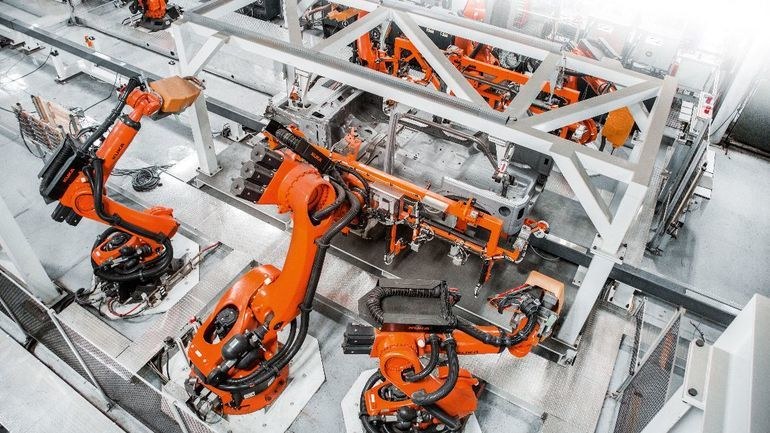
The automotive industry pioneered smart factory solutions utilizing industrial robots throughout assembly lines that have dominated traditional automobile production for more than 100 years. The future belongs to networked interaction of robots and autonomous guided vehicles – or rather autonomous mobile robots (AMRs). Equipped with the latest navigation technology, these mobile robots are much more flexible compared to traditional production lines. Car bodies are conveyed on driverless transport systems. They can be decoupled from the assembly line flow and redirected to assembly stations where individually equipped variants can be assembled. When models are changed completely, it is only necessary to reprogram the robots and AMRs rather than to dismantle the entire production line. With the integration of human-robot collaboration workstations picking up momentum, robot suppliers report robots working hand-in-hand with humans without fencing.
Robots enter new markets
The connectivity breakthroughs contribute to increased robot adoption in manufacturing sectors that have only recently turned to automation, such as food and beverage, textiles, wood products and plastics. Ongoing digital transformation will lead to completely new business models because producers can diversify more easily than ever. In the smart factory, different products are assembled subsequently by the same equipment – the traditional production line no longer exists.
Robots reduce carbon footprint
Investments in modern robot technology will also be driven by the requirement for a smaller carbon footprint. Modern robots are energy-efficient, thus directly reducing energy consumption of production. Through higher precision, they also produce fewer rejections and substandard goods, which has a positive impact on the ratio of resource input over output. In addition, robots help in the cost-efficient production of renewable energy equipment, such as photovoltaics or hydrogen fuel cells.
Robots help to secure supply chains
The pandemic situation has made the weakness of globalized supply chains visible. Manufacturers have the opportunity to rethink supply with a completely different outlook. When productivity is leveled through automation, manufacturers have increased flexibility that may not have been available in high-wage countries like most of the European Union, North America, Japan or the Republic of Korea. Robotic automation offers productivity, flexibility and security.
“Advances in robot technologies are contributing to increased robot adoption,” says Dr. Susanne Bieller. “The Covid-19 pandemic hasn`t started any new trends but it accelerated the use of robotics beyond established practice. In this respect, the pandemic has proven to be the biggest single driver for change in industry.”
IFR International Federation of Robotics
c/o VDMA R+A
Lyoner Strasse 18
60528 Frankfurt/Main, Germany
Tel.: +49 69 6603–1697
Website: www.ifr.org