Everyone knows that production equipment delivers its maximum performance only if it runs continuously at full load. But achieving this in real life is anything but easy. One crucial factor is the supply of material, which in modern electronics factories involves much more than simply transporting it from the warehouse to the machine. Components tend to be spread over many locations, most line-adjacent buffers have limited capacities, and consumption on the line fluctuates. In addition, there are material-related aspects such as expiration dates and moisture sensitivity. The multitude of these factors makes optimizing the material flow a complex puzzle that is almost impossible to manage manually, especially in a high-mix/low-volume environment. To automate and computerize the process, a two-stage system has proven to be useful.
When analyzing the material flow, two basic aspects can be distinguished:
- The “from where” – i.e., the exact inventory data: Which package or reel with which material is located where?
- The “where to” – i.e., the equally exact demand data: Which material is needed where and in what quantity?
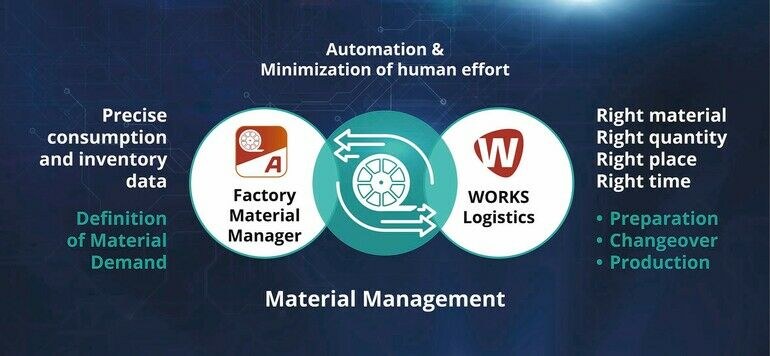
Any software solution that wants to successfully manage and optimize the material flow must be able to answer these fundamental questions quickly and reliably. ASMPT has implemented both of these basic functions in its seamlessly integrated Factory Material Manager and WORKS Logistics applications.
Unique ID for each package or reel
The registration and optimization process begins as soon as the goods are received. The Factory Material Manager software assigns a unique identification number (UID) and prints it along with other data on a label, which is then affixed to each package or reel. The UID is also linked to information about the material‘s quantity, material number, manufacturer, batch number, delivery date, and special features such as its expiration date and whether it is a moisture-sensitive device (MSD). By simply scanning the label, the location of each package is automatically updated every time it gets moved. The software thus generates a digital twin of the physical material flow, making it possible to manage it in a process-synchronous, networked and component-specific manner. This permanent real-time inventory forms the basis for all subsequent optimization steps.
Path-optimized pick lists
With its always up-to-date database, Factory Material Manager can determine the best possible solution for each setup, setup change, and replenishment. The program guarantees the availability of path-optimized pick lists and communicates with automatic storage systems. Standardized interfaces make it possible to integrate third-party systems into the automated workflow. The program supports a broad portfolio of storage systems such as classic racks, SMD lifts, shuttles, carousels and paternosters made by all well-known manufacturers, as well as the Material Tower from the company.
Factory Material Manager selects not only the right component in the right quantity, it also ensures that the material is always picked in accordance with the first-in, first-out principle (FIFO), use-by dates are taken into consideration, and the storage and exposure times of moisture-sensitive devices are monitored.
To carry the material to the line, it requests either people via WORKS Operations or autonomous mobile robots (AMRs) via Factory Automation.
Throughout the entire production process, data on the actual material consumption by the placement machines flows back via standardized interfaces and keeps the previously mentioned digital twin synchronized. As a result, Factory Material Manager has current inventory data at its disposal at all times.
Accurate determination of material requirements
The program initially receives information about the material requirements from a planning process that is also divided into two stages. First, it imports order data from the ERP system before WORKS Planning uses the customer and production requirements to generate a rough plan that makes the best use of existing production resources and minimizes costs. Next, WORKS Logistics takes care of the detailed planning. The software optimizes the material flow on the line by ensuring the right balance between material inflow and actual consumption based on the production schedule created with WORKS Planning.
For smaller orders, it is often sufficient to provide the necessary material for the initial setup and some refills that cover the entire order. Larger orders, on the other hand, must be able to rely on the continuous supply of materials. This is where exact dosing matters. If too little material is supplied, the line may stop due to material shortages. To avoid this, people often play it safe and supply too much, but the resulting emergency stocks put a strain on the buffer capacities and block valuable space on the factory floor. Both situations should be avoided at all costs.
In theory, the exact material requirements can be calculated in advance based on the production schedule, but simply multiplying the throughput rate with the bill of materials is not sufficient in real life. As mentioned earlier, the production process is subject to many other factors that lead to fluctuations in material consumption. For example, quality variations at suppliers may lead to increased reject rates that are difficult or impossible to predict. Even using the actual reported material consumption is not sufficient for demand-based procurement since it looks only at the current state. Since removing items from storage and transporting them to the line takes a certain amount of time, a material tracking system that is based exclusively on current data would always lag behind actual developments, and they can be quite dynamic.
Demand forecasting based on time slices
As indicated above, estimating material requirements is a central task of WORKS Logistics. It continuously analyzes the current production progress and consumption data and uses this information to generate time-slice-based forecasts of which material will be needed where, when, and in what quantity. It can also check when an MSD expires and order replacements, if necessary.
All this information is transmitted as demand data to the Factory Material Manager, which uses it to send supply requests to central and intermediate storage locations and generate time-controlled transport orders. The interaction of the two programs makes it possible to build an automated just-in-time internal logistics system that consistently implements the 4R principle by making sure that the right material gets to the right place at the right time and in the right quantity.
Optimization across production jobs
A modern material flow optimization system must look at more than individual production orders, otherwise, operators would tear down feeders and return components to storage as soon as an order has been completed, only to execute the entire process in reverse a few minutes later.
To avoid this, WORKS Logistics checks after the completion of each order whether any material that is on the machine will be needed for further orders in the next few days. If this is the case, the material stays in the setup preparation area. Operators receive clear work orders from the software. A blinking red light on the feeder means that the feeder should be torn down and the material returned to storage, while a steady red light means that the feeder should be kept in the active feeder rack next to the line for one or more upcoming setups.
Intelligent automation supports operators not only in the provision of materials for a particular production job, it also helps them with the selection and downloading of the right production program. As a result, product changeovers can be executed automatically without any operator assists, even without barcode readers. WORKS Logistics supplies the line control software of ASMPT solder paste printers, SPI systems and placement machines with a production plan that extends across individual orders. When the PCB to be processed changes, its production data is transferred from machine to machine via a standardized interface (IPC-Hermes-9852) and automatically checked. Next, each line unit checks its production parameters automatically via the automatic program change algorithm.
These interconnected material flow optimization applications reflect once more the intelligent factory’s underlying concept, which calls for data being collected, processed and put to use via standardized interfaces across the entire factory – in this case, to ensure the constant supply of material and subsequently the maximized utilization of the production equipment. Numerous transport, storage and retrieval movements, setups, teardowns and manual inventory counts are thus completely eliminated, which makes the work of already scarce skilled workers much easier. And a company that has a firm handle on its inventory and material flows also saves on the purchasing side because it must keep in stock only what will actually be used during the period covered by the production plan, resulting in less capital being tied up and more room for investments.