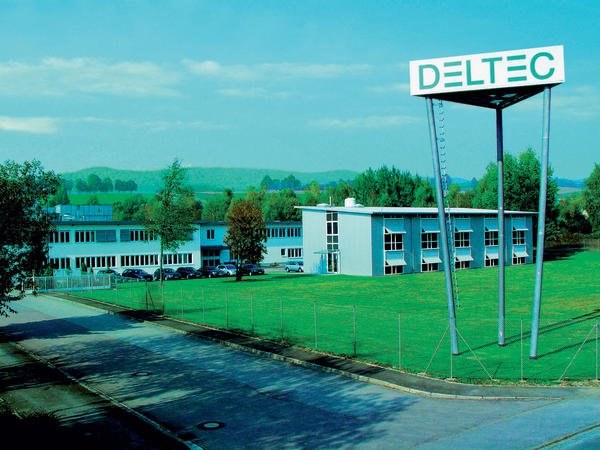
The cornerstone for today’s Deltec Group was laid by Franz Dahlhoff in 1992 when he acquired ABB Metrawatt in Furth im Wald. A second facility was opened in Domažlice (Czech Republic) in 1993. Production of automotive electronics started in 1996 and grew to become the most significant business area, leading to the 1999 founding of the Deltec Automotive GmbH & Co. KG in Furth im Wald. The company’s most impressive leap forward came in 1996 when their SMT capacity quadrupled from 400 million components a year, to 1.6 billion. Today, the Deltec Group is among the top production services providers in Germany.
In 2001, Deltec evaluated AOI systems from various manufacturers. Their starting position was an in-house investigation which revealed that 25 % of defects could not be detected by the human eye. For an automotive supplier, this was clearly unacceptable.
The decision process finally led to an AOI system from Viscom. “Viscom was the only company who could provide us with convincing analysis results. 98 % of the defects were detected; the best the competition could muster was 50 to 60 %”, recalls André Dalhoff, who heads Deltec with his father, to summarize the results of the evaluation phase. Other strong points favoring Viscom were, a wide product spectrum ranging from straight solder joint inspection to special solutions, plus excellent support. During the course of the multi-year cooperative partnership with Viscom, many new requirements were presented to the AOI systems. For example, in 2003 the inspection of lead-free soldered components came to assume top priority. Deltec was the first company in Europe qualified to reflow solder assemblies with 0201 components, in serial production with high piece counts for the automotive industry. After a few months the company began automatic optical inspection after the wave solder stage. At that time this was out of the ordinary and even today remains more the exception than the rule. “AOI after the wave process was implemented in a very short time; today the results speak for themselves. Prior to this, ppm rates between 10,000 and 20,000 were common. Today – thanks to Viscom – each AOI analysis gives an evaluation with a range of 7 to 20 ppm within 30 minutes, for the most complex assemblies. For wave solder technology, this is an exceptionally good result”, again André Dahlhoff.
In addition, the EMS company has employed a system for the inspection of selective solder joints, THT and SMT components on the bottom side of the printed circuit board. To accomplish this, in close cooperation with Deltec, Viscom crafted a solution especially to their needs which in turn gave rise to the S3016, now a standard Viscom product. André Dahlhoff underscores the fruitful collaboration: “The AOI system that we now employ for selective solder joints is very reliable and contains numerous customized solutions that we are very satisfied with. Defect escape is nearly zero. This is an absolute must because the system inspects the soldering process for automotive ignition electronics; the product must function without a hitch.”