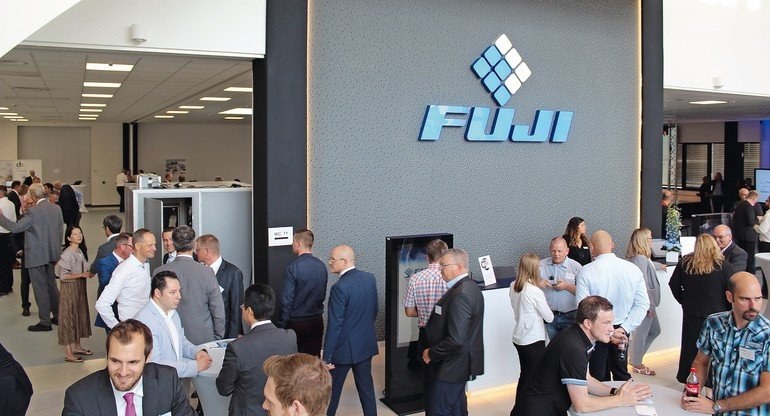
Presentations from their partners focused on the digital age, automated digitalized processes, miniaturized component, high quality stenciling, and flexible, traceable manufacturing. A demonstration of the Fuji line also took place, as well as, an overview of their roadmap, which included details of their fast-forward technology. In the near future, the company is planning to release a variety of tools, including the handling of odd form components, optical verification capability, and the support of tray operation. Future projects on automation are also in the works, including automatic warehouses, automatic part suppliers, and automatic maintenance.
Ulf Oestermann, Fraunhofer IZM
Where is the research going for the digitized production process?
The digitalized production process is an aspiration for the electronics industry. The dream is to have an autonomous production with a goal of being self-organized, from the very beginning of describing functions to the end of delivery. The most important parts, as circuit development, housing design and machine manufacturing, are already digitalized. Changes to work procedures, spatial restructuring, or product changes are first analyzed digitally before they are implemented, in order to identify and eliminate in advance any difficulties that may arise. This saves money and time. Smart, digital helpers support users to make work easier and optimize processes. This is only the beginning. In the future, every single processing step will be clearly traceable down to the smallest part for complete transparent traceability.
Stefan Lau, Wilo
From digital transformation to smart factory
With the Wilo Smart Factory, the production is equipped with new concepts. This primarily involves the consistent planning and control of customer orders in the digital age, in conjunction with the dynamic linking of production and logistics processes. This implements a 5 + 1 production, which means that the raw material cannot be more than five days in the production, to be manufactured in a maximum of one day, between the different production steps. With this, the customer can be supplied as quickly as possible despite individualized products. All processes are supported digitally where the networking enables a real-time check of the process data. The constant exchange of data allows flexible and demand-oriented responses to short-term changes.
Jonas Ernst & Abderazzak Essanhaji, Fuji
All about Nexim
The presentation focused on new features and conversions to Nexim (Nexus Integrated Manufacturing System). With the three tools Plan, Do and See, the operator can easily create new parts and programs, as well as, use optimization tools. It also supports the connection to MES systems, the handling of luminaire class products, as well as, the control of MSL components, which can be connected to storage systems. With the clear user interface, the operator can find his way quickly and easily. Today, a customer can already have many tools included in the standard purchase, there is no production installation limitation. The standard functions of Fuji Flexa and Fujitrax as well as the possibility of other options, which are constantly being further developed, were discussed.
Nicola Fritze
Just do it
Failure to implement knowledge is due to a lack of courage to change. In her activating lecture, author and keynote speaker, Nicola Fritze, explained why and how this could be changed and emphasized that motivation is the key factor. Using extraordinary activities, she showed how thinking and perception can be set in motion. The goal was to take a step back from the comfort zone and avoid routines in the future, since 80 to 90 % of every day thoughts are the same. Through participation, the audience was asked to take on challenges in a self-determined and trusting way, in order to break out of unfavorable thinking and behavioral routines. Only those who are able to motivate themselves, actually become motivated and can then develop their potential.
Helge Schimanski, Fraunhofer ISIT
Processing of discrete components
Miniaturized component geometries combined with increased packing density present challenges for the manufacturing process. A systematic evaluation of the process parameters leads to process-reliable application recommendations. The recommendation that was developed for the printed circuit board layout and printing process is based on what was then the state of the art and end user specifications, such as optically testable solder joints. High quality stencils can increase paste transfer efficiency and reduce the required area ratio. The danger of overpressure is caused by pad reduction. However, the 3D solder paste inspection provides a necessary quantitative control. Components of the metric assembly size 0402 require a nitrogen atmosphere for a secure soldering process. Basically, the process window for manageable and secure assembly production is the goal for the production of reliable electronics.
Frank Breer, Christian Koenen
Smarter service for error-free printing
With the approach of barcode, data matrix code and RFID on the template, traceability is enabled in a networked production. A high-quality stencil is no longer just a laser-cut metal sheet, it has to be refined, since the precision stencil or screen-printing tool has a high impact on the quality of SMT production. Attention should be paid to high-quality and specific basic materials as well as, coordinated and consistent control. Precision and know-how in production in conjunction with an optimal, product-specific layout is also important, as well as, a reliable and fast delivery and a partnership-based cooperation. Despite smaller components for improved functionality, the Plasma 2.0 solution provides a stable printing process, especially if IPC recommendations cannot be met. For more challenging applications, Plasma 3.0, laser photoplotter, or special step stencils for pin-in-paste technology without preforms were discussed.
Wolfgang Runte, Koh Young Technology Europe
Smart Production by Smart Data
The presentation covered the company‘s KSmart solution, which implements process optimization of the complete line and provides a variety of useful tools. The analysis tool collects all the information from the measurement and inspection processes of each system, in order to control every step of the process within the machine. The 3D SPI (printing system), Pre-Reflow AOI (placement system) and Post-Reflow AOI (soldering process) gives feedback and feedforward to each other, in order to communicate any process inconsistencies in real time. Through immediate intervention, the process can be optimized so no errors can occur. The 3D real-time measurement creates a complete reconstruction of an object, to be able to detect the height of the component or the entire structure of a printed circuit board. Other various tools were also discussed, in order to do justice to the Smart Factory. This included the Library Manager, Statistical Process Control, Offline Programming Optimizer, Real-time Monitoring, Remote Monitoring, and KSmart Process Optimization.
Werner Kreibl, Asys Group
Intelligent Factory – Next Steps
In addition to complete transparency and traceability, holistic solutions are necessary for flexible production. In particular, the material flow is crucial for achieving planned production goals. This means that individual production stations, both inside and outside a line, are automatically supplied with material without interruption. Self-organizing, intelligent transport systems should autonomously transport the material from A to B. The so-called AIVs are very flexible and can be adapted to individual applications. Higher-level software virtually maps the production line, as well as, monitors and analyzes the current data and machine conditions. This also ensures controlled processes based on the data collected. The company is thus gradually approaching its vision, from manual to fully automated solutions for flexible production.
Dr. Helmut Schweigart, Zestron Europe
Underside cleaning in the printer
The cleaner for the underside cleaning should not only have a good cleaning power and low fluid consumption, but it should also be compatible with the solder paste. This is because the cleaning agent can pass through the apertures during the cleaning and interact with the solder paste. Incompatible cleaning agents, such as isopropyl alcohol (IPA), change the viscosity of the solder paste, which can have a negative effect on the printing result in the next printing process. The company offers specially developed water- and solvent-based stencil cleaners which are suitable for cleaning typical steel stencils or nanocoated stencils in the printer. The cleaning of the underside of the stencil in the printer is important for an optimal and constantly good printing result, in addition to the mechanical stencil cleaning.
Markus Ankenbrand, FAPS
Additive manufacturing of mechatronically integrated circuit carriers
By combining classic additive manufacturing processes with printed structures, the production of complex mechatronically integrated assemblies is realized. This not only aids to shorten production process chains and delivery times, but it can also implement customer-specific production and design freedom across all relevant economic sectors. Instead of semiconductor processes, printing processes for the additive processing of functional materials are used in printed electronics, with emphasis on simple and large-area electronic systems. While additive printing processes provide electrical functionality for a variety of applications based on different materials and technologies, digital printing processes can be used to create 3D functional structures for high-frequency applications. The rapid developments in the field of printed electronics open new potential for the functionalization of components.