Since April 2004, a moderation of growth has taken hold. Call it a slowdown, caused in part by glaring weaknesses of the support infrastructure, most evident in energy and transportation. And even earlier, alarm bells had gone off in banking circles, stirring fear of an imminent hard landing (or a sudden crash) of the Chinese economy. The Beijing central government stepped in to moderate growth in several overheated industrial sectors such as steel and construction. It is also trying hard to squeeze uncontrolled land developments and real-estate speculation that are spiraling out of control and could take down the so far very successful, industrial development strategy.
While that danger hasn’t passed completely yet, all this slowing-down is done so far without resorting to harsh monetary measures as demanded by an ever shriller chorus of experts, especially from the US, raising interest rates across the board. The resulting higher lending costs would just hit all industrial sectors the same way at the same time. And they would attract even more foreign capital – not just targeting fixed investments but chasing after higher returns and speculating on an upwards revaluation of the renminbi currency from its current low to euro or dollar. Instead, the Chinese government is resorting to a well rehearsed policy: tightening the screws of bureaucracy. This time for good: the amount of funds provided by state-run banks for building projects has been reduced by enforcing higher reserve holdings in the face of a tidal wave of non-performing loans. And second, there are now even more cumbersome and drawn-out building permit procedures in place.
It’s about time that measures like these are enacted so that investments in viable technologies and prosperous industrial sectors do continue. It’s getting harder to keep up current production volumes because rail transportation frequently bogs down, endangering delivery of raw materials. In June and July, electricity shortages were creeping up all across the country, especially in the urban and industrial regions around Beijing. Blackouts, at first hourly, then daily, then bi-weekly, became the order of the day. Resorting to night shifts was a frequent stopgap measure, although this caused its own logistics problems.
An ambitious building program for power plants has been implemented, replacing a more cautious five-year-plan adopted after the Asian financial crisis of 1998. The program calls for 150GW plant capacity to be added to the current supplies before 2006. This brings added business (of almost a billion euro) to power-turbine vendors. Yet continued reliance on coal-burning power plants threatens to postpone for another five to ten years the long overdue mitigation of widespread air pollution. An expanding business of installing emergency diesel generators has sprung up, adding to cost just for protecting sensitive production equipment against failure due to frequent supply interruptions.
The government’s economical measures begin to show: labor-force lay-offs are occurring in urban centers, where production has ceased. Price slumps cheapen commodities, though not basic food stuffs. Ocean bulk freight rates have fallen dramatically. Also, car sales have dropped by 20% month for month. Severe as this is, it is welcome news on the inflation front. Consumer inflation is just a notch below 5% – the officially set trigger point of higher interest rates. Still, industrial output grew by 16% in June compared to the year before, as the Bureau of Statistics currently reported. But it was a tad below the 17.5% registered in May and 23.2% in February. All this is pointing in the right direction since annual investment growth, first quarter of 2004 included, is running at 20% and the GDP share of investment hovering close to 50%. In other words, if there were a sudden slump or stopping of investment, mostly foreign driven as it is, that would have catastrophic consequences, not just for China’s economy – it would probably influence more countries.
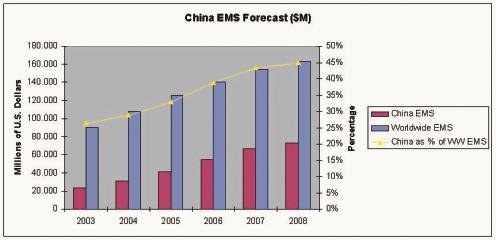
In terms of providing electronic manufacturing services – the paradigm on which its industrial development is based – China receives the high-volume share of the outmigration from the US and Europe, ramping up over the last five years. Market researcher iSuppli stated that the country’s EMS market will continue to grow by at least 25% on average over the next three years. By 2008, China will have 45% of worldwide EMS capacity, today about 30%. It has become the extended workbench of the industrialized world. This is a global phenomenon: almost none of the new OEMs are utilizing local EMS resources in their own hinterlands. Why should they – when they can draw on their own supply of labor? “Chinese OEMs”, says Andy Li of Jabil, “seem to be sticking with their vertical approach to manufacturing”. Likewise, well established foreign EMS firms refrain from sub-contracting work to local manufacturers – out of concern that it would help educate and grow their local rivals and lead to transfer of sophisticated manufacturing know-how.
The announcements of companies setting up shop on the Chinese mainland are many. Suffice it to mention one major occurrence at press time: US-based manufacturer Micron Technology decided, as the last of the three world-leading memory-chip makers, to build an assembly plant in Suzhou, complementing its design facility in Shanghai. Samsung and Infineon are there already. Hynix, number four in DRAMs, has announced its own plans for China. Despite the fact of economic overheating in other areas, there seems to be no danger right now of overcapacity in semiconductor manufacturing. With this year’s growth of domestic semiconductor consumption projected as high as 40% there is an urgent need for added plant capacity. Also, the country has to employ tens of millions of workers dismissed from state-run factories in various old-line sectors. So, manufacturing expansion continues at a quickening pace.
This is a dilemma for economic planners: massive investments in the high-tech base are wanted, but the current infrastructure cannot accommodate them without dangerously straining the available resources. On the other hand, it’s a given that China must quickly catch this chance to bring its rural populace (about 900m of a total of 1.3bn) out of poverty and deliver the promised equality of living standards. There are other prospective EMS regions, such as Thailand or India, getting ready to jump in. Before that happens they will have to challenge China, the most populous country, being the third largest manufacturing base for electronics and IT. Total sales volume of electronics industries in 2003 was euro 210bn, achieving a plus of 30% over 2002. Export of electronic goods rose to euro 95bn, which is a quarter of all Chinese exports. The country is now the largest producer of mobile phones, color TV sets, monitors, etc. PC manufacturing (mainly desktops) is up 29% from 2003 according to iSuppli, reaching 48m units this year. Next year, laptops will take an equal share in production.
In terms of mobile phones and networks, China is near the cutting edge – requesting transfer of technology for access to its markets. Currently, voice and data-centric 2.5 G and 3G services are on the verge of being introduced. This, too, will favor domestic handset makers, of which there are about 100 at this time. They are looking at an annual demand of 100m units. From 270m users right now, the subscriber base will grow to between 400m and 500m by 2008 (more than the US and Europe can ever muster), equaling a penetration of 27 to 37%. And there seems still room to grow.
Think, for instance, about a government initiative to extend a modest IT infrastructure to its rural inhabitants living far from the wealthy, glittering metropolises along the industrialized coast. Of 696,000 villages total, about 40,000 still haven’t had a telephone connection. The large telecoms, carved out of the state monopoly some time ago, were assigned a grand Village-to-Village Communications project. Before year’s end, all those end-of-the-road villages shall be equipped with equipment. And the central government is also pushing for widespread acceptance of digital consumer products. One heavyweight contender there is Intel, promoting its concept of converging TV, DVD and PC into appliances. There will be local manufacturers such as Levono and Great Wall Computer, getting the major share of procuring the end-user equipment.
Currently, foreign-owned EMS plants are running at utilization rates of up to 90%, says Jon Cassell of iSuppli. Yet, they would like to expand further and much faster – if they had the material resources. “The issue is equipment”, says Chris Lee, supply-chain manager at Solectron in Shenzhen. “If we had more equipment, our throughput would increase”. At Flextronics in Shanghai, management is absolutely relaxed about their present utilization rate of only 35% – expecting to quickly fill it up to capacity.
What role does Taiwan play in the development of the mainland? Seen from Taiwan, the road to China is just one big all-you-can-eat excursion. Already before the opening up to the WTO (World Trade Organization) in 2001, more than 80,000 Taiwanese firms had cumulatively invested euro 40bn on the mainland, regardless of political frictions. The Taiwanese OEMs are broadly outsourcing their manufacture – even if they are forced to physically connect via Hong Kong due to the lack of direct flights from Taipei to the mainland’s industrial centers. This is called the OEM invasion of China. Most of the IT companies there are owned by Taiwanese as it is. To these entrepreneurs, the short hop to the mainland is just a reenactment of their own industrial policies when, beginning in the 1980s, second sourcing the PC platform provided access to IT world markets for numerous startups. All this was done without substantial capital allocation. (Korea, on the other hand, with its well-endowed Chaebol conglomerates, has chosen exactly the opposite path: heavy investment in the capital-intensive manufacturing of chips).
Efficient sourcing through the establishment of government-induced high-tech research parks has been the hallmark of Taiwan’s industrial trajectory. Because of its geographical proximity to the mainland, along with its cultural closeness, a special economic relationship has developed between the two countries. As Taiwanese OEMs transplant more capacity to China, their sales will grow by 20% this year. Purely Taiwanese OEMs will encounter a more modest growth on their home turf, in line with the GDP (gross domestic product) increase, which this year will come somewhere between 2% and 5%. While European and US-based EMS firms in China concentrate on high-margin products (having the resources of investing in brand-new sites and infrastructure), Taiwanese firms tend to stick to lower-margin products such as TV sets and mobile phones. But Taiwan’s export orders show that the self-assertive island is recovering nicely from the tech slump. In 2004, Taiwan’s economy will grow by 5.4%. Of its exports, the US and China take most: $4.5bn and $3.5bn, respectively.
If China’s industrial development is seen from Taiwan as an allocation of its own commercial energies, the policy makers have based it on a number of regional Economic and Technological Development Zones (ETDZ). They have been established by China’s State Council after the open-doors policies took hold back in 1978. ETDZs are dedicated to foreign-funded high-tech industries, and they are charged with building an export-oriented economy close to the coastal cities. They are complemented by 15 Free Trade Zones (FTC) to facilitate value-adding import and exports. And there are 14 Border Economic Cooperative Areas (BECA), which have been established over the last ten years.
Despite this highly successful approach, there is no denying the fact that the Chinese manufacturing revolution initiated in and spread from the Southern-more regions conveniently bordered by Hong Kong, namely in the booming Pearl River Delta and the Guangdong prov- ince, including Guangzhou and Shenzhen. Up the coast by about 1,000 kilometers, there is the Shanghai area including the Yangtze River Delta along with Nanjing and Suzhou. And finally there is the Northeastern industrial region of Beijing including Tanjin.
Guangdong, according to a recent study by Technology Forecasters, has historically attracted most of the foreign IT product manufacturers – 41% of them. Next in line, with 14% each, are Jiangsu and Shanghai, followed by Beijing (12%) and Tianjin (6%). The rest is more widely spread. The Shanghai/Pudong area is perceived by foreign multinationals as having the best skilled labor and Western-style quality-of-life offerings. This despite the surprise that, due to limiting the number of cars admitted to the roads, the acquisition of a license plate can be more expensive than buying the car itself (quite similar to Singapore). In spite of this, Shanghai is seen as superior for leading-edge products. In contrast, the (environmentally challenged) Pearl River Delta, because of its “relative freedom from regulatory and customs problems,” is regarded a low-labor/low-land-cost location and supply base best suited for manufacturing legacy or lower- valued electronics. And Beijing, to quote Forecasters, “is rated the worst in most categories”. Naturally, these characterizations are opinionated and prone to change with the dynamics of industrial development. Beijing, for instance, now has the advanced indigenous chip-design house and manufacturer SMIC (with Taiwanese roots). SMIC is presently building three 300mm wafer fabs in total, the first one to come on-stream by the end of this year.
There remain substantial trade issues to be resolved, regarding the domestic tax and regulations treatment of foreign manufacturers. Some of these questions are being resolved such as the recent rescission of higher value-added taxes levied on chip importers. Some other concerns could be resolved soon, such as telecom and consumer-product encryption standards (China favors a wired authentication and privacy infrastructure, WAPI). And progress is also being made in enforcing the internationally accepted intellectual property regime, which is now anchored in the recently amended constitution. “The law is enforced by the government”, says Semi China president Mark Ding, “but not always by the individual companies”.
A softening of the US-imposed Wassenaar Arrangements with its restrictions on imports of latest-generation semiconductor equipment is put forward by Semi to take place in 2005. That will certainly expand Chinese consumption of semiconductor equipment, which in 2003 reached $1.16bn. By comparison, Taiwan’s chipmakers ordered equipment for $2.9bn, while the world equipment market reached $22.9bn. On the mainland, there are about 56 wafer fabs in operation; 12 more are under construction.
There also some other serious issues. The so-called “oil gap” is opening up on the energy markets due to broadly rising demand in China – oil imports are up by 40%. A comparable situation is with steel and other raw materials from the world markets. And other problems will probably arise with the people’s desire for more human rights granted on the mainland. Central government as well as the local authorities used to be very, very rude – and the country’s opening is just an economical matter, not a political one. Take, for example, the Tibet case – still absolutely unsolved; the Tibetans have become a suppressed minority in their own land in the meantime. Also the inclusion of Hong Kong with its still remaining bit of British style of democracy seems not an easy game for the communist-party officials in Beijing and elsewhere. And not to be forgotten: a very “special “ way of doing business with administration officials as well as with other industry companies executives – in order to provide a “smooth” and “convenient” path to a common understanding of a subject under discussion. Yes, we all have our individual habits – but how to they comply with international business standards? So finally, is it easy for the uninitiated to get a foot down on Chinese soil? No, certainly not, Semi’s Mark Ding admits. “There are several different scenarios of how to best play your cards. It is complicated, but there is always a way. Everything is negotiable – even taxes”. To navigate the full range of tax incentives and development credits, stand-alone or in various local joint-venture and partnership configurations, expert help and assistance are required to succeed. The rewards in sheer numbers are alluring. “But”, says Ding, “there is always risk”.
Werner Schulz/Gerhard B. Wolski
EPP EUROPE 406
Munich show concept goes to China, EPP Europe January/February 2002
Take the express to China pronto, EPP Europe, March/April 2003
Whose future lies in China? EPP Europe, May/June 2003
Different sides in the economy of “red” China, EPP Europe, November/December 2003
Threat to the Silicon Valley – China now on recall? EPP Europe, November/December 2003
Firing of executives calls for transparency on China, EPP Europe, May/June 2004
IPC’s complaining about Chinese Renminbi policy, EPP Europe, May/June 2004
China to become the glittering star on the semiconductor sky, EPP Europe, May/June 2004
Nepcon Shanghai – a large electronics-manufacturing event, EPP Europe, May/June 2004