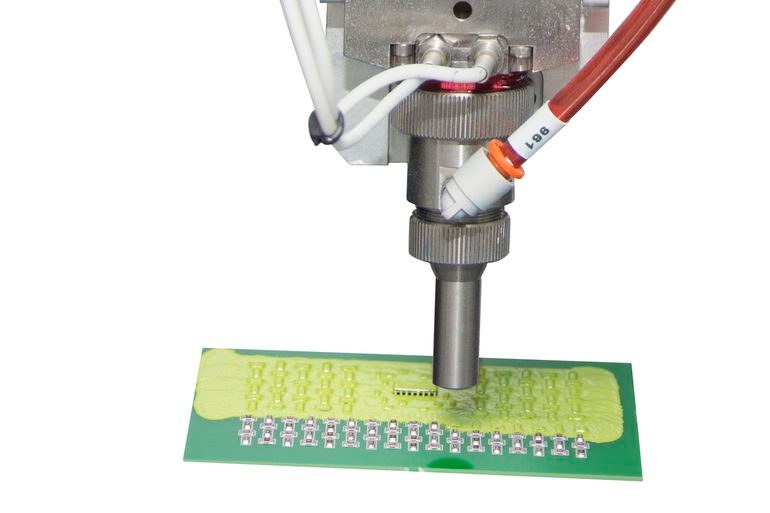
Coating materials have traditionally been formulated in solvent-based form, however, the use of solvents has become more restricted from an environmental point of view and consumers are increasingly becoming aware of the ‘waste’ of these processes in the form of the energy required to remove the solvents, as well as the impact of their release on the environment. Electrolube says its new solvent-free technology responds to the needs of both manufacturers and consumers, fundamentally based on global ethical changes, performance levels and process.
“The new UVCLX is a bio-based conformal coating that is completely unique to the industry and provides the highest levels of protection whilst maintaining a swift processing time,” the company said. “Applied via a selective coating machine, UVCLX exceeds traditional UV Cure Coatings, being touch dry after just a short exposure to LED-365nm UV light. UVCLX guarantees full cure in less than 24 hours by virtue of the secondary chemical cure mechanism, which ensures that even shadowed areas are fully cured in a matter of hours. UVCLX performs in stark comparison to traditional UV Cure Coatings, that can require weeks at a time for a complete cure and still with some shadowed areas remaining uncured. Inevitably, UVCLX enables a greatly reduced level of work in progress.
“Optimally applied at between 200–350μm, the new bio coating achieves excellent edge coverage even over sharp components and the highest levels of protection, even during temperature cycling and thermal shock, vastly out-performing other UV coatings on the market even in the harshest environments. UVCLX offers exceptional performance due to its hydrophobic nature which ensures it provides excellent protection against moisture, salt mist and even full immersion for short periods. This immersion period can be extended by applying the coating more thickly.
“Camouflaging components and PCB tracks for more sensitive designs, UVCLX is an opaque green coating. The versatility of UVCLX enables it to be deployed wherever a coating is needed and is ideal for automotive and EV applications.”