- All solid state relays have a leakage current associated with their semiconductor heritage, consequently they do not have as high an insulation resistance. The leakage current is also nonlinear and can vary a great deal with temperature. The on resistance can also be non-linear, varying with load current.
- There is a compromise between capacitance and path resistance, solid state relays with a low path resistance have a large capacitive load (sometimes measured in nF for high capacity switches) which restricts bandwidth and introduces capacitive loading. As the capacitive load is decreased the FET size has to decrease and the path resistance increases. The capacitance of a solid state FET switch is considerably higher than a reed relay.
- Reed relays are naturally isolated by the coil from the signal path, solid state switches are not, so an isolated drive has to be incorporated into the relay increasing size and cost.
- Solid state relays can have much higher power ratings.
- EMRs are designed to have a wiping action when the contacts close which helps to break small welds and self-clean their contacts. This does help lead to higher contact ratings but may also increase wear on the contact plating.
- EMRs can have much higher ratings than reed relays because they use larger contacts. Reed relays are usually limited to carry currents of up to 2 or 3 Amps. Because of their larger contacts EMRs can also often better sustain current surges.
- EMRs typically have a lower contact resistance than reed relays because they use larger contacts and can normally use materials of a lower resistivity than the nickel iron used in a reed switch capsule.
- Reed relays exhibit much faster operation (typically between a factor of 5 and 10) than EMRs. The speed differences arise because the moving parts are simpler and lighter.
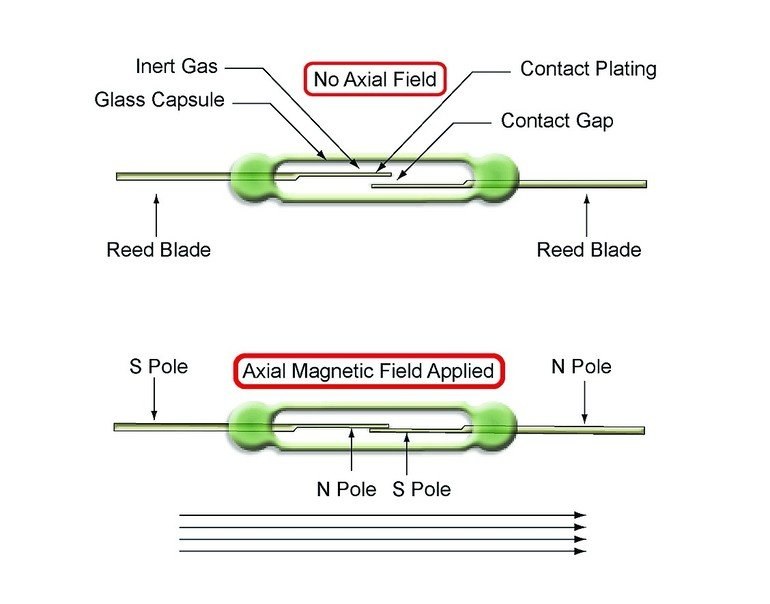
- Reed relays have hermetically sealed contacts which lead to more consistent switching characteristics at low signal levels and higher insulation values in the open condition. EMRs are often enclosed in plastic packages which give a certain amount of protection, but the contacts over time are exposed to external pollutants, emissions from the plastic body and oxygen ingress.
- Reed relays have longer mechanical life (under light load conditions) than EMRs, typically of the order of between a factor of 10 and 100. The difference arises because of the lack of moving parts in reed relays compared to EMRs.
- Reed relays require less power to operate the contacts than EMRs.
- Reed relays and EMRs both behave as excellent switches. The use of high volume manufacturing methods often makes EMRs lower cost than reed relays but within the achievable ratings of reed relays the reed relay has much better performance and longer life. With the continuing quest for further miniaturisation, better materials and production methods, it is clear that reed relays will be around for many years.
- Former-less coils