Much is being talked about it, reports from Japan fascinateus, but so far very few are deploying the “colleague robot” in their board assembly. Pros and cons are forever being discussed, without coming to an end. With the new collaborative system, the company, a system provider and market- and technology leader in the selective soldering technology, puts an end to this tiresome “I would like to, but I don’t know how” discussion and unveils ist implementation.
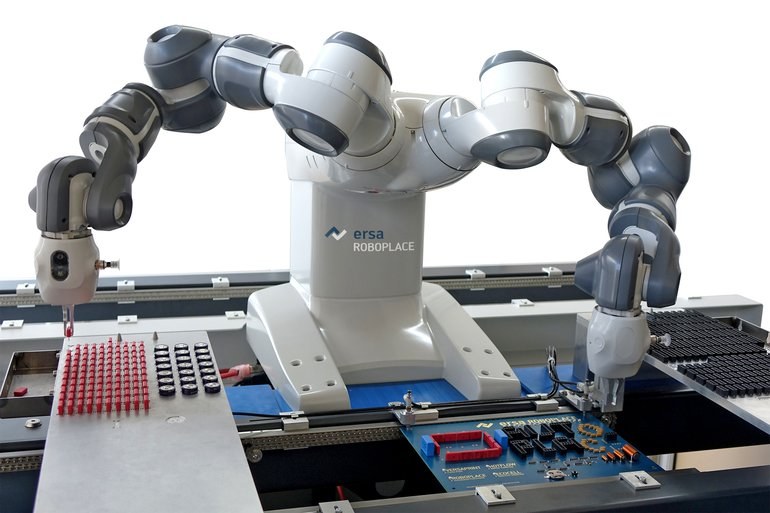
For industry and the automotive sector, THT components are still integral parts of complex board assemblies. Connectors, capacitors, chokes or special components, often only a few of them per board, need to be manually placed on an infeed conveyor. This normally in a flow production environment with short cycletimes, so that, in order to maintain the throughput, a few employees need to be tasked with the assembly. Here now enters the solution to assume this monotonous, repetitive task for small to medium production volumes. While it does not replace the operators, it rather permits their transfer to perform higher-valued tasks. The lean-concept in combination with the SMART-factory is implemented, and a link to Factory 4.0 (Industry 4.0) is prepared. As the base of this new era in man-machine cooperation – in which robots perform, side by side with humans, the same tasks without jeopardizing the safety of humans – Ersa selected the YuMI robotic technology from ABB.
The collaborative robot is deployed in front of selective- or wave soldering systems, and does not require any safety guards. Since it will stop if touched, or move away from the point of contact, it is, like all collaborative systems, slower than the common, behind safety guards operating robots. This supposed disadvantage is compensated for by the Ersa Roboplace with dual gripper arms, which make it twice as fast. Another advantage of the dual arm technology is the possibility to install two different grippers, enhancing ist flexibility. Both arms are independently controlled and also move fully independently, whereby a collision is precluded. Taking up the components is, as a rule, by finger grippers, since here the centering of the component is assured. Components are presented either on quick-change trays, or in common sticks or tape-and-reel presentation.
Communication: Multi-code capture of the board assembly, SMEMA interface to the loading system, communication Roboplace plus transfer to the selective system including product tracking, as well as linkage to the MES is via the Roboplace system control. The motion sequences are taught via smart devices, i.e. tablet-PC or smartphones. Component placement software is available for the teach-in, from which basic sequences, already optimized for robotics, can be called up. Also, the operator can program, easily and intuitively, his own motion sequences with this App (within the maximum movement range).