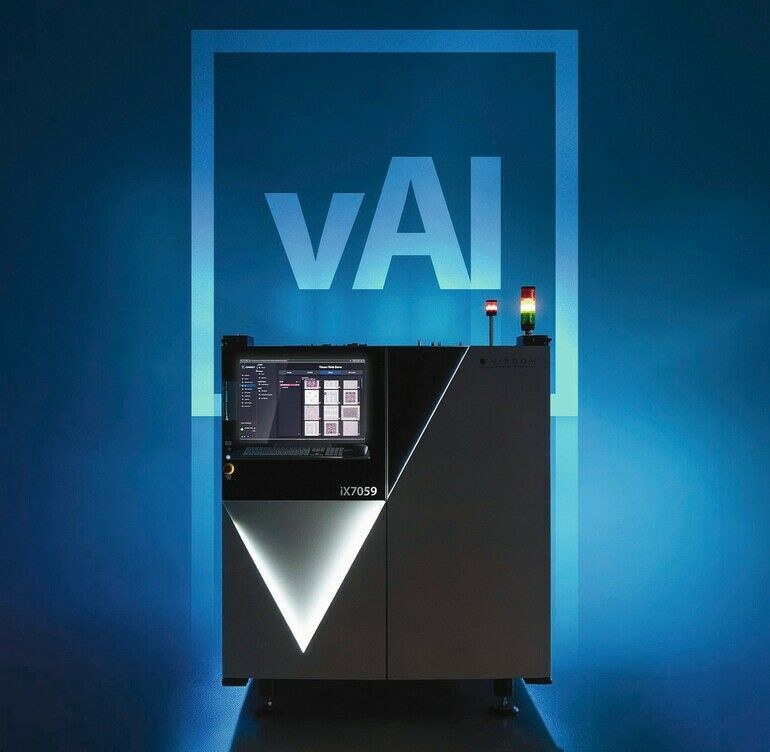
Built on a solid foundation of high-resolution image processing, advanced 3D measurement, and industry proven algorithms, vAl solutions enhance automation, tackle complex tasks, and deliver results faster, without sacrificing transparency or control.
vAI is more than just AI. It is about equipping manufacturers with the capabilities to meet today’s production demands and be ready for the future. Viscom delivers a powerful, purpose-built AI solutions portfolio designed for modern electronics manufacturing.
AI-based verification: Advancing quality assurance
Distinguishing between acceptable and defective components often comes down to subtle visual cues that even experienced operators may overlook. Viscom’s AI-based verification addresses this challenge by integrating deep learning into the verification process.
Working in line with the four-eyes principle, the system cross-checks its classification with that of the human operator. If a discrepancy is detected, the operator is prompted to confirm or correct the decision. The AI currently supports classification in defined areas and reduces manual effort by leveraging user feedback, which Viscom tracks and evaluates. Improvements to the AI are made during their dedicated “Reclassify” step, where unclear cases are reviewed and reassessed in bundles.
Unlike basic automation, this AI technology mimics human-like reasoning, interpretating visual data in a broader context. Yet, traditional inspection algorithms and measurement techniques still play a vital role and work seamlessly alongside AI components for optimal results.
By minimizing human error, vAl-based verification enhances quality, reduces costs, and cuts down on waste, supporting a more streamlined and sustainable production process.
Why AI-based verification stands out
The company enhances customer-specific AI models by training them primarily on customer data, which is supplemented with a large pool of annotated images from real-world electronics production. This approach ensures sufficient defect coverage while adapting to the specific characteristics of each application.
Every AI model is delivered with a vAl Quality Report: A detailed statistical overview showing expected workload reduction, accuracy metrics, and insights into potential optimization areas. This transparency builds trust and ensures complete process oversight.
A standout example of this innovation in action is Viscom’s collaboration with TE Connectivity, where a groundbreaking AI solution for solder joint inspection was developed and successfully implemented in a demanding production environment.
Vice President of the Business Unit Automotive Global of TE Connectivity, Josef Sinder, explains: “We saw with this specific soldering process application that we were reaching the limits of conventional camera technology, which also led to increased manual rework. That’s why we considered using AI in this area.”
The need for an integrated solution was clear. Sinder adds: “Of course, we looked at and evaluated several providers in the market, but it quickly became clear to us that we needed an integrated solution. Since we were already using systems from Viscom, it was naturally a very obvious choice.”
AI-supported image processing: Enhanced feature recognition
Traditional algorithms can struggle in challenging scenarios, like detecting voids in thermal connections or tracking wire bond paths, especially when dealing with noisy or distorted images. This is where the AI-supported image processing excels.
The AI-assisted segmentation tools, especially in X-ray imaging, can isolate voids and critical structures with remarkable accuracy, even when shadows or overlapping components complicate the view. These models are trained in advance using labeled data and deliver stable, repeatable results.
Dr. Maren Awiszus, Head of Viscom’s AI Team, explains: “With AI-assisted segmentation, tasks previously considered unfeasible can now be automated. Even under changing lighting or noisy conditions, our models maintain their reliability. Sometimes even eliminating the need for 3D imaging entirely.”
To address demanding inspection requirements, the company leverages AI for automated detection of Voids in 2D X-ray images. This AI-based method has shown highly promising results though it requires an initial training phase. During this stage, the system is trained on image data to reliably identify voids and differentiate them from other structural features.
After successful validation using test data, the AI is ready for deployment and delivers results in real time. The company’s technology is already integrated into numerous production lines, playing a key role in reducing cycle times.
NPI: Automatic inspection plan creation with vAI
Creating inspection programs is typically straightforward when complete CAD and BOM data are available. However, when information is missing or incomplete, AI steps in.
Viscom’s AI solution autonomously identifies components, assigns inspection patterns, and configures tests, making it ideal for prototype development or high-mix production environments where manual planning would be labor-intensive.
Today, an optical inspection plan can be generated in under 15 minutes using traditional methods. With AI, even partial datasets are no longer a hurdle. The system intelligently detects and classifies component shapes and solder pads, accelerating setup and minimizing the need for operator intervention.
Centralized intelligence with vAl hub
To manage the entire AI workflow, the company offers the vAl Hub—a unified, cloud-based platform accessible via vConnect interface.
Dr. Maren Awiszus, who developed the vAI Hub together with her team, explains: “Through the vAl Hub, customers can upload and manage their own inspection data, label and organize datasets, train and refine AI models. Download and then deploy models to their inspection systems.”
This centralized approach ensures fast adaptation and seamless integration into existing production processes. From void detection in X-ray images to verification of potential defects, the vAl Hub keeps AI implementation efficient and user-friendly.
Inspection: Reimagined
The company’s vAl solutions go beyond simply adding AI to existing processes, they redefine the potential of electronics inspection. With AI models trained on extensive real-world data, transparent performance reporting, and seamless integration into daily operations, vAl delivers measurable results.
By enhancing inspection accuracy, reducing manual labor, and increasing First Pass Yield, vAl does not just improve production, it transforms the approach to quality assurance in modern electronics manufacturing.
As challenges in electronics production continue to evolve, Viscom remains at the forefront, delivering innovative AI solutions tailored for the industry’s next generations.