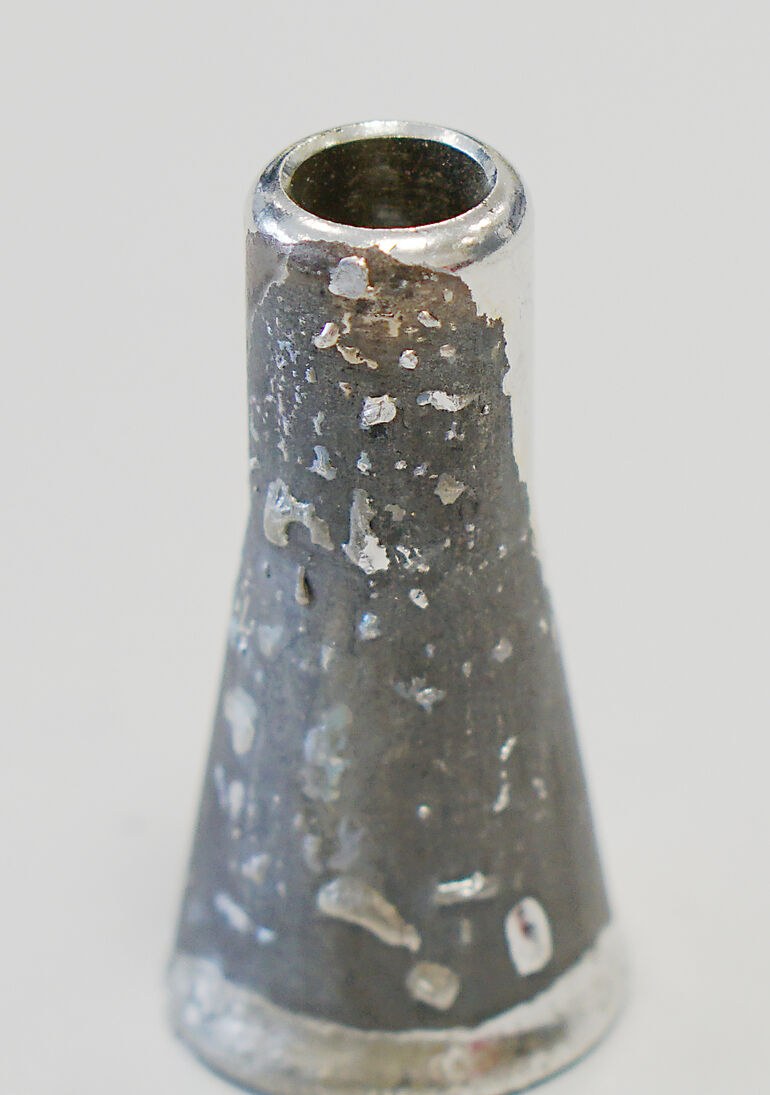
Dirty nozzles in selective soldering processes can cause the solder to not reach the solder joints evenly or in the correct amount. This can result in incomplete or poorly wetted solder joints that affect the functionality of the final product.
Effects of dirty solder nozzles
Residues in the nozzle can also lead to an uneven flow of solder. As a result, the solder flow is no longer controlled, increasing the risk of short circuits or bridging between neighboring solder joints.
Defective solder joints must be laboriously reworked. This not only increases production costs, but also the time required for quality assurance and troubleshooting.
Another serious drawback of residue on the nozzle is that it can interfere with heat transfer and temperature control during the soldering process. This can lead to inhomogeneous solder joints, resulting in either cold solder joints or overheating of the components.
In the long term, the build-up of residues on the solder nozzle can also have a negative effect on its material properties, which can significantly reduce the life of the solder nozzle. Higher maintenance and spare parts costs are then inevitable, often combined with unplanned downtime that affects overall production efficiency and slows down production.
Continuous care and maintenance of the solder nozzles is therefore essential. Although manual cleaning is a common method, it can be associated with various disadvantages that impair the production process in electronics manufacturing.
Disadvantages of manual cleaning
Manual cleaning of nozzles in the selective soldering process presents several risks and challenges. One major drawback can be the quality of the cleaning. The success of the cleaning process depends heavily on the experience and diligence of the operator, which can lead to inconsistent results. For example, residues on the nozzles are not always completely removed, which affects the quality of solder joints and leads to defects such as uneven solder joints or bridging.
Another disadvantage is the time required for manual cleaning. This results in downtime and a reduction in production capacity. Repeated manual cleaning also increases the risk of nozzle damage. Improper handling or mechanical cleaning processes can damage nozzle materials, resulting in higher replacement costs in the long term.
Manual cleaning processes also typically involve the use of chemicals, some of which are aggressive. Personnel are exposed to fumes during the cleaning process.
Finally, manual cleaning can pose a traceability problem because it is difficult to fully document the cleaning process. This is a risk, especially in demanding production environments where precise quality control is required.
Overall, manual cleaning of solder nozzles can lead to efficiency losses, increased costs and decreases in quality. As a result, automated solutions are increasingly preferred in electronics manufacturing.
Advantages of automatic cleaning
Compared to manual cleaning processes, automatic cleaning of solder nozzles offers numerous advantages that affect both the quality and efficiency of the selective soldering process. The most important advantage is the consistency and precision of the cleaning process. Automated systems operate according to set parameters that ensure consistently high cleaning quality. Because the process runs independently of the operator’s experience, residues are reliably removed, and the nozzles are optimally prepared for the next use. This results in more stable and consistent soldering quality.
The automatic ultrasonic cleaning system developed by SEHO Systems causes the liquid solder to vibrate, cleaning the surface of the solder nozzle in the absence of atmospheric oxygen and immediately rewetting it.
As the ultrasonic process is non-contact and requires no chemicals or acids for the cleaning process, there are further advantages in terms of handling, and potential cost savings. There are no special storage requirements, no need for staff to be specially trained in the use of chemicals or acids and, of course, no harmful vapours are produced during the cleaning process to which staff are exposed. In addition, chemical and acid-based systems always require some form of dosing device to clean the solder nozzles, which in turn is susceptible to maintenance and failure.
Another benefit of this automated cleaning is reduced downtime. Ultrasonic cleaning is faster and more efficient than manual cleaning, minimizing production interruptions. Because cleaning can be integrated into the production process, there is little disruption to production, which increases production capacity. Maintenance costs are also significantly reduced by eliminating the need for manual intervention.
In addition, ultrasonic cleaning reduces the risk of damage to the nozzles because the nozzles virtually never come into contact with the cleaning system. The system works with defined parameters, which optimizes the handling of the nozzles and minimizes the risk of errors or damage. This not only extends the life of the nozzles but also reduces the cost of spare and wear parts, resulting in greater cost effectiveness.
Another key benefit is the elimination of human error. Since the cleaning process is independent of the operator‘s level of fatigue or diligence, the likelihood of errors is significantly reduced. Ultrasonic technology ensures precise and repeatable cleaning, which increases the quality and reliability of the entire soldering process. This precision also affects the quality of the solder joints, as consistent and thorough cleaning of the nozzles significantly reduces the risk of soldering defects.
Documentation and traceability of the cleaning process is also greatly improved by the automated system. The cleaning cycles can be programmed via the software and are archived via the production data acquisition system, providing a complete record of the cleaning process. These records are an absolute plus for quality management and audits.
Conclusion
Switching to automatic ultrasonic cleaning of selective soldering nozzles offers numerous benefits that improve both production quality and efficiency. The consistency and precision of automated cleaning reduces soldering defects, minimizes downtime, and extends nozzle life. It also reduces maintenance and saves money.
In an increasingly competitive industry, the automation of cleaning can be a critical factor in improving production processes and a company‘s long-term competitiveness.
Automatic ultrasonic cleaning for mini wave solder nozzles is available for many SEHO selective soldering systems.