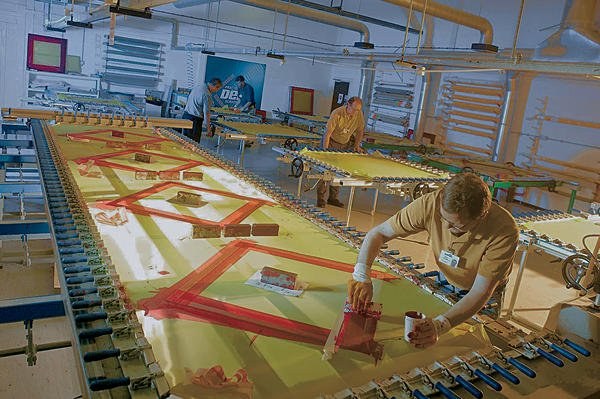
With electronics manufacturers looking to increase productivity while reducing costs – and shortening time-to-market for their products – all aspects of the production process come under scrutiny, including screen printing. As industry demands more cost effective ways to build the latest generations of high-tech instruments and devices, there is an increasing requirement to deposit electronically conductive inks, biomedical chemical agents and other compounds. The capabilities of screen printing, using a precision emulsion screen as part of a tightly controlled process, now allows manufacturers to print these materials cost effectively in high volumes, with track and gap widths less than 50 microns.
The quality and accuracy of an emulsion screen is fundamental to achieving a high level of performance. It also demands investment by the screens supplier in the leading-edge equipment necessary to exploit new opportunities where screen printing can be an attractive enabling technology. Similarly, process knowledge is crucial; the know-how within DEK Precision Screens helps to create new products that enhance screen printing processes all over the world – and this is not limited to manufacturers running DEK printing platforms. The company is an acknowledged specialist in precision screen printing platforms and boasts four decades of experience in an industry sector characterised by a drive toward extremely miniaturised products. In turn, this has precipitated some significant advances in the methods and technologies deployed in screen printing. DEK Precision Screens enjoys a continuing investment programme that brings these advantages to bear in new application areas. It’s no coincidence that the company was one of the first screen manufacturers in Europe to achieve ISO9001 – 2000 qualification.
The firm recently invested in new ISO 14644 Class 10,000 clean room manufacturing resources for emulsion screens, as well as for its metal and plastic stencils predominantly used in SMT assembly. Another indicator to the importance of screens in industry is the fact that the company’s Precision Screens division has grown from a staff of 8 to a 24-strong production team.
The business has ready access to the vast knowledge base built up by DEK through working with screen printing customers in the demanding electronics market and allied sectors. However, DEK Screens’ customers are active in many sectors outside the electronic assembly industries. They include manufacturers of precision gauges and dials, medical diagnostic test strips, position sensors for automotive systems, solar and fuel cells and other industrial sensing and metrology applications. For some applications, screen printing delivers a new solution to the issue of materials deposition. This is partly enabled by advances in the raw materials, such as fine-weave screen fabrics with thread diameters less than 30 microns that features several hundred threads per centimetre.
DEK’s history of consistent innovation in screen printing technology (and as one of the largest buyers of stainless steel and polyester meshes in Europe) positions the company to work with mesh manufacturers to push material technology forward. For example, emerging combination and high-stability polyester meshes allow screens to sustain a print resolution of less than 50 micron track and gap – a territory previously dominated by more expensive stainless steel meshes. Such advances allow low cost screen printing processes to address even more complex material deposition requirements, and deliver high quality results.
The ability to assess a customer’s process and optimise the screen design makes a compelling offer. With investment in automated design, manufacturing and inspection equipment, precision screens are generated from source data such as Gerber or CAD files, and then compared with that source data after manufacture. This is important, since inspection of screen features is difficult, especially for fine resolution screens. In fact, as high-resolution printing processes progress towards 40 microns track and gap, high accuracy inspection equipment will become a prerequisite for all screen manufacturers.
The company’s Weymouth facility also includes mesh-tensioning beds capable of operating with synthetic as well as stainless steel meshes, plus automatic coating equipment accurate to within +/- 2 microns. Inspection equipment accurately verifies emulsion thickness, dimensions and tensions. Further inspection identifies defects in the emulsion coating, or the weave of the mesh, preventing these defects from passing into the field and impairing results in production. As industry interest in screens increases and the suitability of high-resolution screens for a diverse range of applications expands, a focus on quality and accuracy becomes critical. As such, an emphasis on housekeeping and the use of clean room facilities in particular, increases as typical track and gap requirements reduce to the 40 micron range. Meshes, photo imaging and exposure process can be contaminated by handling and/or airborne dust.
DEK is targeting specialist applications, where screen printing can offer measurable cost and performance benefits, with an agenda that addresses an extremely diverse range of requirements. Peter Hawkins, Screens Manager at DEK, is driving a truly global screens capability. “With our infrastructure and backing, we are able to focus on producing emulsion screens for precision applications to consistently high quality standards while offering the shortest possible turnaround to customers across the globe,” he claims. Typically, his organisation can satisfy a precision screens order inside 5 working days. “It’s just one advantage of being part of a worldwide leader in screen printing. Another is that many screen manufacturers are simply unable to make the up-front investment or supply the technical resource required to offer a complete solution,” he adds.
EPP Europe 425
Der Autor untersucht den Markt für Präzisions-Emulsions-Siebe. Die Einsatzmöglichkeiten des Siebdrucks unter Verwendung eines Präzisions-Emulsions-Siebes als Teil eines straff kontrollierten Prozesses, erlaubt es den Herstellern jetzt, Materialien wie etwa elektronisch leitende Farben, biomedizinische chemische Wirkstoffe und andere Verbindungen kostengünstig in hohem Volumen zu drucken und das mit Spurbreiten und Lückenweiten von weniger als 50 Mikrometern.
L’auteur étudie le marché des filtres de précision par émulsion. Les possibilités de mise en œuvre de l’impression de circuit par sérigraphie à l’aide d’un filtre de précision par émulsion dans le cadre d’un processus strictement contrôlé permettent aujourd’hui aux fabricants d’imprimer des matériaux tels que peintures électroconductrices, substances chimiques biomédicales et autres liaisons, à coûts réduits et volumes élevés, avec des largeurs de piste et intervalles inférieurs à 50 micromètres.
L’autore esamina il mercato dei filtri di precisione per emulsioni. L’utilizzo della serigrafia con un filtro di precisione per emulsioni come parte di un processo rigidamente controllato consente oggi ai costruttori di stampare con convenienza grossi volumi di materiali quali colori con conducibilità elettronica, additivi chimici biomedici e altri composti e in piste e intervalli inferiori a 50 micrometri.