Is this statement from the US-based forecaster good or bad? Or just the plain and over-optimistic transatlantic view, expecting almost never-ending business success in the Peoples’ Republic? If this is the future of electronics manufacturing (figure 1), is it North America’s future as the recent Apex 2003 exhibition in Anaheim, California, has drastically shown? Mass-market, high-volume production continues to shift out of the traditional highly developed industrial regions – regardless of their flexible, inflexible or whatever work environment, regardless of favorable trans-action costs, smooth infrastructures and well-defined intellectual-prop-erty regimes.
Cost of labor and lack of stifling regulation seem to be the real forces that move electronic production plants around the world. Only a few factors remain in Europe’s favor, new or old, east or west, the same applying to North America and Japan as well (even of Singapore and Malaysia) for that matter: closeness to their enduser markets and direct access to certain leading-edge technologies. In the case of mobile-phone production, this at least keeps final assembly (fulfillment) and software installation within the proximity of 48 hours by truck or train delivery to their destinations in Western or Central Europe. Next to the technology and logistics paradigm, cultural issues one could say.
Of course there is today – as there will be in the future – a substantial and profound manufacturing base left in Europe – even if the geographical shift from west to east, old to new, from Ireland to Russia, cannot be hindered. Losses on one side, gain on the other – it all depends upon where you draw the boundaries of an industrial region and how fast you can dance to the tune of the new manufacturing melody.
Before we continue on our tour through European manufacturing, let’s take a brief look at technology developments and the regulatory causes and concerns as they influence the strategic directions of worldwide investment and work flows. Let’s focus for a moment on the most recent roadmap of Nemi (North American Electronic Manufacturing Initiative), the manufacturing research and standardization co-operative of the U.S.-based industry. Bear in mind however that it openly reflects the national interest of the U.S.-based industry solely – and their perceived challenge by other world regions, namely Japan and Asia Pacific – and attempts to bind U.S. firms into a common goal. Whereas the many national European industries are bound by tradition into more corporatist models of co-operation – and nowadays they get some of their marching steps from EU-wide industrial policies, but still with plenty of regional influence.
”As the electronics industry matures, it will inevitably enter the commodity phase of its life cycle. In this period, breakthrough technology may no longer be sufficient to insure business success. Customers will demand and get the right solution at the right cost from winning enterprises.” Nemi sofar says. Never mind that a large part of the industry has already entered the commodity phase – and is irretrievably lost to the high labor cost and highly regulated industrial regions. This view also opens a chance for European enterprises: in highly sophisticated solutions, especially in industrial and automotive markets where it is enjoying worldwide advantages. ”Breakthroughs” are not the only alternative and not always necessary for this competitive advantage – just continued efforts to stay ahead of the curve.
Nevertheless, Nemi sees the next major regulatory hurdle especially for U.S.- and EU-based industries in the following legalization efforts: ROHS (restrictions in the use of hazardous substances) and WEEE (waste from electrical and electronic equipment). They are bound to be implemented as soon as 2004 or 2006, respectively. These regulations will require the industry to do co-operative research on the material content of finished products and components, as toxic materials such as lead or bromides must be removed or reduced below currently unfeasible levels, according to Nemi. Second point: EU-imposed end-of-life producer responsibility legislation will hit European manufacturers – and importers equally well – in the pocketbook, for the sake of the consumers. However, the ”green” restrictions are worldwide concerns in which Japan has taken the lead in introducing environmentally attractive consumer goods, and it is faring well with this strategy.
Market-wise, Nemi sticks to the cautious analysis of U.S. forecasters, namely that PC growth will remain stalled throughout 2003, and that the optical IT equipment market will shrink long-term: from $85bn in 2000 to a low of $40bn in 2005. Flat-panel manufacturers, on the other hand, are expected to invest $40bn, over the next several years, in their expanding manufacturing capacities. Volume drivers, as already visible and known, will be wireless networking and automotive entertainment. In addition, other forecasts say that GSM phones will exceed PCs for web access by 2005.
In terms of manufacturing technologies, Nemi identifies three activities impacting rapid change on manufacturing: board assembly, test and inspection; measurement and final assembly. Board assembler in their roles as EMS (electronics manufacturing services) providers are taking on more and more duties previously left to OEMs: supply-chain management, test, system configuration, distribution and repair services. The current trends, Nemi concludes, proscribes to the North American industry – and by analogy to the European industries as well – to restrict itself to a role as NPI (new product introduction) facilitators and special-service vendors. Board assembly in general needs faster ramping strategies to volume manufacturing and therefore quicker qualification procedures. Yes, electronics production apparently takes place in a global village, although, for every forecast, one implication should not to be forgotten: don’t play the one-eyed among the blind.
Another pressing issue: MEMS are a disruptive technology with consequences for electronics manufacturing – as are optoelectronic components and their respective assembly onto substrates and boards. Ever increasing packing densities are another factor. All of these and their concurrent and speedy automation with their implementation at multiple sites, Nemi thinks, will be differentiators for the local U.S. as well as European industries.
Test, inspection and metrology, Nemi states, ”continue to be the major limitations in semiconductor, PCB, and system test.” Cost of test systems is becoming prohibitive and their performance is not keeping up with impending requirements. The other side of the coin: development and introduction of test systems are also not that attractive anymore. However, as always: limitations are chances, too – especially for innovative test houses of which Europe has several. Protection of intellectual property – especially in test systems and strategies – should keep some segments of the manufacturing chain securely at home.
Packaging is a further concern. It has become one of the largest factors of expense since it began to outrun the cost of the semiconductor device itself. MEMS and SiP (system in a package) pose another challenge in this arena. They require higher-density capable organic substrates and low-cost flip-chip materials. SiP and bare-die have somehow unified the challenges as the test requirements in semiconductor components and systems begin to overlap. All this requires higher investments in packaging research and development. Crisis and chance are tightly linked here as well.
The ascent of electronic manufacturing services has changed the European industrial base. In the past decade, contract manufacturing has grown at double-digit rates, notes London-based Reed Electronics Research in their latest (6th edition) of The European Contract Electronic Assembly industry 2002–2007, which is just off the press. From a base of $50bn, it has expanded to $20.6bn in the last boom year 2000. Despite the hopes for a speedy recovery, the Western European CEM market fell by 5% versus 2001 to $22.8bn in 2002. (All Dollar figures are based on exchange rates in 2000.)
Returning to the present: Reed sees an optimistic upswing in electronics assembly of 5% for 2003 and of 24% in 2004. It prognosticates that European contract manufacturing as a total could grow this year by 9% or more. 2004 should bring a plus of 24%. So, with some luck and a favorable world economic climate change, Europe’s CEM (contract electronics manufacturers) market could reach a new high of $55.7bn by 2007.
Yet, consolidation is the daily routine in the manufacturing industry of today – as Reed exemplifies by pointing to recent mergers and acquisitions. Among them is the acquisition of Alcatel’s, Xerox’s and Telia’s plants in 2001 by Flextronics, as well as the closure of Flextronics’ Brno (Czechia) location in mid-2002. Also in 2002, Sanmina-SCR for its part was active acquiring Viking components, HP’s French plants as well as Alcatel’s French and Spanish facilities, and of IBM’s Scottish (Greenock) location. In 2001, Celestica was busy taking over Sagem’s Czech operations. In 2002, another Alcatel plant (in Brest) went to Jabil, as well as the Compaq plant in Ayr, Scotland, along with PCMS (Philips Contract Manufacturing Services). Finmek landed a deal with ABB and with Fiat. All this just counting the world-leading EMS providers besides several other such buy-out agreements with lesser known players, but nonetheless accounting for a great deal of activities in reordering the European contract-manufacturing scene.
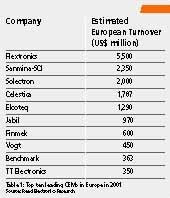
Europe’s top ten contract manufacturers (despite the continuing migration to the Far East, accounting for a total sales volume of $17.5bn – which is about 66% of the Western and Central European manufacturing market.) As shown in table 1, four of them, although not the leading ones, are ”native” Europeans.
One interesting facet of Reed’s research is the fact that most small and medium-sized manufacturers are not that much concerned about the migration to the Far East, namely to China and beyond, for example, to India. They use their geographical closeness to their customers to their full advantage. And in where they have something to offer in terms of advanced or specialized technology, that is difficult to match or replace at another location, for example, demanding automotive electronics.
Another conclusion of the Reed study: contract manufacturers with well-working supply-chain management in place are much less touched by the economic slump and the geographical shift because they are able to cope with the new paradigm of quick product ramp-up policies and product change requirements from their customers. This is especially valuable in the distribution paradigm for EMS providers of direct delivery to the final selling outlets for the endusers of their product. The most interesting market at least in the near future, states Reed, is the automotive segment, whereas the typical industrial market remains the mainstay of the smaller players, because its high mix/low volume, needing plenty of expertise.
One more result pertaining to our survey of the European manufacturing landscape, as reported by Reed: if board assembly in Europe in 2002 saw a serious decline, it no doubt was due to out migration and economic slowdown. Nevertheless, another factor often overlooked is the continuing price erosion of electronic components – by 10 to 30% per year since 2000. As a result of all these factors, European electronics assembly volume in 2002 sank to $56bn. During the last boom year 2000, this had been at $82bn. All in all, assembly and box-build taken together in Europe reached $70bn in 2002. Of that total, contract manufacturers currently hold about 32%.
An overview of European component markets is given in table 2. These figures again reflect the price erosion of components. Assuming a factor of 50% for labor, testing and overhead, Reed arrives at the figure of $56bn for the European assembly volume given further above. Grouped by regions, the European CEM market looks like and should develop as shown in table 3. The table includes the activities in Eastern European countries because their companies are mostly headquartered in the ”old” West. It documents the continued predominance of Germany and Britain, with strong contenders France and Scandinavia.
In terms of industry or enduser figures, table 4 shows that, somewhat surprisingly, computers (better: data processing equipment, not restricted to PCs) will evolve to grow further in absolute terms and percentage-wise over the next four years. The major players in the production of electronic equipment are Germany ($33.9bn) and Britain ($33.8), long with France ($22.3), Italy ($12.7) and Ireland ($11.1).
In the worldwide electronics markets over the past 24 months (despite the hesitant recovery attempts in early 2002), Europe has fared better than the U.S. industry, notes Mark Kirstein of In-Stat/MDR in his presentation given at the last Electronica in Munich. One typical occurrence in the traditional stronghold of color-TV manufacturing may serve as an example of regional shifts in European manufacturing: In Western Europe, TV-set production fell from 21m in 1995 to a mere 15m in 2002 – only to gain in the Eastern region: from 3.3m to about 12m in the same period.
The automotive sector, shining beacon of Europe’s industrial strength, is mainly centered in Germany, accounting for 45% of the European production. Computers (again: data processing) are still, as already pointed out, the largest segment in Europe: amounting to 24% in terms of production and of 35% market-wise (meaning: imports beat domestic production to a large degree). Growth dynamics, if modest and dependent on corporate replacement demand, is however driven by PC notebooks.
In the past, another important driver for European production activities has been mobile phones. They accounted for 11% of the Western European electronics markets in the year 2000 (the telecom hype age). Western Europe (16 countries) as a whole takes 22% of all electronics goods, and it produces about 19% of world demand. This, notes Kirstein, is on a level with the industrial giant of Japan. Against these figures and despite the regional CEMs drifting to Eastern Europe, the developing industrial regions still originate only about 2% of the world production, Kirstein says. Currently, it is Hungary that dominates its neighbors, with a production share of 48%. There are close to 40 firms outsourcing their production to Hungary, as Paris-based market researcher Decision, Etudes Conseil, part of the Europartners network of industry consultants, has found out. Next are Czechia (with about 28 relocations) and Poland (with about 20). Most of these Eastern CEMs (about 27) are owned by European OEMs, followed by North American firms (23). About 18 are pure-play worldwide EMS providers.
Apparently, the migration to the East continues and it gains ever-greater footholds, but is strictly focused on high-volume consumer products. Next stations along the road are Ukraine, White Russia and Russia proper – all of them with an eager and highly educated workforce waiting. But with a critical infrastructure, also in terms of a high influence of mafia-like groups on regular business. To Europe – and the U.S. and Japan as well – there seems only one role left to play in the long-term: in product and components definition, R&D, standardization and product life-cycle determination – with one word: technology-evolution, inducing market trends and prescribing product utility. Another role for the U.S. and Europe to play, of course, is in profound and highly skilled product, application and manufacturing research – both adequate as a submission of broadly available, indigenous capital and knowledge resources. And a lucrative way of value enhancement as well.
Werner Schulz/gbw
Reed Electronics Research: The European Contract Electronic Assembly Industry, 6th edition, 2003
NEMI Roadmap 2002, www.nemi.org
Decision, Etudes Conseil: The European Electronics Industry 2001–2006
Decision, Etudes Conseil, EECA/EPIA, Electronics industry migration, Electronica 2002
SEMI, World Fab Watch, 2003
Mark Kirstein, Trends in the Western European Electronics Markets, Electronica 2002. In-Stat MDR/Reed Electronic Research
www.instat.com/rer/electronica
Walt Custer, Mild upturn in early 2003 but global uncertainties prevail (published in Circuitree Magazine, April 2003), Custer Consulting Group
Walt Custer, Global Electronics Industry Business Outlook, 2003, www.custerconsulting.com
Boy Lüthje, IT and the Changing Social Division of Labor: The Case of Electronics Contract Manufacturing, Institute of Social Research, University of Frankfurt/M, Germany; for conference Transforming Enterprise, Washington, D.C., 2003. Luethje@soz.uni-frankfurt.de
Jan Vardaman, TechSearch International, Austin, Texas, Flip Chip and Wafer Level Packaging Market Analysis, 2003, www.techserchinc.com