
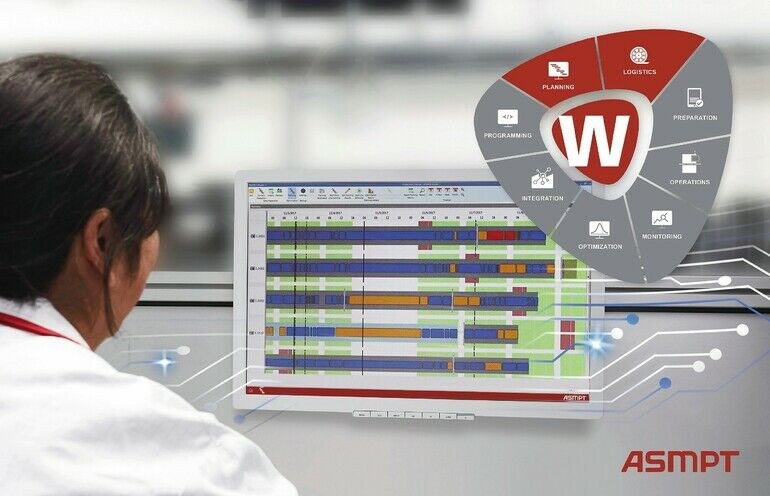
Delivering both on time and cost-effectively is ever more challenging in the highly-competitive industry that is SMT manufacturing. Despite delivery within a week having been common not so long ago, customers are now stipulating that deliveries take place on specific days – and at the same time ordering multiple different products in small lot sizes. Meeting these new demands requires exceptional flexibility and efficiency – particularly as cost-related pressures are also rising.
Production planning – a highly complex task
Now more than ever, success depends on intelligent and networked production planning that considers the requirements of both the customer and the manufacturing line. The goal is to maximize utilization of existing production capacities while
minimizing interruptions and setup changeovers. By this point, the planning process has become a highly complex task in which order production sequence plays a vital role. A simply switch from lead-containing to lead-free solder paste, for instance, will interrupt production for up to 30 minutes while the
reflow oven heats up or cools down to cater for different melting points. For this reason, it makes sense to run orders requiring the same type of solder paste consecutively on a line. Moreover, some lots require X-ray inspection for ball grid arrays while others involve odd-shaped components (OSCs) that must be placed with the TWIN placement head – requiring special equipment not necessarily available on every line. Even this relatively simple example which considers just three critical factors demonstrates the central problem: namely, that individual requirements overlap and influence one other. Add to this the fact that there may be line clearances for certain products, as well as other factors, and you are left with a highly complex, multidimensional matrix with countless possible variations – and only one optimal solution.
Dependency on individual specialists
In factories that plan manually, the quality of scheduling still depends largely on individual employees. These are usually specialists with years of experience who know both the products and customers very well. This fundamental dependence on specific employees often becomes a problem, particularly in locations where the company-employee bond is less pronounced than in Germany. When a qualified scheduler leaves the company, there is a loss of very specific know-how that can affect the whole production. The shortage of skilled labour also makes it difficult to find suitable replacements.
Software developed by practitioners for practitioners
When new products are introduced, even long-term and highly experienced employees can no longer keep track of the entire process matrix. It thus makes sense to automate the planning process. This is easier said than done however. To develop a new software product, you need to be familiar with the conditions and processes of modern SMT production while also taking individual freedoms into account – after all, no two factories are alike. Those who are purely software developers often fail to do this because they lack the necessary experience.