- Complete removal of all dusts, smokes, vapours, odours and gases.
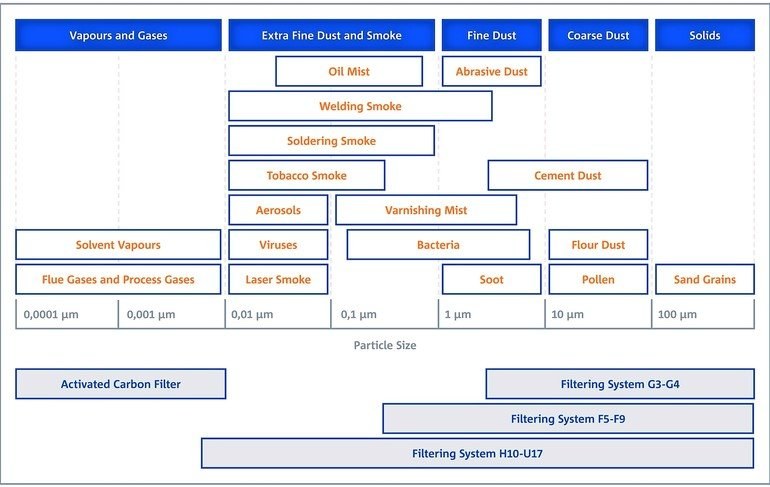
- Incremental filtration: Utilisation of prefilters for coarse particles (sedimentation dust 10 µm) to avoid premature saturation of fine dust filters (for particles 10 µm) and adsorption filters.
- Adaptation to relevant contaminants: An extraction system must absorb all particles, vapours and gases. Therefore, the capacity of the filter media must be adapted to the emitted amount of particles. For example, a large amount of coarse dust requires high-capacity filters to avoid too frequent replacement. Too low saturation conditions lead to extremely high maintenance efforts for the extraction system. On the contrary, if fine dust is largely produced, coarse filters may have low capacities.
- Adaptation to work places: In large production plants, attributes such as ‘space saving’, ‘mobile’ or ‘silent’ do not matter. However, such characteristics are welcome at individual and manual workstations. Filter technology must not be annoying – it should never disturb work routines, neither physically nor acoustically.
- The capture of contaminants is regulated by law in various countries. These regulations determine risk categories for specific hazardous substances, e.g. in terms of fire and explosion risks or in types of health damaging effects (carcinogenic, mutagenic or toxic for reproduction).
- large quantities of pollutants can be captured
- there are relatively low capture efforts
- good filtration opportunities are given
- low energy consumption possible