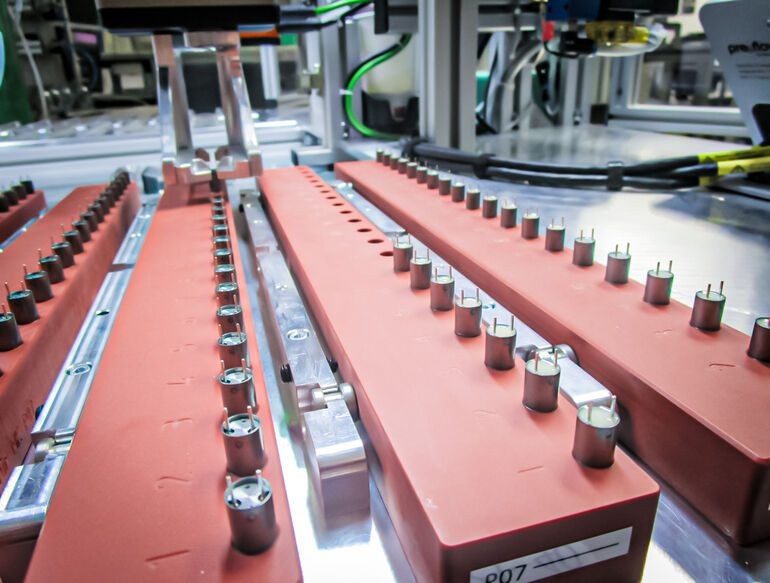
Pins are critical to parts and components during potting processes. If the miniature contacts become contaminated with glue, the electrical conductivity suffers, along with the component quality. By automating the potting of 2-component adhesives in magnetic heads for solenoid valves, Staiger has been able to reliably prevent this issue from occurring in the manufacturing of micro solenoid valves of just 7 mm in size, and to also ensure that exactly the same filling heights are always achieved.
Hand-mixing method
“Up until now, we‘ve been mixing the material by hand and then also dosing it into pallets manually,” explains Stefan Waldinsperger, the department head for operational and test equipment construction and process development at Staiger. Although the manual potting performed by the four highly trained employees responsible for this process was of an acceptable quality, it nevertheless proved too monotonous to handle for manufacturing quantities of between 600 and 800 units per shift. The increasing difficulties in finding suitably qualified personnel, along with the consistent precision guaranteed by robotics, ultimately drove the decision to automate the process instead.
The challenge
Initial tests were carried out with the Eco-Duo from microdosing solutions provider preeflow. Over the course of these tests, it then became clear that the two components of the Henkel potting compound used are only suitable for static mixing in the system under certain conditions. “The 2-component material poses challenges for mixing and dosing,“ explained Waldinsperger. For this reason, he got in touch directly with preeflow to discuss alternative technical solutions to the challenge. In particular, this concerned the very small design of the solenoid valves and the wish to have a precise dosing system that can handle very small quantities. The technology also needed to be suitable for the challenging material properties of the 2-component potting compound. “The hardener is of very low viscosity – it hardens quickly even as an individual component and must therefore be processed swiftly,” Waldinsperger explained. “All of this has an impact on the process.”
Joint discussions
Over the course of joint discussions, the parties evaluated the technical requirements and suitable technologies and decided on the Eco-Duomix. The greatest advantage of this is that it implements the mixing dynamically using a high-torque engine. Particularly for complex media of varying viscosities, this increases the process stability and consequently has an impact on the processing quality.