Chances are, as entrepreneur Harting believes, that in 2003 the long ”thirst period” will come to an end: inventories are being depleted at a record pace, more components are being used in industrial and automotive systems, and the merciless price erosion due to underused manufacturing capacities will be reduced to its regular peace-time pace.
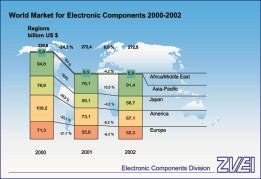
Compared to 2000, the time frame of the last Electronica, the two following years 2001 and 2002 were bad of course, and equally so. They brought a drop of 24.3% in total world market volume for electronic components, active and passive, discrete and integrated alike. It as a steep drop indeed: from $359bn in 2000 to $275bn in 2002. Nevertheless, Harting insists, 2000 was a highly exceptional year. Have patience, he pleads, ”After all, we are still 8% above 1999”.
In all of this, only the Asia-Pacific region did reasonably well. It even man- aged to grow its component markets by 15.5% in the midst of global gloom and doom. This emerging area grew at the expense of the Americas (-8.2%) and Europe (-6.3%) as well. In total: the component world market achieved a solid ”zero growth”, and it resulted in significant shifts in regional market weights. In terms of market shares: Asia-Pacific now accounts for 33.5% in total market volume. The Americas (North and South) still hold 24.0%. Japan follows with 20.8%. And Europe, number four in this row, stands at 19.2% amid all the migration to low-cost manufacturing environments, namely mainland China.
The official ZVEI outlook for 2003 is quite optimistic: single-digit component-market growth overall. Not too far from the average growth figure that all other industry pundits cannot agree upon when it comes to a short and midterm prognosis. At least it’s something to begin the new business year with fresh beliefs. WS/gbw