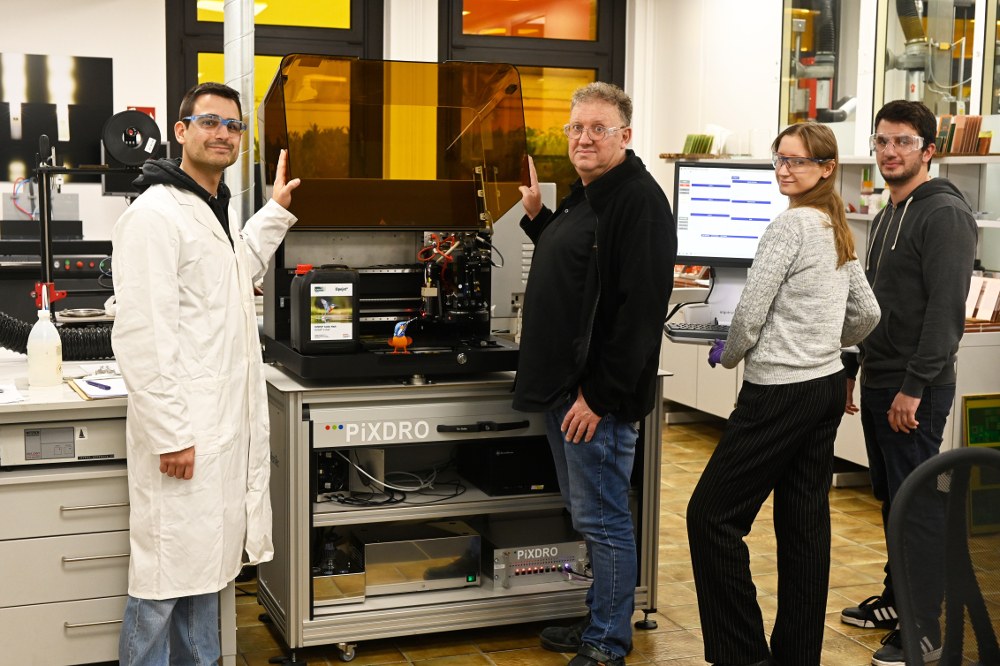
The second inkjet printer enables the R&D department of the Lower Rhine ink manufacturer to simulate projects from industrial customers in their own laboratories. A direct result of this will be the advancement of the qualification process and more reliable recommendations. “The print head is the same, so a laboratory project will also work on industrial printers equipped with several print heads of this type,” commented Kevin Poth, ELPEPCB Project Manager at Peters.

“Thanks to the precise positioning and small droplet volumes, inkjet printing is suitable for a variety of applications, such as printed electronics, printed circuit boards or semi-conductor assembly,” explained Leon van Lieshout, a service engineer from the Eindhoven-based manufacturer SUSS MicroTec. Among the main features of the Pixdro are its robustness, process control, user-friendliness and precision, added van Lieshout, who recently set up the new printer at Peters with a team of three engineers.
Electrical properties optimised
Solder resist for digital inkjet printing highlights Peters’ decades of expertise as a supplier of high-quality electronic coatings and its forward-looking focus. The Samba Dimatix print head sprays ink the same way that an inkjet printer does and applies it selectively to the circuit board. Besides protecting against corrosion and mechanical damage, the solder resist optimises the electrical properties of the PCB. Solder resist has already withstood solder processes without any problems and has therefore already fulfilled its first essential service.
Inkjet printers and the ELPEPCB solder resists from the Elpejet IJ 2467 series enable new PCB layouts and interesting resist geometries. Via the so-called “digital drop-on-demand” technology, the solder resist is applied selectively. The process is simplified and accelerated, compared with conventional application methods, resulting in a key reduction of material consumption.
For more information, visit www.peters.de.