John Arena, Pamela Lipson, Teradyne Assembly and Test Division
The value of AOI was documented when users recognized successive improvements in later stages’ labor costs, scrap and rework rates. Product and process quality improvements realized along the way were also significant. Over time, AOI became increasingly viewed as additive to in-circuit test procedures. In some cases, the delivered coverage of AOI has enabled manufacturers to reduce or even eliminate ICT coverage, with proportional reduction in fixture, programming and test costs.
However, since these salad days of AOI, the technical inspection requirements for machine vision of board assemblies have intensified substantially. The improvement in AOI capabilities has not emerged so rapidly. Each generation of incrementally more powerful portable electronic devices are useful as barometers of that era of manufacturing sophistication and capability. By way of example, the current mobile phone technology yields products that are far smaller, lighter and have a greater range of functionality, incorporating unrelated telephony applications such as still cameras, live video, personal organizers and wireless web access. To accommodate this expanded functionality with the ever-smaller size, manufacturers must design and produce denser, higher-complexity board assemblies that regularly challenge the envelope of manufacturing capabilities. This in turn put increasing requirements on the manufacturing technology used to build them.
The changes possible that allow these portable electronics are several: increasing semiconductor content, reduction in size and power of silicon die; innovative types of packaging, increased connectivity, and the use of more complex multilayer PCBs. Designs for small wireless products, especially those with RF circuitry, often restrict or eliminate the traditional probe access for electrical process or in-circuit test (ICT), with the close proximity of RF, video, audio and digital functions that mandate increasing amounts of shielding in the design. The progress at commodity portable electronic products in particular represents a harbinger of things to come for the PCB assembly industry as a whole. The experience and breakthroughs in packaging, shielding and component technology used in personal electronics eventually find their way into other areas and products where increased functional density, size and cost drive innovation into different dimensions.
The technological innovations that have enabled manufacturers to deliver smaller, highly functional products to consumers have in turn created application and use headaches for traditional ICT. In particular, the resulting loss of access for bed-of-nails ICT has driven manufacturers to implement automated optical inspection technology as a non-invasive countermeasure to physical loss of access. While a significant opportunity for AOI suppliers, it highlights a number of challenges that remain in AOI: improvements in programming efficiency, reliability and flexibility. AOI suppliers have recognized the discontinuities brought on by denser, highly complex boards, and have stepped up to evolve utility.
Maintaining a high-yield environment is more difficult in high-functional density boards, because large numbers of small components result in a higher probability of defects, and because higher interconnect and assembly complexity create more opportunities for defects. Although the defect production rates (measured in defects per million or DPMO) in modern processes appear mathematically low, growing board complexity represents larger numbers of opportunities for errors. Defects produced equal the probability multiplied by the opportunities, thus a ‘low’ error rate can yield unacceptable numbers of defects with sufficiently complex boards.
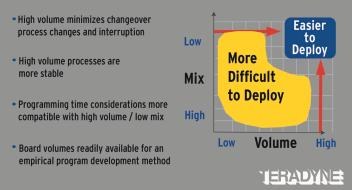
AOI systems are proven to be successful primarily in higher-volume applications, and have in some cases replaced electrical tests where board volumes and process stability are securely established. However, the AOI Achilles heel is deployment in lower volume or moderate mix applications. Where increased process and induced variation are common (e.g. production changeovers), a conventional AOI shortcoming is apparent: needing sufficient board volume and programmer skill to set nominal operating parameters. Such systems use human judgment to establish the programmatic standards for good and bad, and what range should exist around each decision. How good is good enough depends on judgment and initial results. Because conventional AOI systems depend on empirical programming methods, its fitness is established over time and volume, using statistically measured values and volumes as proxies for good and bad. Where unforeseen process variation exists, conventional AOI programming paradigm is challenged to accommodate it. Where time and volume are unavailable to establish these stable test norms, AOI is a challenge to deploy and run effectively.
Conventional AOI faces another challenge in process variation. Once set, traditional AOI thresholds are fixed. As machinery, environment and operators constantly vary, such ‘normal’ variations expose another limitation of AOI – programming thresholds are invariant. As a consequence, when operating or process conditions diverge from the expected thresholds, the generation of false calls or flags (good results being judged bad) occurs. Changes in process that are not already established in the program give rise to false calls. The changeover of production, different component/board suppliers introduce sources of substitutional variances that cause false flags. Such variances are episodic and can’t be easily accommodated in an inspection program a priori. Where volumes are small or board type mix increases, variation exposes the limits of conventional AOI. It requires users to compensate for variation, but the difference cannot be compensated for unless first seen by the programmer. A vicious circle results.
Manufacturers and new product introduction (NPI) centers require a new form of advanced machine-vision systems to adequately replace electrical test, to compensate for the loss of physical access. Smarter machine-vision solutions would allow manufacturers to succeed with smarter, non-invasive alternatives to defect detection, while providing process quality checking to detect error conditions in the first place.
The next generation of optical machine vision must yield solutions that automatically comprehend and compensate for practical day-to-day operation in surface-mount processes. The next generation of systems must embody built-in awareness of a process and its variation, and built-in awareness of the objects being viewed. These next-generation machine-vision systems must replace conventional exhaustive programming efforts eliminating heuristic methods and judgment of the human programmer. The systems need to be equipped with truly automatic solutions that ‘know’ the structure of the objects they inspect, and the context of the objects relative to their backgrounds. Said another way, such systems would replace the domain knowledge today supplied by human programmers with a standardized database/expert system. Such features would reduce or substantially eliminate the requirements for user-skill consistency and experience as proxies for reliable process data.
AOI systems have evolved substantially thus far in their gestation. They are very sophisticated, have a high degree of user flexibility in imaging conditions, possess multiple lighting solutions, multiple angle lights, multiple cameras, and fancy timing and control systems to bring it all together. Knowing how to deploy these hard and software assets is the sine qua non of the next generation of optical systems whose performance will challenge current electrical test methods for efficiency and ease-of-use. A new generation of robust systems must be developed that work in low-volume/high-mix environments, employing far more sophisticated backend analysis of images to compensate for part and process variation. Suppliers are beginning to listen and respond to these needs. Recent developments in machine-vision improvements have come in two basic forms that promise to revolutionize what we call inspection.
One promising method, statistical or appearance modeling, is an automated means to learn and define library entries from good and bad examples distilled from the initial production. The benefit of statistical methodology is to automate the process of defining good and bad, and to eliminate the effort from the user to define good and bad in their own terms or in the terms of the target hardware. Statistical appearance methods allow users to input image data collected during prototype or initial production, and then automatically compile the examples into a composite good or bad database entry. The stored samples are normalized for rotation, size and shape, and collapsed into eigenvectors, a set of internal representations of the collective basis appearances for subsequent use. As other examples of good and bad are collected, the library entries are further annealed to eigenvector entries, which are adjusted for the incremental variations.
Statistical modeling helps AOI by eliminating users having to make manual iterative adjustments to hardware to account for variation. Statistical modeling automates this key step, removing the manual tasks of evaluating the impact and making the manual library adjustments. Statistical modeling also automates the process of comparing new images to stored eigenvector basis vectors, simplifying runtime operations.
A potential shortcoming to statistical modeling is that it is still statistical – that is, it operates based on samples gathered from a larger population, and thus still requires sufficient examples that mimic the larger population to achieve workable library results. As a result, statistical appearance-based techniques for board-assembly verification require substantial sampling to achieve workable (~100 ppm) false flag (call) rates. A second downside is that as statistical appearance techniques depend on initial samples of good and bad assessed by human programmers; there are opportunities where the judgments of good and bad can be in error, leading to errors in eigenvectors, and later coverage or defect detection issues, which may go undetected.
A second promising method, configural recognition, is based on use of combined scene and object recognition. It is detecting objects and scenes made of objects contained in an otherwise ordinary image. Such recognition techniques are based on having defined in advance the spatial relationship and variance allowed in key object regions, and the relationship and gradient of those regions to other key regions in the image. Configural recognition has been integrated into visual search engines and shown to successfully select graphic objects – as in a web search. Its advantage is that the knowledge of what good and bad is pre-exist in the data coded into the application, and are not based on statistical or large numbers of learned or taught examples. Therefore, it operates with comparatively few practical examples, and (in theory) can still be effective with as few as one example. Thus, configural recognition holds great promise for product introduction and low-volume/high-mix applications where volume is scarce or non-existant. Another advantage is that the hardware required is simplified in that only a static fixed light source and camera are needed.
A downside to configural recognition is that it is computationally very intense and until very recently outside of the realm of possibility for low-cost computing. With the advances in speed, multi processing, parallel computing and price/ performance, the method is a near-term reality. A second issue is that it requires that precise process knowledge be delivered in the application.
In a nutshell: AOI is currently enjoying popularity in high-volume manufacturing, and future developments promise extraordinary improvements upon current possibilities. The challenge for suppliers of equipment now is to expand the technological solutions to deliver to the users the true promises of machine vision: ease of use, comprehensive performance and reliable diagnosis.
Anwender von AOI-Systemen kennen das zur Genüge: falsche Fehleranzeigen (false calls), weil sich bei Boards Toleranzen zeigten, die im optischen Inspektionsprogramm nicht berücksichtigt sind. Das führt dann zu so genanntem Programmtuning (Debugging) in ruhigeren Produktionszeiten, um die fehlerhaften Aussagen zu minimieren. Abgesehen davon, dass solcherart verstandene Inspektion größere Produktionsvolumen voraussetzt, ist das permanente Tuning auch lästig und reduziert den Durchsatz. Die nächste Generation von AOI-Systemen soll’s besser können: nämlich mit statistischer Modellierung (statistical appearance modeling) oder Configural Recognition, bei der alle nötigen Daten aus den bereits vorhandenen Bildern destilliert werden.
Les utilisateurs de systèmes AOI connaissent plus que suffisamment les faux signalements de défauts (false calls) dus à des tolérances sur les cartes non prises en compte par le programme d’inspection optique. Ceci conduit à un “tuning“ du programme (debugging) lorsque la production est plus calme afin de réduire les erreurs de signalement. Mis à part le fait qu’une inspection ainsi comprise présuppose des volumes pro-duits importants, le tuning permanent est une opération fastidieuse qui nuit au rendement. La dernière génération de systèmes AOI est sensée y remédier grâce à la modélisation statistique (statistical appearance modeling) ou à la Configural Recognition, avec laquelle toutes les données nécessaires sont obtenues à partir des images déjà existantes.
Gli utenti di sistemi AOI conoscono bene le conseguenze: indicazioni di falsi errori (false calls), perché sono state indicate delle tolleranze delle schede non considerate nel programma d’ispezione ottica. Ciò porta dunque al cosiddetto tuning di programma (debugging) in tempi di produzione calmi, per minimizzare le informazioni erronee. A prescindere dal fatto che un’ispezione così interpretata premette maggiori volumi di produzione, il tuning permanente si rivela anche alquanto fastidioso e riduce inoltre la produzione oraria. La prossima generazione di sistemi AOI dovrebbe essere migliore: infatti, essa si presenta con una modellatura statica (statistical appearance modeling) o Configural Recognition, nella quale tutti i dati richiesti vengono distillati dalle immagini già esistenti.
Interesting discussions of statistical appearance modeling can be found at: www.cs.bu.edu/techreports/pdf/1994-015-search-by-shape-example.pdf and whitechapel.media.mit.edu/vismod/demos/facerec/index.html