Malte S. Fengler, LPKF Laser & Electronics AG, Garbsen (Germany)
In Laser Direct Structuring (LDS) – now the predominant technology for manufacturing MIDs (molded interconnect devices) – a laser beam generates the structures of the planned circuit patterns directly on a plastic component. Copper then builds up on these structures in a electroless metallization bath, followed by other refining surface coatings.
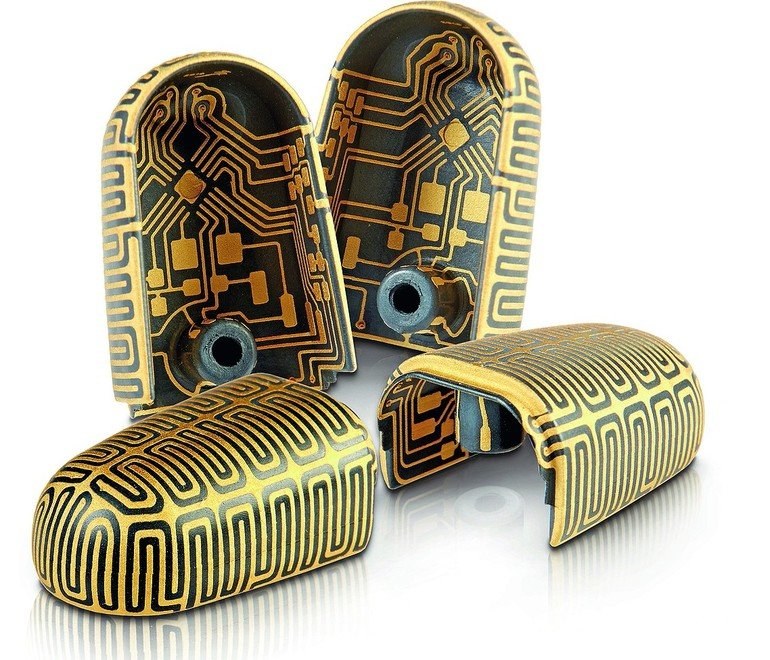
This makes it possible to manufacture circumferential conductor paths or even micro-vias. One good example of the potential for complexity is the sensitive robotic fingertip produced as part of a research project by CITEC (Bielefeld University) that identifies forces and their direction. On the inside, the detected forces are processed electronically and transmitted to analysis software. The size is approximately that of a human fingertip – even so, twelve sensory fields work together here to identify the force, its direction, and how it changes over time.
This generally requires the LDS additive to be distributed in the plastic uniformly and at a sufficient concentration. A wide laser process window, good metallization suitability, and reliable bond strength are the criteria that need to be met by LDS plastics if they are to be approved by LPKF. Currently, a selection of more than 80 LDS materials from nearly 20 well-known, globally operating plastic manufacturers are available to product developers. The portfolio ranges from impact-resistant PC and PC/ABS types – primarily used for antennas in the telecommunications sector where good RF performance is important – to special polyamides with very high mechanical rigidity levels for structural components and materials with a high resistance to heat, such as LCP, PEEK, or PEI for lead-free soldering. Thermosetting plastics capable of LDS are being developed today that can be processed in injection molding and exhibit excellent thermal stability and adjusted low coefficients of thermal expansion (CTE). Thermosetting materials have great potential for complex fine pitch applications and make LDS parts increasingly reliable thanks to sealed encapsulation by overmolding technologies (housing).
The material pyramid shows the wide selection of commercially available materials that users have for a great many different applications and requirements. Today, colors and property profiles are only a matter of choosing the right material. And the portfolio of new LDS plastics is constantly growing.
One new development, for instance, is special thermally conducting polyamides that are suitable for LDS and therefore of particular interest, especially for the rapidly growing LED market. In general, plastics function as thermal insulators that, unlike metals, permit very little heat transfer or dissipation. Modifying them with special additives makes it possible to increase their thermal conductivity considerably. Thermally conducting LDS materials thus close the technological gap between standard LDS plastics and LDS Powder Coating developed by LPKF, helping, for instance, by systematically dissipating lost heat generated in the LEDs throughout the component body. This makes the development of new cooling concepts for LED MIDs possible.
The pioneering work for this was done by Mitsubishi Engineering Plastics (MEP), which introduced two materials with conductivity values of up to 5.1 W/m·K. What is more, the two grades, XHP2082ET and XHP2084ET, are available in white, which can lead to further advantages for LED applications, such as when used as reflectors. Both varieties are based on the well-known MEP type Reny XHP (PAMXD6), which is also very thermally stable and suitable for both reflow soldering processes and vapor phase soldering.
Other additions to the portfolio of thermally conducting LDS plastics are Ensinger’s new Tecacomp LDS PPA TC and a material from Singapore-based Polyone Corporation’s Therma-Tech PA6 serie (TT6000–8709 EI LDS).
The Swiss polyamide specialist, EMS-Chemie AG, recently began offering an LDS-capable high-temperature polyamide (Grivory HT XE 11015 LDS black 9511) that stands out due to its high degree of mechanical stability, good plasticity, and a comparatively low coefficient of thermal expansion – properties that are particularly relevant for complex MID components in microelectronics. Together with a new LCP variety from Ensinger GmbH, Grivory HT XE 11015 joins the ranks of LDS high-temperature materials, along with Vectra E840i LDS (Celanese), Stanyl ForTii (DSM), and Vestamid HTPlus (Evonik).
Ensinger’s new Tecacomp LDS LCP expands the supplier portfolio of the popular material, thereby supporting the material procurement situation for LCPs suitable for LDS. PTS Creamid takes a different tack for when there are special thermal stability requirements. LPKF, Norwe, LaserMicronics, and PTS Plastic Technology Service have researched the suitability of radiation cross-linked polyamides in a joint project and have designed them as temperature-resistant injection molding bodies for producing spools – with good success. After radiation cross-linking, the components can withstand soldering temperatures of up to 400 °C for three seconds. Meanwhile, the joint experiment has led to several Norwe series components that offer high coplanarity and good solderability.
All materials have been tested by the company for metallization suitability and adhesiveness and can be found on the current LDS Approval List.