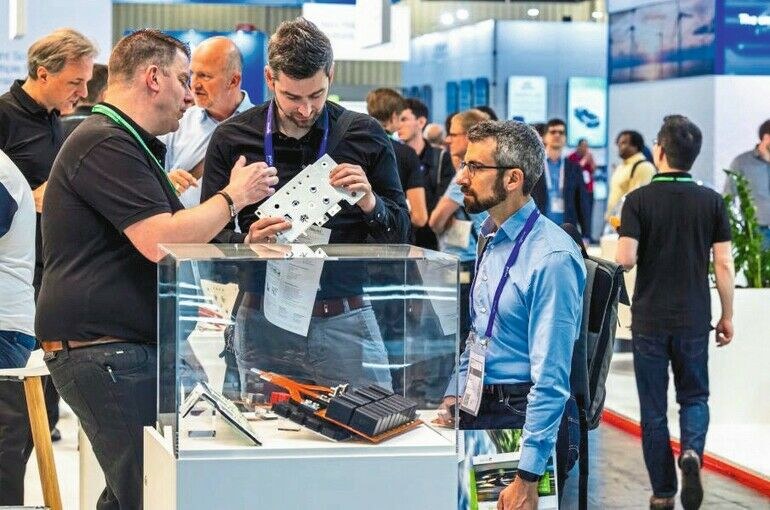
By bringing experts from around the world into its varied program, the expo aimed to help advance forward-thinking developments in the industry. Taking place across 40,000 m2 of floor space and hosting more than 650 companies from 31 countries, it brought to the forefront the newest advancements in the fields of power electronics, intelligent motion, renewable energy, and energy management, but also tried-and-tested technologies that have helped to bring greater efficiency to manufacturing processes. A key goal of the organizers was to provide a glimpse into the future of power electronics manufacturing. They did so by bringing the most innovative trends and solutions under one roof, combined with a conference program informed by industry and academia.
Among the exhibitors were established solution providers such as Onsemi, Mitsubishi, Semikron Danfoss, and Wolfspeed. An array of newcomers—including bdtronic, Infotech, and Endrich Bauelemente—helped to round off the offering and forge new connections. This year’s edition of the event featured two new halls, where products from industry giants such as Toshiba, Novosense, Microelectronics, and Renesas Electronics were on show.
Reflecting technological advancements
Aiming to encourage and spur technical progress and provide a platform for the sharing of ideas, the expo conference program featured an extensive line-up of presentations across three stages: Exhibitor, Technology, and E-Mobility and Energy Storage. The Technology stage featured presentations such as “Lateral, Vertical, Bidirectional! Innovations and Progress in GaN Devices and Power ICs” by Fraunhofer IAF, and experts from Infineon Technologies expounded on the benefits of vertical power delivery in artificial intelligence and GPU applications. Furthermore, technical talks and podium discussions enabled attendees to engage directly with the experts. The presentations on the Technology and E-Mobility & Energy Storage Stages were recorded and have been made available on the event website.
Additionally, the event featured a University Research Zone offering exclusive access to the most recent scientific findings in power electronics. Each day, a different university was featured, presenting the most current projects and providing insights into related developments. Participants included Aalborg University in Denmark, the University of Stuttgart in Germany, and Teesside University in the UK. Current research findings in the field of sustainability presented by the University of Innsbruck in Austria were particularly well received.
Future-oriented innovations
The accompanying PCIM Conference once again provided a platform for promoting exchange between the realms of industry and science. More than 400 first-time publications gave attendees the chance to gain in-depth insights into the latest breakthroughs in power electronics and first-hand knowledge of current scientific advancements. According to the organizers, this strategy of knowledge transfer continues to play an instrumental role in driving and influencing progress in the sector.