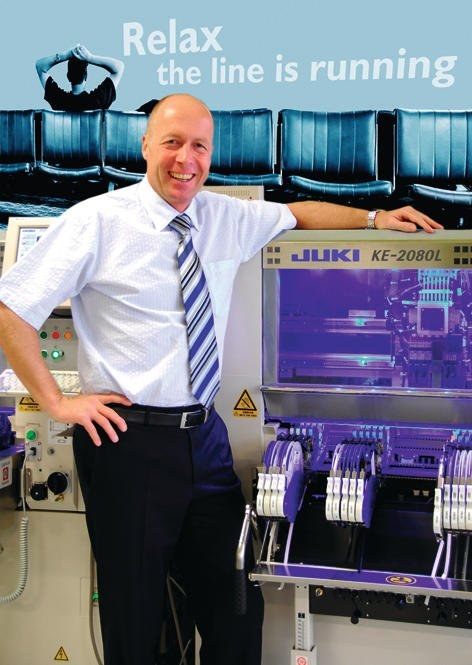
We talked with Juki Europe CEO Jürg Schüpbach about “Why Juki?” Do you agree with the first statement regarding the future challenges?
In today’s electronic market the margin gets smaller and smaller for our customers, especially in the EMS business. This means a production line has to be more cost effective from the initial investment through to operation and support with the minimum of manpower whilst also to producing top quality product. For example, repair work is prohibited in a wide part of automotive production, and is of course extremely expensive. Juki concentrates on the core business of the pick and place process and has been known for many years to have reduced the cost of production by regularly introducing systems with improved price/performance ratio and optimized process tools. Intelligent machine and feeder systems are a standard in today’s world and to attack above subjects we always strive to improve the systems.
What is Juki’s general strategy regarding their product portfolio for the next two years and beyond?
Juki will further expand their product portfolio. Five fully compatible product lines are currently available to cover the requirements of customers both with lower production needs and also in the high speed advanced segments. We have further expanded the portfolio too; it also covers super high speed demands as well as being able to offer some specific needs such as semiconductor, LEDs (with very long boards) and even pick and place processes not directly related to SMD. For example we will shortly introduce systems to cost effectively automate Manual Insertion of parts and processes.
Do you have any specific areas where you plan to intensify Juki’s efforts?
There are many different areas. As an example I would specifically like to mention the Sentry system; our current focus is on the integration of the Sentry system inside the pick and place process. The system was presented to the public for the first time at productronica 2011 in Munich and will guarantee a zero defect production. It is a combination of two parts. The first is the EPV system, which records picture images of the pick and place process in real time. The information is used for picture traceability and most importantly, if there is a process problem, it enables the operator to go back and check what happened during the pick and place process of a certain component and to quickly adjust it. The second part is the SIM. SIM is an integrated placement quality control system which will prevent boards with any error from being passed through to the reflow oven.