Assembléon Netherlands B.V., Veldhoven (Netherlands)
HPI Electronics supplies a complete PCB and equipment design, prototyping and manufacturing service for OEMs, is a leading Danish electronics contract manufacturer and increasingly a major force in Europe. Applications cover consumer to telecoms, industrial, medical, automotive and security equipment. So, the company has to deal with the broadest range of circuits – from analog to embedded systems and digital interfaces, power management systems, and wired and wireless communication.
That variety of equipment demands a tremendously wide range of components, from transformers and large connectors right down to micro-miniature 01005 chip components and 0.3 mm pitch CSP devices. The pick & place equipment must handle all these, but so too must the screen printer up front in the production line. Three quarters of manufacturing defects can come from faulty solder deposition. The different sizes of components need very different – and consistent – amounts of solder paste to ensure 100 % reliable connections for several thousand joints on a PCB.
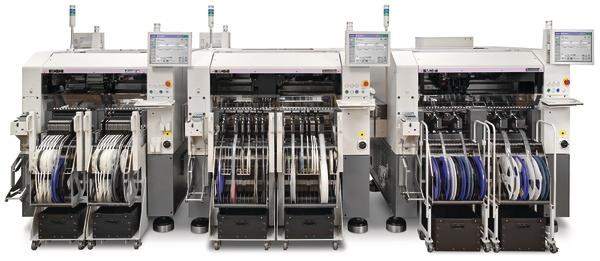
These were issues facing HPI when it recently upgraded its production facilities. It was faced with increasingly complex production requirements and ever wider component mixes. To handle the various high-quality requirements, the company decided on Assembléon’s MCP screen printer followed by a high-mix medium-volume pick & place line with an MC-1, MC-8 and MC-12 from Assembléon’s Modular Compact range.
“We already used Assembléon machines, so our staff is familiar with the user interface”, said HPI’s CEO, Gert Nielson. “The equipment is easy to set up and use, and gives us all the capacity we need with very low lifecycle costs. We already have experience of Assembléon’s excellent after-sales service. They have helped us to increase our business share over the last five years, and we felt our purchase will continue to give us a significant competitive advantage over at least the next five years.”
As the first major assembly stage, stencil printing is also the most critical. With component solder lands and the resulting screen aper- ture sizes becoming smaller and more closely spaced, additional factors start to affect solder paste deposition. Too little or too much solder can mean rework, which is getting more and more difficult and expensive for each new generation of equipment assembly.
The tiny volumes of solder that make per- fect connections for ultra-fine pitch printing need high and constant solder transfer effi- ciency. Even the smallest process variations can have major consequences. In particular, as the pitch and aperture openings of stencils decrease, squeegee blade angle and speed become significant. Assembléon’s MCP screen printer has an innovative head design with variable attack angle printing, allowing it to maintain constant solder pressure independent of the stencil thickness.
That significantly improves the repeatability of paste deposition for micro-miniature components like 01005 (0.4 mm x 0.2 mm) chips. It produces perfect solder shapes with stencil thickness down to 50 µm and half edging stencils with stencil steps of 30 to 50 µm. PCBs can mix 01005 chips with larger components.
A fast wet or dry vacuum cleaning system operates during the PCB transport cycle, minimizing the impact on tact time. A high-speed digital inspection camera scans the printed PCB, detecting excess or insufficient solder and bridging, and eliminating them from production. The system also has a unique feature that keeps the stencil from shifting during the print stroke, allowing better print repeatability on any board, even on FlexFoil flexible printed circuits. The stencil is secured on each side of the board during the print stroke, holding the stencil in place and not allowing it to slide on the board.
The single-head system also allows easy setup, and greatly reduces maintenance. It is the first printer to match the high quality of pick & place equipment, reducing manufacturing faults to near single-digit defects per million. With a board cycle time as low as 11 seconds, the system is also the first stencil printer to match the high throughput of today’s pick & place machines.
The new pick & place machines are HPI’s third generation of Assembléon equipment, replacing the Orion, Emerald, Topaz and Opal – the previous mid-volume generation. HPI is in fact a long term Philips customer – starting off some fifteen years ago with the Philips CSM60. The EMS vendors MC-12, MC-1 and MC-8 combine to give fully balanced production with a total of up to 69 k components per hour (Figure 3). The MC-12 is used for chip shooting, with the MC-1 as an IC shooter. These handle all the common packages including Quad Flat Packs, Ball Grid Arrays and Multi-Chip Modules. Alongside any remaining chips and ICs, the MC-8 places special and odd-form components like press-fit through-hole connectors with variable placement force up to 30N.
The line has amongst the world’s highest productivity/floorspace. The MC-12, for example, produces 36 k cph from just 2 square meters. It has up to 120 ultra-thin feeders, and takes components up to 100 mm x 45 mm x 25.5mm and boards up to 700 mm x 510 mm (more than double A3 size).
Placement accuracy is 50 microns for chips and 30 microns for QFPs. The company needs that accuracy for placing devices like Systems in Package (SiPs) with 01005 components for Bluetooth and other advanced modules. Automatic accuracy temperature compensation ensures that environmental changes have no influence on mounting results.
“As a contract manufacturer, we of course have many New Product Introductions”, remarked Nielson. Offline and online software on the machines shortens the time from CAD to production. On–machine or scan teaching of PCBs without CAD data simplifies program generation. We find it easy to teach the system how to handle new components. From around 200 different components on a line, we are expanding that to 340 or more. Fast changeover is very important, particularly with single-batch runs for prototypes. The MC machines integrate with our MES software to improve manufacturing efficiency and perform tracking and tracing.”
SMT/Hybrid/Packaging
Stand 7-325
www.hpi-electronics.com
HPI Electronics, ein EMS-Dienstleister aus Dänemark mit einer Highmix-Produktion, verwendet in seiner Fertigung Schablonendrucker und Bestückungsautomaten von Assembléon, um seine Kunden stets zuverlässig und mit höchster Qualität beliefern zu können.
HPI Electronics, un prestataire EMS du Danemark, utilise dans sa production des imprimantes sérigraphiques et des automates d’alimentation d’Assembléon afin de pouvoir fournir en permanence une qualité élevée à ses clients, malgré une production highmix.