The requirements for mobility are changing worldwide. Electrification and automation of vehicles lead to high demand for cost- and performance-efficient materials. These are required to meet the increasing need for safety and support systems such as advanced driver assistance systems, increasingly intelligent control units, as well as in-car entertainment systems. The increasing demand is accompanied by harsher requirements for components and materials as well as TCO challenges.
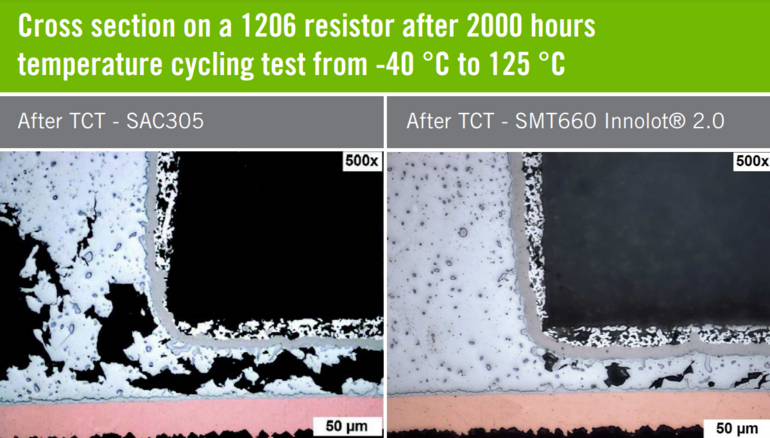
With its new solder alloys for automotive applications, the introduces the ability to maintain a competitive Total-Cost-of-Ownership, while fulfilling emerging requirements. The new alloy offers reduced cost while maintaining the well-known features of higher creep resistance, resulting in longer product life cycles at higher operating temperatures. It also performs in the air without additional N2 during reflow, while keeping defect rates low, reducing your TCO.
The new material uses an acrylic based synthetic resin eliminating potential batch-to-batch variations when using natural raw materials. Due to its low impurities and the flux design, a high SIR performance is achieved. As a result, SMT 660 reduces the risk for electrochemical migration.