From its formation 27 years ago, JJS Electronics has established a fine reputation for its electro-mechanical and system integration capability, notably working on high profile mechatronic assemblies – a process that demanded key electrical and mechanical skills, along with wiring and fitting expertise. The company enjoyed considerable success during the late 1990s and into the new millennium.
Then, according to Head of Engineering Russell Poppe, about 12 years ago customer requirements changed and an increasing need for surface mount circuit boards became apparent. “As an organisation committed to meeting its customer’s needs, we identified that there was a requirement for more technology to address increasingly complex boards and, as a result, invested in new process technologies and increased capacity. We selected a DEK 265 printer and a Mydata placement machine as the heart of the SMT capability and began to attract new business.” In addition to its investment, the JJS team identified growing industrial sectors for superior EMS services. In addition to its industrial customers the company started to attract business from a broader range of markets including test & measurement, communications, medical, automotive and defence. “Nowadays, for some we just manufacture SMT boards; for others we manufacture boards and then integrate them into products that we build and test for them, and in some cases ship direct to their customers,” says Poppe.
In 2005 the company established a manufacturing facility in the Czech Republic. “We wanted to be able to provide our customers with a best of both worlds service through dual manufacturing facilities in the UK and the lower cost region of central Europe,” says Poppe. Interestingly, the company remains highly active in the cabinet build and system integration business, and much of this work is now handled in the Czech plant. “Integration is typically a high labour content process and so our Czech facility offers the optimum base for this type of activity,” Poppe explains. “We have been delighted with the availability of skilled labour and their work ethic.”
The next major event was the acquisition in July 2007 by The Paragon Electronics Group. The company ideally complemented the market-leading supply chain management services capabilities of Paragon. With the full support of Paragon, and despite the world economic forecast looking bleak, the management team took the confident decision in 2008 to re-invest in SMT equipment to further enhance capability and capacity. Russell Poppe drove the investigation into new capital equipment. “Naturally we looked at a number of vendors for every part of the assembly process. Of course, already having DEK and Mydata equipment on site, and the fact that both have performed excellently, did give those suppliers an edge,” explains Poppe. Included in the screen printer appraisal process were other well-known vendors and a Chinese import which, according to Poppe “Was ‘inexpensive’ to say the least”. Poppe recalls the management conversations at that time: “Quite rightly there was lots of discussion. The Chinese printer appealed to the accountants and someone was even heard to suggest that ‘a printer is just a printer!’ But my take was that with screen printing being the first critical part of the SMT assembly process, we needed to invest in the most proven and reliable system we could identify.”
JJS opted for another Mydata placement system and a new DEK Horizon 03i screen print platform. Shortly after, the company appointed Nigel Burton as Principal Process Engineer. Burton has a distinguished background having previously worked at a broadcast and film post processing specialist company, and was pleased with the decision in favour of the Horizon printer. Having worked before with DEK printers he has first-hand experience of the level of technical support provided by DEK. “Support is a key factor in equipment utilisation and in addressing new packaging technologies as they come along,” Burton claims. “The evidence of support from other printer suppliers was not sufficiently convincing, particularly those from overseas, and none could offer premium stencils as part of the package,” he adds.
Burton cites one primary example of vendor technical support leading directly to greater productivity. Early in his mission, he identified a print process shortcoming that he attributed to the stencil. The issues included inconsistent joints and short circuits post-reflow. With his stencil materials experience and knowledge of stencil aperture ratio formulae, he was able to redefine the company’s stencil rules with support from DEK. Burton introduced DEK VectorGuard lasercut stainless steel and some e-formed nickel stencils for boards requiring finer apertures to ensure better paste release. More importantly, Burton points to the fact that he has ‘offloaded’ JJS’s stencil responsibility back to DEK. “Doug Black (UK Stencils Operations Manager) at DEK now owns and manages the JJS stencil rules document, and we get the benefit of all that expertise,” says Burton happily.
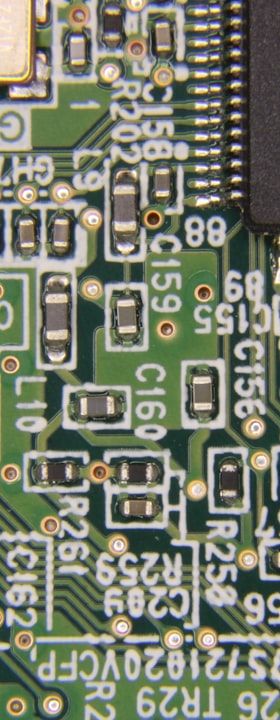
“We are now successfully producing boards that JJS couldn’t have begun to manage three years ago,” Burton claims. The boards now regularly running down the assembly lines include BGAs, LGAs, 0201 passives and an increasing number of heterogeneous boards featuring ultra fine pitch spacings alongside large pads for components like connectors and displays. “This kind of mixed technology on a single board is an increasing challenge for all SMT assemblers,” Burton believes.
An example is a recent board from a new customer featuring fine pitch components and a USB connector that requires substantial anchor points. Burton again collaborated with Doug Black at DEK to produce a stepped stencil, which features different stencil thicknesses across its surface to allow the print process to deposit sufficient paste for large devices while retaining stringent control over the precise volumes needed for fine pitch components.
One of Burton’s early initiatives at JJS was to upgrade the new Horizon platform’s manual tooling to High Density Grid-Lok automatic board support system. Part of the justification for Grid-Lok was the number of double sided boards the company now deals with; the other was to improve factory-wide productivity. With typical batch sizes of 10 to 20 boards and a maximum of around 200 boards, product changeover is a regular feature of the production. The result is changeover on each line in less than 30 minutes – helped by Grid-Lok’s instant electro-pneumatic pin array and the capacious inventory of the Mydata intelligent feeders.
Burton sees his task as ongoing. He says today’s status sees SMT capability at JJS in various stages of process development and refinement, and his focus is on right-first-time quality: “Many more pass test first time,” he reports. His assessments reveal an end-to-end line improvement of at least 50%. His emphasis on quality is designed to increase yield and, more critically, reduce rework. Both Burton and Poppe agree that rework is expensive and risky. Burton points out that the Mydata systems physically and electrically verify every component prior to placement “Which essentially eliminates the possibility of placing the wrong device, even if a rogue component gets onto the reel. So that’s sorted.” Similarly, a new over profiler successfully addressed reflow issues. But all SMT process engineers know that screen printing still presents the most opportunities to introduce faults, so it’s here that Burton and his team are focused – committed to delivering the perfect print.
“Traceability is no longer desirable, it’s expected,” claims Poppe. One of the leading exponents of traceability is our sister company Paragon, which delivers full traceability to component level as part of its kitting service. Similarly, the company introduced a factory-wide traceability programme late last year alongside a new paperless production control system. Both have proved successful and valuable. “Every board is bar-coded and scanned at each stage of production. Our customers can now prove traceability back beyond board level,” Poppe states.
Alongside all of this activity and investment in the SMT manufacturing area, the company has also been enhancing its Quality Management Systems. As part of the company’s World Class Initiative launched in mid 2009, they embarked on a company-wide quality tools training programme. Members of staff across the business have received training on a variety of tools and techniques including SPC, FMEA, 8D and Six Sigma. Poppe explains, “The World Class Initiative has led to new people, new processes and a lot of training, and as part of this we have been working to implement the AS9100 standard. I would say that we are now two-thirds of the way through and are confident that we will be in a position to announce full accreditation at the end of the summer.”
In the medium-term future, Poppe is working on the company’s New Product Introduction (NPI) capability and recruiting for the SMT Section. With its new equipment and improved process productivity, JJS can turn around boards promptly. So Poppe is set to introduce a fast response, fast-turn service but recognises the obligations that come with the territory. “Up-front engineering is more critical with NPI, as is efficient testing,” he explains. “Design for Manufacture (DFM) is important, and we can help with that – it’s something in which we already engage for existing customers. We make things easier to build by advising on board design and layout for optimum manufacture. Who better to do this than the organisation that will assemble the board?” asks Poppe rhetorically.
JJS already undertakes prototype and pre-production projects. To turn this into a full-service NPI provider, Poppe is adding logistics handling and looking to make more investment in test. “We are adding flying probe test, then enhancing our Boundary Scan capabilities, then adding some VXI/PXI functional and system test tools,” he reveals. Burton comments: “Ultimately, I see the NPI Section deploying a compact line comprising some of our existing SMT equipment with a shiny new production line right behind it,” he says enthusiastically. Russell Poppe would not be drawn on the detail – but it would appear that JJS customers can expect to see an exemplary NPI capability pretty soon. Looking back at how they have advanced over the past three years I wouldn’t doubt that they will deliver that for a minute.
www.dek.com; www.jjselectronics.com
JJS mit Firmensitz in Großbritannien und Werken in Mitteleuropa bietet einen vollen EMS-Dienstleistungsumfang mit Testentwürfen, Produktion und Montage von Leiterplatten, eingebauten Anlagen und Vorrichtungen, mechanischen Montagen und Montagen kompletter Systeme. Dank einer vorausschauenden Strategie und Investitionen hat man heute volle Auftragsbücher.
L’entreprise JJS, qui est basée en Grande-Bretagne et possède des sites en Europe centrale, offre un large éventail de prestations EMS avec ébauches de test, production et montage de circuits imprimés, installations et dispositifs intégrés, montages mécaniques et montages de systèmes complets. Grâce à une stratégie et des investissements tournés vers l’avenir, l’entreprise bénéficie aujourd’hui d’un carnet de commandes plein.