David Owen and Bob Stasonis, Pickering Interfaces, Clacton-on-sea (UK)
Like other ecosystems, platforms evolve and often replace other platforms. The reasons for changing could be a simple obsolescence – the instruments and switching systems are no longer available.
Maybe software drivers for newer programming environments are not available. Upgrading a test system to accommodate new test programs – perhaps the original instruments don’t have the bandwidth or the switching system is not expandable to address new needs. Size and ease of use – adapting older platforms to address new needs, or taking a platform that does not lend itself well to a new application could create a system that is physically too large, which can be potentially unwieldy. In addition cabling must be considered – will the platform create interconnection issues that can effect reliability and add cost? And the price, management may require change to address a smaller budget – as profit margins get squeezed, test needs to adjust as do other areas of manufacturing. In many cases, the above considerations suggest a hybrid system is called for.
In upgrading an existing system, it might be impractical to replace the entire system with a new design – so for example, replacing the obsolete portion of the test system with a new instrument would be the pragmatic thing to do. New designs might call for several different platforms to work together – reasons include selecting the best instrument for the job, a switching platform that is more flexible for the application, and even utilizing surplus test equipment in stock to save on new capital investment. Fortunately, standardized test platforms are designed to work with other platforms. Software programming environments also feature tools to support multiple platforms – good drivers from the instrument vendors would be a help here as well!
The following applications talk about companies that made changes in strategy and incorporated LXI in their test strategy. In the case of this article, the LXI choices were all switching systems. There are an equal number of examples from other manufacturers that show migration of test systems to different platforms, incorporating a hybrid test strategy. In each case, there is either a change of or a migration from one platform to another – either partial or in its entirety. In many cases, the end result is a hybrid system with platform combinations using GPIB, VXI, PXI, and LXI instruments and systems.
The conclusion is that you need not limit your test strategy to a single platform, and hybrid systems should be considered to normal good practice in some applications. The focus here is LXI, but each test platform has its strengths and weaknesses – as does your unit under test – and you need to balance budget, specs, and size against your test plan.
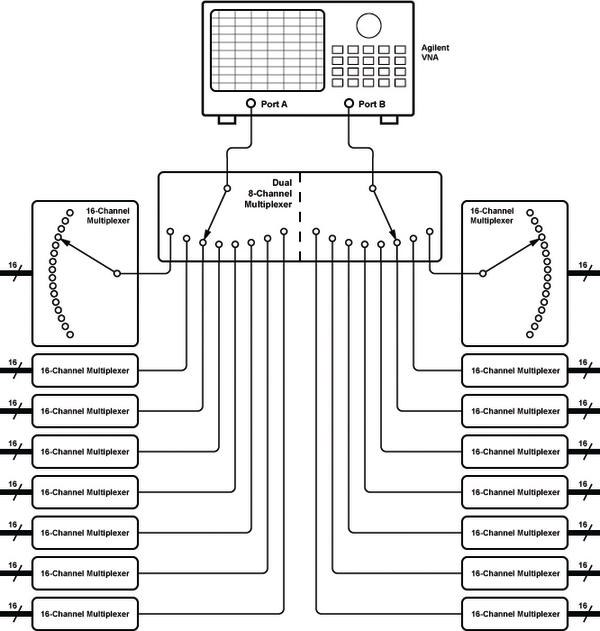
The costumer, a leading aerospace company, needed to replace an existing dual VXI 90 channel RF multiplexer switching system used for testing PCB backplanes. The multiplexers were used to multiplex a VNA to characterize different paths on a PCB backplane. Not only was the VXI platform large, it is also expensive. A modular LXI solution was proposed which gave the customer the flexibility to change the size of the multiplexers by just adding or removing a module from the chassis. An evaluation unit based on 7 slot LXI chassis with a 16×1 PXI mux was provided to back up technical discussions and it proved to be ideal for the application. For the application, the customer is using an LXI based VNA and one 18 slot LXI chassis with sixteen 16 x1 mux modules and one dual 8×1 mux allowing for two 128×1 multiplexers for connection to each port of the VNA. The use of LXI here provided a system that was much smaller than the existing VXI system and at a lower cost. A leading Integrator for Aerospace applications who provides functional testers for Civilian and Military Aircraft needed to replace an old specific VXI system by a generic tester which could test a range of cards for several different aircraft ECUs. This system required more than 9000 points of switching to test all the different cases. Covering a large variety of applications with a single tester is more economical than creating several smaller testers, and logistically easier to manage. One of the main objectives was also to reduce the size of the full cabinet and the quantity of cabling in order to get the best flexibility and repeatability at a competitive price.
Despite the fact that the customer was attracted by PXI modularity and effectiveness, the customer came to the conclusion that building a tester with 9000 points of switching would be less effective, labor cost would be higher and it would take much more space than a LXI solution. A PXI solution for the matrix switching part would require more than 18 PXI cards with 512 relays and many cabling connections between the modules to implement the full matrix. For this application, the customer has used a PXI chassis for all the instrumentation resources (DMM, Serial, Scope, DIO and Avionic cards) and six LXI 64 X 24 Matrix modules configured as a 384 X 24 using integral loop thru connections that were designed into the matrix – again, the mechanical freedom of LXI allowed the designers to add loop through connections which greatly simplified the cabling compared to a PXI solution. The resulting system has much less cabling with better performance than the original VXI system and is an example of a user selecting two different but complimentary platforms (PXI and LXI) to implement different parts of the system to obtain the most effective test solution.
A large manufacturer of private aircraft was in the process of streamlining their test process of various Aircraft Electronics subassemblies. The plan was to replace many separate test systems with one common core tester. To achieve this, it was realized that a large matrix would be able to configure multiple instruments and test hardware, allowing for a single test system. This would save bench space, reduce the number of wire bundles as the unit would have a universal connector, simplify test procedures, and reduce maintenance in the long run. It was determined that the matrix needed to be a configuration of 100 X 100, and carry voltages up to 250 VAC at a maximum of 2 Amps. Bandwidth was not critical as the highest frequency would be about 100 KHz for the ARINC Serial busses. Initially the customer looked to a solution in PXI. That was dismissed for several reasons. First, the form factor limited the number of relays per module, which meant that the systems would require four PXI Chassis, creating a test system that was 18 U high. Second, the custom cabling to interconnect the modules and create the large matrix would be very complex and expensive. In the end, the customer chose Pickering Interfaces and purchased four 50 X 50 matrix with easy to use loop through connections to allow for easy expansion. The total system was only 4 U high versus 18 U for a PXI equivalent. Four low cost loop-through cables interconnected the X axis’ and Y axis’ together to achieve the 100 X 100 configuration. The end result was about 40 % lower in cost than the PXI solution and less than one quarter the size.
Aviation application for systems integrator in France supporting a major airline. After a specified number of flying hours, every airplane, be it private or commercial, has to be dismantled and fully checked to ensure it continues to be airworthy. A commercial airplane company required a switching system that would provide the ability to test for continuity and insulation integrity of cables in the entire aircraft. Insulation tests needed to be performed at voltages up to 1 kV. The switching system used for the test had to support cold switching at 1kV and also be suitable for use with low voltages consistent with continuity testing. The switching system needed to be an 800 X 2, 2-pole matrix. The first approach was based on GPIB backplane chassis with several switch cards using high voltage Reed Relays. This solution was much too expensive and occupied more than 18U of rack space. There was also a solution based on the use of PXI modules. The PXI solution required 4 chassis since 52 PXI cards were required, the 4 chassis needing around the same rack space as a GPIB solution. The end cost of the PXI solution was also prohibitive. Pickering Interfaces proposed an LXI solution to reduce both the cost and space required. The application required a great number of crosspoint switches and LXI solutions are much more effective at implementing these large matrix systems because of the lack of restrictions of the mechanical aspects when compared to modular solutions. With no LXI solution in the market, Pickering Interfaces decided to develop a standard product for this type of application. A 2U box with 3 density options at 100×2, 200×2 to 300×2, each with 2 poles, was developed. The entire system was implemented in 6U of rack space. The system could be implemented using just three 2U LXI Devices to construct a 800×2 2 pole matrix with simple and cost-effective inter-Device cabling to link the products. This solution was 30% cheaper than the alternatives and occupied just one third of the space of alternative approaches.
As you can see, many platforms were possible – some were rejected for technical reasons and others for commercial reasons. Where it made sense multiple platforms were selected in the test system to provide the best systems level performance and effectiveness. So as you plan your next test system, or assess the requirements for an existing systems upgrade, look at LXI where it makes sense. Don’t discount other platforms either and don’t be nervous of mixing them together. Your hardware and software vendors should be aiming to support all of the platforms relevant to their business. As a vendor of many platforms, Pickering Interfaces believes in “survival of the fittest” – and the fittest will depend on the application. Just as in the biological world, one species does not succeed in all locations and environments; the same is just as true with most test platforms. More than one test platform is often needed to make an efficient test ecosystem.
Im Test- und Prüfbereich gibt es viele Plattformen wie GPIB, VXI, PCI und LXI. Der Artikel bespricht deren Einsatz und Verwendung für einen wirtschaftlichen Test. Der Fokus liegt auf Verfahren mit verschiedenen Testsystemen, denn oft ist mehr als ein System für einen effektiven Test notwendig.
Il existe dans le domaine des essais et des tests de nombreuses plateformes telles que GPIB, VXI, PCI et LXI. Cet article traite de leur utilisation pour réaliser des essais économiques. Il se concentre sur les procédés utilisant divers systèmes d’essais car il est fréquent qu’il faille plus d’un système pour réaliser un test efficace.