Moisture-sensitive components are, for example, thin fine-pitch devices and field-arrays packages. Their sensitivity in regard to moisture is a subject that has to be understood clearly for board assemblers. When plastic-molded components are exposed to the elevated temperatures (about 220°C and even more in the case of lead-free processing) that occur during reflow soldering, moisture trapped inside plastic-molded SMDs (surface-mount devices) produces plenty of vapor pressure to damage or destroy the package of such an IC or chip component. Common defect varieties include internal separation (delamination) of the plastic from the die or lead-frame, wire-bond and die damage. Very often, internal package cracks do not extend up to the component surface, so that they do not become optically visible; nevertheless, the device is erroneous. Under forceful conditions however, coarse cracks will extend up to the component surface, and in the most severe cases, the component will bulge and pop (commonly known as the popcorn effect).
Dealing with these problems, the IPC organization released the IPC-M- 109, the Moisture-sensitive Component Standards and Guideline Manual. In order to avoid difficulties with moisture sensitivity, the study of this manual seems a necessary and successful task. It includes a range ofsingle documents which are listed in the following (note that the US-preferred acronym PWB stands for printed wiring board – just the board assembly):
• IPC/JEDEC J-STD-020 – Moisture/ReflowSensitivity Classification for Plastic Integrated Circuit (IC) SMDs
• IPC/JEDECJ-STD-033 – Standard for Handling, Packing, Shipping and Use of Moisture Reflow Sensitive SMDs
• IPC/JEDEC J-STD-035 – Acoustic Microscopy for Non-hermetic Encapsulated Electronic Components
• IPC-9501 – PWB Assembly Process Simulation for Evaluation of Electronic Components (Preconditioning IC Components)
• IPC-9502 – PWB Assembly Soldering Process Guideline for Electronic Components
• IPC-9503 – Moisture Sensitivity Classification for Non-IC Components
• IPC-9504 – Assembly Process Simulation for Evaluation of Non-IC Components (Preconditioning Non-IC Components)
In turn, with the publication of these current standards, the old document relating to the moisture sensitivity of components, IPC-SM-786 (Procedures for Characterizing and Handling of Moisture/Reflow Sensitive ICs), no longer is appropriate. We will therefore clarify in short what meaning the new standards have for practical aspects on the electronics shop floor.
IPC/JEDECJ-STD-020 defines the classification procedure for moisture-sensitive components which are hermetically sealed in packages made from moisture-permeable materials such as plastics or comparable materials. The process includes exposure to reflow-soldering temperatures followed by detailed visual inspection, scanning-acoustic microscopy, cross-sectioning and electrical testing.
The verification results are based on component-body temperature, because the plastic molding is the main concern. The standard reflow temperature is defined with 220°C (+5K/-0K). But experiments revealed that small-volume components reach temperatures as high as 235°C, as the board is temperature-profiled for large-volume components. When the higher temperature is possible, as would be the case on boards that contain both small and large-volume components, a reflow temperature of 235°C is recommended for the evaluation. Reflow equipment that is convection-dominant, infrared (IR)-based or operating with the vapor-phase principle can be used, as long is it can achieve the desired reflow profile according to J-STD-020.
The eight moisture classifications and different floor life levels are listed in the following. (For details regarding soak time criteria, reference J-STD-020.):
• Level 1 – unlimited floor life at less than or equal to 30°C/85% RH
• Level 2 – one year floor life at less than or equal to 30°C/60% RH
• Level 2a – four week floor life at less than or equal to 30°C/60% RH
• Level 3 – 168 hour floor life at less than or equal to 30°C/60% RH
• Level 4 – 72 hour floor life at less than or equal to 30°C/60% RH
• Level 5 – 48 hour floor life at less than or equal to 30°C/60% RH
• Level 5a – 24 hour floor fife at less than or equal to 30’C/60% RH
• Level 6 – time on label floor life at less than or equal to 30°C/60% RH
(Note for level 6 that the components must be baked before use, and reflowed within the time limit specified on the moisture-sensitive caution label.) Weight-gain analysis (reference J-STD-020) establishes an estimated floor life, and weight-loss analysis establishes the bake time required to remove excess component moisture.
J-STD-033 provides detailed information regarding bake temperature and time, and it also offers recommendations for handling, packing and shipping procedures of those components. The emphasis is on packaging and preventing moisture absorption; baking or desiccation should be used as a last remedy after excessive exposure has occurred.
Dry packing involves sealing the parts in moisture-barrier bags with desiccant, humidity indicator card and moisture-sensitive caution label. The label contains information regarding shelf life at specific temperature and humidity range, peak package-body temperature (220 or 235°C), exposure time after bag is opened, details about when baking is required, the baking procedure and the bag seal date. To reach the characteristics according to the required level of classification, the following procedures are necessary:
• Level 1 – drying before bagging is optional, bagging and desiccant are optional, and labeling is not required unless the components are classified at 235°C reflow temperature
• Level 2 – drying before bagging is optional, bagging, desiccant and Iabeling are required
• Level 2a up to 5a – drying before bagging is required, bagging, desiccant and labeling are required
• Level 6 – drying before bagging is optional, bagging and desiccant are optional, and Iabeling is required
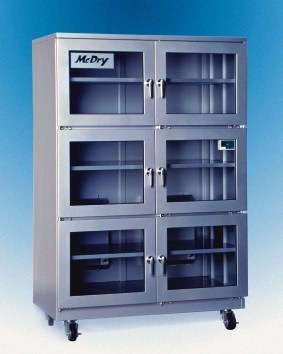
For component drying, we can use two methods: desiccation or baking. Room-temperature desiccation, an option for components that were exposed for less than 8-hours to conditions not exceeding 30°C/60% RH, uses standard dry-pack methods, or a dry box capable of maintaining 25°C (± 5K) with less than 10% RH.
Baking appears a bit more complicated than many users might think. There are baking recommendations for pre and post-dry packing based on the required level and device-package thickness. Pre-baking is applied to prepare components for dry packing, while post-baking is used to recondition components after floor life expiration. Review and follow the time and temperature recommendations for baking in J-STD-033. Baking temperatures can decrease component solderability by oxidizing the leads, or impact reliability by causing excessive intermetallic growth. It’s advisable not to store components in an oven at baking temperature. Note that high-temperature trays can be baked at 125°C, while low-temperature trays must not be treated at temperatures higher than 40°C.
Article is based on information supplied by Seika Sangyo, Düsseldorf, Germany.
• For a device-package thickness less than or equal to 1.4mm: levels 2a through 5a demand bake time ranges from 8 to 28 hours at 125°C, or 4 to 14 hours at 150°C
• Package thickness less than or equal to 2.0mm: for levels 2a/5a, bake time ranges from 23 to 48 hours at 125°C, or 11 to 24 hours at 150°C
• Package thickness less than or equal to 4.0mm: for levels 2a/5a, bake time is 48 hours at 125°C or 24 hours at 150°C
• Package thickness less than or equal to 1.4mm: for levels 2a/5a, bake time ranges from 4 to 14 hours at 125°C, or 5 to 19 days at 40°C
• Package thickness less than or equal to 2.0mm: for levels 2a/5a, bake time ranges from 18 to 48 hours at 125°C, or 21 to 68 days at 40°C
• Package thickness less than or equal to 4.0mm: for levels 2a/5a, bake time is 48 hours at 125°C, or 67 or 68 days at 40°C
Der Kunststoff, in dem Bauelemente eingegossen sind, nimmt in einem bestimmten Umfang Feuchte auf. Beim Reflowlöten können durch den Dampfdruck im Package kleine oder größere Cracks oder interne Delaminationen zwischen verschiedenen Teilen auftreten und so Komponenten zerstören oder ernstlich vorschädigen. Baugruppenhersteller müssen dies in ihrer Fertigungsstrategie umfassend berücksichtigen, um Probleme mit Ausbeute oder Zuverlässigkeit drastisch zu minimieren.
La matière plastique dans laquelle sont noyés les composés absorbe une certaine quantité d’humidité. Lors du brasage à reflux, la pression de la vapeur peut provoquer des fissures plus ou moins importantes ou des délaminations internes entre les différentes parties, ce qui peut conduire à une destruction ou un endommagement sérieux des composants. Les fabricants de sous-groupes doivent en tenir compte d’une manière globale dans leur stratégie de fabrication pour prévenir les problèmes de rendement ou de fiabilité.
Il materiale all’interno del quale vengono pressofusi gli elementi costruttivi assorbe un certo quantitativo di umidità. Nella saldatura a riflusso, in seguito alla pressione del vapore all’interno del Package possono verificarsi piccoli o grandi cracks o delaminazioni interne tra diversi componenti, con la conseguenza della loro distruzione o di seri danni. I produttori di gruppi costruttivi devono considerare del tutto questi fattori nella loro strategia di produzione, al fine di ridurre drasticamente al massimo i problemi di sfruttamento ed affidabilità.