Anthony J. Hynes, Precision Valve & Automation, New York
The long term coating needs are often difficult to assess. Production numbers may remain consistent; however, a new board may be online within the next few years Another coating material may be specified after unparalleled test results. What if that material is twice as viscous and has a different cure mechanism? A programmable conformal coating system must respond positively to these conditions. It must successfully coat a board without masking, and easily adapt to any material to offer any future benefit.
The application of conformal coating to PCB assemblies provides protection. No matter what application method is chosen, the foundation of the process will lie within the choice of coating. An excellent application technique coupled with improper coating can lead to inadequate protection. Choosing the proper conformal coating entirely depends upon the protection required. Traditionally, different materials provide distinct scopes of protection. It is suggested to consult a material manufacturer to determine the proper coating to meet the protection requirements. Flexible automation should allow any material to be applied regardless of chemistry or viscosity.
Conformal coatings can be classified into two categories: solvent-based and 100% solids. Historically, solvent-based materials have been popular because of the user’s ability to control viscosity by dilution. This was required to adapt to the equipment’s characteristics to viscosity. These coatings were also favored as a result of their relatively inexpensive price. However, there has been a movement away from these coatings since regulations by the US Environmental Protection Agency (EPA) in the 1980s sited health hazards caused by solvents like toluene and xylene. Solvent-based materials have remained popular as they became more environmentally friendly. The low price remains an attractive characteristic. However, it must be noted that a material containing 50% solvents will require approximately twice the desired cured thickness to be applied. For example, the specified thickness on a final product is 3 to 4-mil. To achieve this, 6 to 8-mil must be applied since 50% will evaporate into the air. So, while these coatings do remain low in price, half of the material used in this example will not remain on board when cured. These materials can vary widely in solvent content.
On the other hand, 100% solids materials have gained momentum in the industry. These environmentally more friendly materials provide an alternative to solvent-based coatings. Higher viscosities and the absence of solvents are the most obvious differences. Solid coatings require less ventilation, and have a tendency to be consistent in their application. In short, the material that is applied at 4-mil will be cured on the board at 4-mil. The higher viscosities also allow for greater handling of boards before curing. Nonetheless, 100% solid material is more expensive than its solvent-based counterparts are. However, the true cost of a conformal coating operation should be evaluated per part. This will give the most reasonable way of determining the cost situation associated with any material.
With all of the conformal coating materials available on the market, and with the continued development of improved chemistries, it is vital to choose a spray valve that can easily apply any coating. This is not the case with many spray techniques, however. Restrictions on chemistry or viscosity can limit the options. The foundation of a flexible coating line lies within a valve’s ability to apply any material. Contract manufacturers are typically most affected by the flexibility of spray technology. The ability to adjust quickly without equipment changes is important, especially when one is unsure of the material that may be used the other day or next week. Turning customers away because of the inability to spray their specified material can be detrimental to subcontractors.
A stainless steel design offers the greatest flexibility as any coating or cleaning material may be used with no fear of damage to the dispensing head. The coating should never become exposed to air or moisture inside the valve. This is especially important with moisture-cure silicone, which will cure if exposed to air inside the spray nozzle. With an airtight valve and material delivery system, material can be left in a system indefinitely, eliminating the need to purge or flush.
The spray pattern produced should offer even thickness with good edge definition, and no overspray. Transfer efficiencies of 99% or higher should be achieved with an automated system. If the spray pattern is not accurate enough to eliminate masking, then it cannot take full advantage of automation. Spray valves can deliver patterns ranging from 1/8 to over 2-in width on a single pass. Widths can be controlled by the height in the Z-axis of the dispensing head and the spray nozzle chosen. For example, a fan-shaped nozzle can typically produce a wider spray pattern than a conical shape.
Total control over spray thickness is available by adjusting the flow of material through the valve, the speed of the robot, and/or increasing or decreasing the material and atomizing air pressure. Consistently, we see the standards ranging from2 to 5-mil in thickness. Valves are the most im-portant factor in a spray operation. Motion ca-pabilities often take a backseat to spray technology. If the valve cannot successfully apply the coating, motion will not be able to hide this. To keep a conformal coating operation as flexibleas possible, it is of great importance to utilizea spray valve capable of accommodating anymaterial.
The major benefit of choosing a programmable system over a dip, brush or manual spray operation is the elimination of the masking process. Anyone who has ever needed to mask boards before knows that it is a labor-intensive, costly operation. A system provides the greatest payback once it is able to eliminate masking. Otherwise, it is merely a costly alternative to hand spraying. It is crucial to a flexible conformal coating operation that motion is able to occur simultaneously in all axes. This allows for optimal cycle times without the need of stopping to change, for example, the Z-axis height.
PCB assemblies continue to become increasingly complex. Many coating systems utilize two or three axes of articulation. An operation’s ability to eliminate masking and coat a board successfully is limited by the motion capabilities of the robot. 2 or 3-axis systems, while applicable for many boards, are proving to be insufficient for a collection of others. 2-axis systems provide excellent coverage on boards that bear no components, however, changing the spray pattern width on-the-fly or contouring the Z-axis is not possible. For many boards this may be inadequate. Many of these systems may utilize a pneumatic Z-axis control.
3-axis give the ability to work in the Z-axis and increase flexibility. Z-axis motion is helpful spraying coating up one side of a component and down the other. This is also advantageous in controlling and adjusting the pattern width. Movement in the Z-axis during dispensing can be used to alter the width of the spray pattern on the fly. This will result in a continuous path and flow of material and, consequently, a reduction in cycle time. A 3-axis system will significantly increase the scope of boards capable of being coated, compared to a 2-axis.
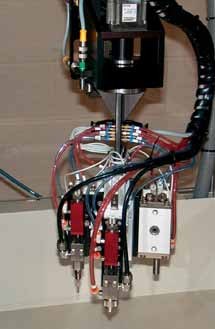
To maximize flexibility, an application should utilize not only a spray valve, but a needle-dispensing valve as well. This capability allows for greater coating proficiency. Needle valves permit beads and dots, thus increasing cycle time on many boards where small spots must be protected. Hidden or component side areas require another approach. Pneumatically tilt axes for a needle valve present the best alternative. This permits the user to apply coatings to underfill areas of the board with the accuracy of a needle valve. This technology also makes it possible to coat the sides of components with accuracy and repeatability to eliminate masking.
Pneumatically tilt axis coupled with a 3-axis ro-botics is popular, however, still restricted in motion capabilities. While excellent for accurate spray coating, it is only able to take advantage of underfill areas with the pneumatic tilt lined on one side of the board. For example, utilizing a 3-axis robot with the pneumatic rotary axis will allow complete coverage on top of components, although it will only be able to dispense at an angle on the east side of the board. Obviously, the orientation of a system would dictate which side will be capable of underfill dispensing. However, with a 3-axis system, it will always be on only one side.
To offer high flexibility required for coating any board without the need for masking, a 4-axis robot employing a pneumatically rotary tilt axisis available. 4-axis will still present programmable X, Y and Z-axis, as well as a programmable theta move. This provides complete motion in a 360°-pattern. A theta axis allows the flexibility of applying coating at angles in any direction, north, south, east or west, and any increment in between. Demand for these systems has been far greater than anticipated. PCBs previously unable to be coated with a programmable system now can be done quickly and easily, without masking. To allow process a very high degree of flexibility, a programmable 4-axis system will permit unparalleled motion capabilities, while maintaining the possibility for use in other dispensing applications without hardware changes.
Very few coating applications remain the same forever. This is the idea behind flexible equipment. Change can come in many forms. For example, a material may be specified. If a valve cannot accept the change in viscosity, is this flexibility? Material changes can quite often lead to costly solutions. A valve applying any coating becomes crucial to flexibility. Conformal coating equipment that processes a wide variety of boards can include programmable conveyors. This feature allows selecting the program from the screen on the machine, and all conveyors through each module will automatically adjust to the appropriate board width. No manual adjustments are needed. The conveyors are motor-driven on ball-screw slides for increased accuracy. Barcode readers can be used in conjunction with programmable conveyors. By simply scanning the codeon a board, the system will find the appropriate program, and could automatically adjust conveyors. This can all save time over manual change-overs.
Change is one of the most important factors. Concerns over changing programs, changing materials, and how much time it takes to do so, are factors that always need to be taken into con-sideration. This is important for manufacturers large and small. Production facilities have little time to waste on shutdowns or changeovers. Altering the process must take as little time as possible. This is where modular system design and programmable conveyors become factors.
Users must face these issues as well as frequent material changes. Small companies often do not believe that they can justify automation investment for a petite PCB volume. This very well may be valid. However, the company may have a small dispensing unit where silicon, epoxy and solder mask are applied in different applications. Automation equipment now has the flexibility to do all of these different dispensing applications, without the need for hardware changes. Imagine applying solder paste with one valve, spraying conformal coating with another, and dispensing adhesive with a further. Changing jobs is as easy as selecting a program. Then automation equipment not only does one application, but three or four. This offers the flexibility to allow the equipment to grow with. As one application becomes more predominate, the system can be justified for that process.
Conformal coating material is usually supplied in a pressure vessel ranging from one to ten gallons in size. This is dependent upon the volume in which the coating will be used. Smaller operations may even utilize cartridges or syringes. Disposable Teflon tubing is convenient for material transport, especially during changeovers. This tubing can be discarded easily and replaced in seconds. Completely changing a coating material may necessitate flushing the valve with a solvent or cleaning agent. Changing material should only require minutes. Accommodations can now also be made, with the addition of multiple spray heads and delivery systems, to change materials instantly within a program.
Once a PCB has been coated, the curing process becomes just as important to the overall quality of the board. Materials have a variety of cure mechanisms. Conformal coating can typically be broken down into the following categories forcuring, ultraviolet light, room temperature, heat-accelerated and moisture-based.
Everyone wants to handle the PCBs as quickly as possible after application. Great strides have been made in reducing cure times. Each mechanism has a different effect on the equipment necessary to complete the coating process. UV-cure material can be handled only a short time after being exposed to ultraviolet radiation. This allows curing tunnels to be short in length and efficient. When used properly within process, UV-cured material can produce fast and efficient results. The user should be aware, though, that by using these materials, some sort of UV-chamber is needed. This will inevitably add to the final cost. Curing can be completed with either an in-line UV-cure chamber or a stand-alone light box.
Additional precautions must be made in the tubing used for transporting the material to the valve. Black lines will guard against any ultraviolet light being able to cure the material prior to entrance into the valve. Since the material will only cure when exposed to UV radiation, can this present a problem when coating underfill or shadowed areas. This makes it important to investigate the presence of a secondary cure mech-anism. Many UV-cure coatings have moisture, heat, etc. as a secondary mechanism. This may effect the total time required after curing.
Moisture-cure materials rely upon humidity to harden. This can be done on the shop floor, or with the assistance of a humidity chamber. Relative humidity, temperature and the presence of carbon dioxide can all effect the cure cycle. Thus, these variables must be tightly controlled to obtain the optimum cure time. This is often difficult to do by merely allowing the PCBs to cure on a rack in production. A humidity-cure chamber can allow total control over the conditions, and present consistent results. Consideration must still be given to the cure time, even at optimum conditions. This, coupled with the largest board size, will affect the cycle rate through a curing oven. Reduced cycle times and increased flexibility may be achieved through longer tunnel lengths. Optimum throughput characteristics cannot be achieved without a curing tunnel. A material that takes 5-min to cure in the humidity tunnel may take 45-min to 1-hr in room temperature conditions. Some moisture-cure materials may not be able to accelerate tack-free times with the addition of heat. Consult of the material supplier for optimum conditions are helpful. Room temperature-cured material is very popular, especially in small to medium production. It becomes the material of choice because of its relatively short cure times. Often, moderate users choose program-mable coating systems, however, shy away from curing tunnels because of the added project cost. Room temperature-cured materials allow for quality results without the need for a curing chamber. We find that many customers choose to automate their coating process, while specifying a fast curing material that allows PCBs to be placed in racks until handling is possible. It is important to make sure that sufficient space is available in the line if racks are to be used.
Heat will typically accelerate curing times for these materials. This is where an IR (infrared) or convection oven can become useful in increasing throughput. Room temperature-curing times can vary greatly depending upon the material. It is always good to assess curing capabilities prior to finalizing on a material.
Curing options offer the user flexibility in auto-mation. Modular systems then become critical.A user can choose programmable coating equipment, with plans of expanding the line with growing needs. The addition of a curing tunnelis often the next logical step in the process. The ability to do this with little or no modificationsto the current coating workcell is imperative,while keeping costs down and maintainingsimplicity.
Whether a user is developing a conformal coating process for the first time, or if he is simply looking for a new approach, it is important to take stock of the needs such as: What is the current volume? What do we project for the next few years? What conformal coating material will we be using? What are its cure characteristics? Will we needa curing tunnel, or do we plan to cure withthe use of a drying rack? What are the pros-pects of changing coating materials in the fu-ture? Is the conformal material going to change regularly? What effect will this have on theprocess?
And the list of questions is even longer: How much money will we spend on a masking operation each year? Can this be reduced? How much material waste is calculated each year? What does this cost? How can this be improved by another method? Will a defined number of boards require coating? Will these always remain thesame or is this relatively unknown? How com-plex are these boards? How much masking willbe required? What is the most accurate andefficient method for applying the conformalcoating?
These are all questions that must be addressed when evaluating processes. A company must consider where it is now and where it expects to be long-term. It is unrealistic to think that anyone would know the answers to all of thesequestions. However, users must evaluate the current needs while choosing equipment that offers adaptability for future considerations.
Programmable equipment brings many advantages to the forefront. Reduction in masking labor and materials are crucial factors. Many applications can save on material costs, even up to 50% with transfer efficiencies of 99%. The real testof flexibility comes when automation equip-ment does not limit with capabilities, and al-lows for variables in the coating equation. Finally, can the conformal coating equipment grow along?
Once each of these questions has been assessed, a picture should begin to take form of the proper process. Flexibility in a conformal coating system has become indispensable. As improved coatings continue to become available, the ability to change an existing line easily and with minimal cost is vital. Overlooking the importance of flexibility in a system can be costly in the future. However, with proper research and evaluation, a user can successfully prepare coating operation for any changes that may come.
Selektive Beschichtung (Conformal Coating) von Leiterplatten und Baugruppen ist ein wichtiger Schritt, um diese Objekte gegen Umwelteinflüsse aller Art effizient zu schützen. Die Automatisierung dieses Schritts in der Boardfertigung verspricht Vorteile. Hohe Flexibilität des Equipments ist dabei eine wichtige Eigenschaft, denn viele Variablen müssen im Prozess berücksichtigt werden. Nicht zu vergessen sind die Anwender mit kleineren und mittleren Losgrößen. Bei ihnen rechnet sich die modular konfigurierbare Anlage vermutlich besser, wenn man eventuell zusätzlich noch Underfiller oder SMT-Kleber damit dispensen kann.
L’enduction sélective (conformal coating) des cartes imprimées et des ensembles est une étape importante pour leur protection contre les agressions de l’environnement de toutes sortes. L’automatisation de cette étape dans la fabrication de cartes promet d’être avantageuse. L’équipement doit pour cela faire preuve d’une grande flexibilité car de nombreuses variables doivent être prises en compte dans le processus. Les utilisateurs ayant des lots de taille réduite à moyenne ne doivent pas être oubliés. Pour eux, une installation modulaire configurable est probablement plus intéressante si elle permet d’appliquer en plus l’underfiller ou la colle CMS.
Il rivestimento selettivo (conformal coating) di gruppi costruttivi e di circuiti integrati è un passo importante per proteggere questi oggetti da agenti ambientali di qualsiasi tipo. L’automazione di tale passo nella produzione delle schede promette molti vantaggi. Un’alta flessibilità dell’equipaggiamento riveste in tale ottica un ruolo importante in quanto nell’ambito del processo devono essere tenute in considerazione numerose variabili. Non dimentichiamoci poi degli utilizzatori con lotti piccoli o medi. Un impianto a configurazione modulare può essere ancora più attraente se fosse possibile integrarvi anche il dosaggio di collante SMT o Underfiller.