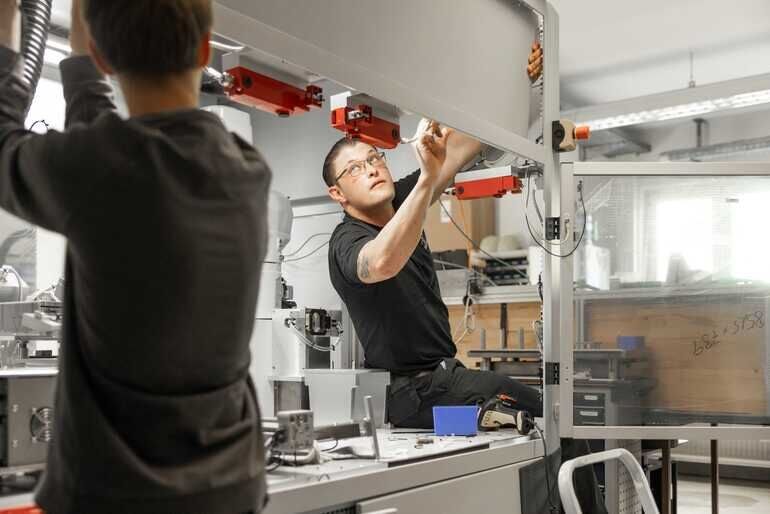
The Swabian special machine manufacturer has been pursuing a consistently unconventional approach to the development of its selective soldering systems for many years: “Our approach does not start within the traditional framework, but deliberately beyond it,” emphasized Managing Director Matthias Fehrenbach. This philosophy is based on the idea that selective soldering systems should not be regarded as scrap metal at the end of their service life, but as a valuable resource for new applications. Thanks to the modular design of its systems, the company can take back used systems, refurbish them, and put them back into operation, in line with the principle of functional reuse. Instead of quality-reducing recycling, the value of intellectual and material achievements, including complex soldering processes, is retained. “What used to end up at the recycling depot is now the basis for new solutions,” commented Fehrenbach.
Fehrenbach and his team have been pursuing this approach for around five years. He explained: “At the beginning, we had to frequently explain what we were doing. The cradle-to-cradle concept was and still is relatively unknown in mechanical engineering. This was also the case for our customers, but they quickly understood the added value it could offer.”
Existing customers subsequently contacted us proactively and offered us their decommissioned EUTECT systems, in many cases for a small contribution to their Christmas fund. Some systems thus found their way back to Dusslingen, where they were dismantled and refurbished in parts before being delivered to new customers for new tasks. “One machine has now completed this journey for the second time. After its return, it was sent to a customer for a limited period, who returned it to us after completing the order,” Fehrenbach added.
For customers, this approach means a significant boost in cost-effectiveness and flexibility. They no longer have to purchase machines, instead, they can be rented or leased for prototyping, pre-series production, or as test systems in the company‘s own technical center. This reduces investment risks, accelerates project start-ups, and shortens delivery times, both for complete systems and for individual soldering modules that are available directly from stock. If a module needs to be serviced, a refurbished replacement module can be provided at short notice, with the same performance but without delay.
The concept also makes economic sense. “People often assume that cradle-to-cradle solutions are more expensive. In fact, they are around 20% cheaper on average,” explained Fehrenbach. The targeted use of durable materials and components reduces procurement costs while increasing the service life of the systems. In the long term, the company is pursuing a larger vision: to build a closed ecosystem in which machines, modules, data, and services interact intelligently over many years.