China – where today not only U.S., Japanese and Western European vendors have their goods assembled – Taiwan, Korea, Singapore, the previous relocation hot spots of the 80s and 90s, have their goods assembled there as well. Japan, the target of the first wave of the migration to cheap manufacturing sources, is deeply involved today as well, moving its plants with the third wave: from Korea and Taiwan to China.
If second-wave Taiwanese companies, as the New York Times reported recently, still manufacture 80 % of the world’s PC motherboards, 72 % of all notebook computers and 68 % of all LCD monitors, it only appears that way. But in reality, the migration of final assembly from Taiwan to China is in full swing.
As with these first- and second-wave moves among the newly industrialized Asian countries, China itself is transforming from workbench to high-tech drawing board, nurturing its own R&D community, trying to put its own cultural stamp on the technology revolution (in telecom standards, for example), and developing consumer brands. China is getting out from under the licensing and patent regimes of its U.S. and Japanese counterparts.
Along with China´s transition to a high-tech force of its own, the globalization champions of the first and second waves are taking note and adjusting their strategies accordingly: First of all management-wise, to measure up to the present challenges in workforce education, with all the intercultural frictions which have been presented and discussed at length. Secondly, as global companies they are refining the hunt (some would say: ”he war“) for talent, especially in the realm of R&D. Thirdly, they think harder about the establishing and maintaining of global brands and about protecting valuable IP assets, which tend to dissolve in the long supply and consumption chains with many intermediate steps in countries that are still struggling with low legal enforcement standards.
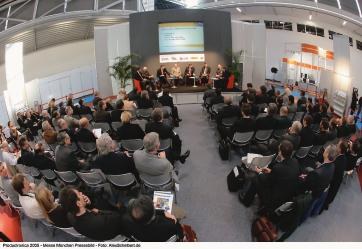
Semiconductor manufacturing has been the trailblazer in this process. Now it’s common practice. But with the ascension of China to the WTO, the rules have changed. And are changing again – as re-confirmed by the high-caliber executives’ panel in Munich, Germany. CEOs and Vice Presidents of seven global electronics manufacturers discussed their views.
Relocating for gains in cost und access to markets has become another focus of corporate strategy as the Productronica panel explained: structure and purpose of globally active enterprises are changing again. Supply and delivery chains are mutating into virtual intra-company networks. With them, traditional boundaries between OEMs, ODMs and EMS providers are beginning to overlap if not disappear altogether. EMS providers are taking on design and development and are competing. OEMs are turning into ODMs. OEMs manufacture branded goods for other OEMs. The global corporation takes its functions wherever they are most efficiently utilized.
So, possibly the most courageous and future-oriented thought uttered by the panel was John Pomeroy’s (Dover Technology International) question: “How many of you have considered moving your headquarters to China?“ A rhetorical question of course, one that came up in his managing board, as Pomeroy readily admitted. But the time may come, when the sheer size and influence of markets, availability of motivated workforces including engineering and management talent, and the technology trends evolving from those resources, will bring this question into reality.
For EMS providers such as Flextronics, relocation has always been easier because they stitched their empires together on foreign shores. Flextronics, fittingly, is based in Singapore. Flextronics is the truly global entity, as Francois Barbier, Senior Vice President European Operations, says: it is “nowhere at home,“ continuously on the move, shifting resources to wherever they are best practiced. No wonder then that Flex is investing heavily in a new industrial park in India.
What will remain of a company’s distinctive culture in terms of its own strengths in technology, branding, marketing? “Make sure that all operations are running according to your own standards,“ says Amir Aghdaei of Agilent, “so that the quality is there.“ Development of employees on all corporate levels, frontline workers to executive staffs, is the guiding principle. “Thirty to forty percent of our lower top hundred (management) are Asian,“ Aghdaei says, “or they are becoming Asian.“
Tilo Brandis of Siemens EAS concurs. Despite a lower percentage of Asian management in his division, his Chinese operations “are run by Chinese, and our factory in Singapore is run by Singaporeans.“ But, he warns, “looking at CEOs and management is only one side of the story.“ Equally important, he says, is considering the whole value chain in a company, “which you have to align to what your customers have taught you.“ The trick, Brandis concludes, is maintaining quality. Siemens’ medical group, for instance, “is doing their engineering, it doesn’t matter where they are. They just develop their product. You can not say where it comes from. But it’s made by Siemens. That’s the logic behind it.“ Werner Schulz
EPP EUROPE 400
But wait! It’s never too late as the panel concluded. Because there is a new target evolving: India. In terms of manufacturing services and place of relocation, India is the next China, so to speak. Not just in software, as the prevailing wisdom has it. Also in real physical manufacturing of low-priced consumer goods to be shipped back to their highly developed markets. Cell phones, for instance.
Steve Corbett, President and CEO, Cookson Group Electronic Division, Plc.; John E. Pomeroy, CEO, Dover Technologies International, Inc.; Tilo Brandis, President, Electronic Assembly Systems, Siemens AG; Francois Barbier, Senior Vice President European Operations, Flextronics; Thomas Gambke, Managing Director, Schott Electronics GmbH; Amir Aghdaei, Division General Manager, Agilent Technologies Sales and Services & Co. KG; Stefan Janssen, Assistant General Manager, Fuji Machine MFG Europe GmbH. Moderation: Hermann Simon, CEO, Simon – Kucher & Partners Strategy & Marketing Consultants GmbH, Bonn, Germany.