Jörg Spiegelhalter, Sick AG, Waldkirch (Germany)
This improved ergonomic efficiency often pays off rapidly, especially compared to mechanical guards, because cycle times can be reduced by up to 30 % or more, depending on the machine. In addition, as a result of the innovative single housing design of the V300WS – with its integrated image-processing sensor and new mounting, connection and commissioning concepts – it is possible to achieve enormous cost savings per workstation compared to other safety solutions.
The V300WS is intended for applications on semi-automatic machines in which persons have to intervene regularly during the process or sporadically as part of an emergency strategy, therefore requiring Safety Category 3 or Performance Level (PL) “d” according to ISO 13849–1 or SIL 2 in line with IEC 61508. This camera sensor is electro-sensitive protective equipment based on image-processing technology with resolutions of 20 mm, 24 mm and 30 mm. The sensor’s transmitter and receiver are integrated in a single housing, as are the supplementary Reset and Electronic Device Monitoring (EDM) functions. The compact, triangular housing allows mounting in or on the corner of a workstation’s slotted profile frame, or behind the cladding of a machine, i.e. in places where the sensor is largely protected against impacts or de-alignment. A reflector strip is attached opposite the installation location. The camera system automatically detects the entire length and width of the reflector area and adjusts the monitored field accordingly, even with a maximum off-axis mounting of +/- 24 cm to the machine opening. The V300WS responds within 20 ms when a person reaches into the machine during a processing operation and immediately stops the process.
The V300WS can be used for protecting hazardous points and areas in vertical and horizontal applications within the PL “d” range. Variable protective field heights or lengths of up to 1.5 m; diagonals of up to 2.12 m; two devices in synchronized operation; straight and rounded contours – in all cases, the safe camera sensor’s flexibility in terms of the size and geometry of the protective field opens up new levels of freedom during the construction and operation of machines. Whether on coil winding machines, placement machines, bonders, processing systems, panel separators, inspection equipment, in-circuit testers or pad printing systems – the classic, purely rectangular, monitoring scenarios of many machines are now joined by individual “special geometries”.
These include, among others, cable channels within the protective field; curved geometries, e.g. for preventing stepping behind protective doors; long and very narrow apertures for reaching-in and removing or transferring goods; protection within hoisting ducts; off-axis mounting behind machine cladding; and the monitoring of L- and V-applications by means of two synchronized devices – without a central brace in the corner transition which would impair the work of operators. All these situations can now be dealt with during design – and always with the same sensor! This is also, of course, ideal for reducing organizational effort as well as purchasing, stock-keeping and logistics costs: just one type of device is ordered and just one part number administrated. There are no differing device versions. Type changes are thus unnecessary during both initial and retroactive mounting. Moreover, only a single uniform connection cable need be procured, stocked and installed because the transmitter and the receiver are integrated in the same housing. Flexibility is also trumps during on-site commissioning: if the intended protective field dimensions have to be altered due to hitherto unrecognized conditions at the installation location the V300WS can be appropriately adjusted at the press of a button.
Almost no other safety sensor is as easy to mount and align as the V300WS. Only two screws are required to firmly fix the device; a single connection cable must be laid and installed. Alignment of the sensor on the reflector strip is just as easy. Because the reflector strip is detected within a range of up to +/- 24 cm to the optical axis, visual judgment is sufficient for its installation – the time-consuming alignment of transmitter and receiver during initial installation or readjustment is entirely unnecessary. Taken together, this all leads to an average V300WS installation time of less than ten minutes – keeping commissioning costs correspondingly low. In addition, as a result of this detection tolerance, the V300WS can fundamentally always be located where it is exposed to the least mechanical stresses and causes the least trouble for operators.
In order to achieve maximum throughput performance, electronics production requires efficient and comprehensively automated assembly, handling and inspection processes with maximum availability. This means that solutions like the V300WS must offer possibilities for rapid configuration during commissioning as well as for targeted diagnosis during operation. The safe camera sensor from SICK is thus equipped with a 4-LED display for this purpose. During device installation it supports the teach-in process and shows whether the safe OSSD switching outputs, EDM and Reset functions have been activated. In the case of a warning or a fault it provides clear allocation – and thus allows targeted rapid measures for fault correction. In protective mode, each LED acts as an “in order” indicator for a defined sector of the protective field – ensuring rapid fault location and correction, e.g. if reflectivity is too low due to strong contamination. The downtimes of the workstation are always minimized because fault correction can be carried out very quickly and without expert knowledge.
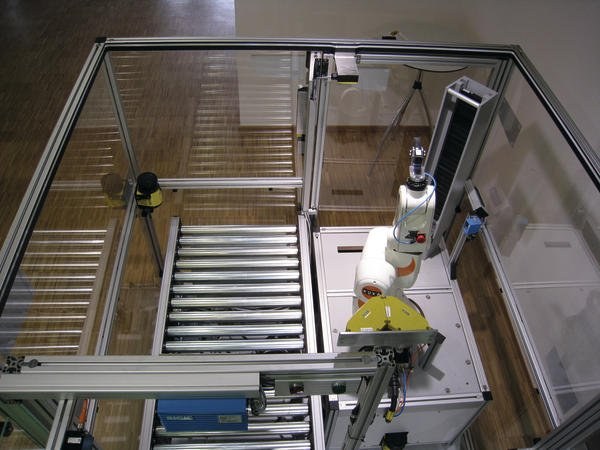
In addition to the V300WS safe camera sensor, Sick’s complete portfolio offers numerous other sensor solutions from a single source in order to ensure that automated production and inspection processes in the electronics and solar industries can achieve maximum reliability and availability. Examples include optoelectronic, electromagnetic and ultrasonic sensors and encoders, e.g. for use in handling and process systems. Powerful 1D and 2D code readers provide reliable solutions for the stationary or mobile identification of circuit boards, multiple panels, wafer boxes or solar modules. Then there are the camera sensors like the Inspector (e.g. for monitoring the presence of parts) and Machine Vision – solutions for the three-dimensional high-speed inspection of, for instance, soldering paste on printed circuit boards. In safety terms, a wide range of products are available to ensure an optimum combination of safety, availability and ergonomy on partially automated processing stations as well as on fully automated robot cells. These include electromechanical safety systems, laser scanners or the miniTwin2 and miniTwin4 safety light curtains. Finally, intelligent safety-oriented control solutions (e.g. the Flexi Soft modular safety controller) which open up the most varied of networking and control possibilities for differing safety sensors on a machine, are gaining in importance.
In der Elektronikfertigung muss Bedien- oder Wartungspersonal von Zeit zu Zeit eingreifen, u.a. zur Nachschubversorgung. Der sichere Kamerasensor V300WS überwacht solche Gefahrstellen, bietet neue Freiheitsgrade beim Maschinendesign sowie ein Höchstmaß an Ergonomie.
La production de matériel électronique des interventions occasionnelles des opérateurs ou du personnel de maintenance restent nécessaires pour assurer l’approvisionnement, réaliser un changement d’outils ou supprimer un défaut. Le capteur caméra V300WS, très sûr, surveille de telles zones à risque et offre de nouvelles marges de manœuvre dans la conception de machines ainsi qu’une ergonomie maximale.