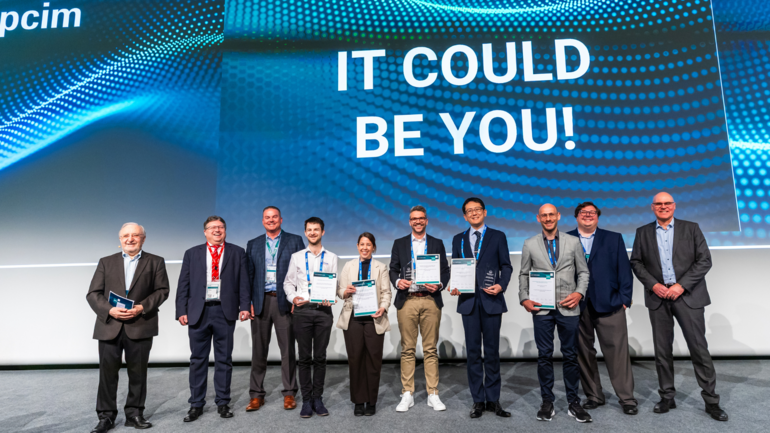
The awards recognize both young talents and established experts who are driving technological advances and new approaches in the industry. This year, the event’s international advisory board, chaired by Prof. Leo Lorenz, selected the winners from more than 450 submissions.
Outstanding research papers and innovations
Besides reflecting the current challenges and trends in power electronics, this year’s awards also provide impetus for future developments in energy technology, power semiconductor technology, and smart systems integration. The quality and relevance of the submissions were particularly high, underscoring the forward-looking nature of the industry.
Rigorous scientific quality in power electronics
The Best Paper award was jointly won by three outstanding entries that offered innovative solutions and in-depth scientific findings. The winners deal with key technologies and pioneering approaches that advance the efficiency, sustainability, and performance of power electronics systems. At the forefront of their disciplines, they propose practical solutions to the challenges facing the industry.
The winning papers were:
- Hironori Akiyama, MIRISE Technologies, Japan, “Low-Loss Active Gate Driver with Surge Voltage Detection for SiC MOSFET”
- Michael Basler, Fraunhofer IAF, Germany, “Highly-Integrated 1200 V GaN-Based Monolithic Bidirectional Switch”
- Bastian Korthauer, ETH Zurich, Switzerland, “Improved Insulation Design of Medium-Frequency Transformers Using a Semiconductive Coil Former”
Young talent providing fresh impetus
The Young Engineer award was presented to an engineer whose paper demonstrated technical sophistication and a fresh approach. The award-winning project is an example of how digital technologies and system innovations can create new opportunities for power electronics. This year’s winner was Martin Schiestl from Infineon Technologies, Austria, for his paper “Compact Highly Integrated 1kW Peak Motor Drive”.
Research contributing to the future of power electronics
The Young Researcher award was presented to an outstanding scientist aged under 30 years, whose research has made a significant contribution toward the further development of power electronics. The award encourages academic debate on forward-looking topics and continued research in power electronics. It also lays the foundation for the technological innovations of the future.
The winner of this award was Lena Köhler, Fraunhofer IISB, Germany, for her paper on “Machine Learning and Digital Twins for RUL Prediction of DC Semiconductors Circuit Breakers”.
Presenting the awards and prizes of €1,000 were Prof. Leo Lorenz and this year’s conference sponsors.