As a supplier to the electronics industry, the company uses its market position and process knowledge in the areas of SMT/electronics production and backend/chip assembly to strengthen its role in the advanced packaging segment. Since automotive electronics are demanding in terms of robustness and reliability, advanced packaging technologies are driven to large extent by electrification and other automotive trends. As a result, divisions of labor and supply chains that were established over many years in the automobile industry are changing, and deliveries from OEMs and Tier 1 suppliers to OSATs (Outsourced semiconductor and test providers) are expected to increase by more than 30 percent annually. The company stands ready to meet the dramatically rising demand of OSATs and new manufacturers for advanced packaging technologies and the associated manufacturing equipment.
Solution clusters at the booth: electrification, ADAS, and connectivity
In addition to SMT solutions, the company’s 800-square-meter booth will feature innovative process solutions for advanced packaging applications in the automobile industry from a strong technology partner that can implement fully integrated process solutions with synchronized equipment. ASM has in its portfolio a multitude of solutions for a wide range of process steps, such as laser-based wafer separation, fan-out processes, bonding, SiP assembly, testing and packaging. This is all paired with in-depth process knowledge and many years of experience in the automotive sector.
Getting everything from a single source makes for lower investment costs, project times and risks. The company presents the solutions at its booth in three clusters: Electrification, ADAS (Advanced Driving Assistance Systems), and Connectivity.
Electrification
Electrically powered vehicles need more components containing power electronics. The high currents and electric outputs result in higher temperatures during switching operations and a significantly higher heat input at the contact points between electronics and substrates. The challenge for automotive electronics: due to the longer duration of high temperatures in the individual components, the different heat expansion coefficients of the surrounding materials and – last but not least – the vibrations in a moving vehicle, traditional solder joints become unreliable.
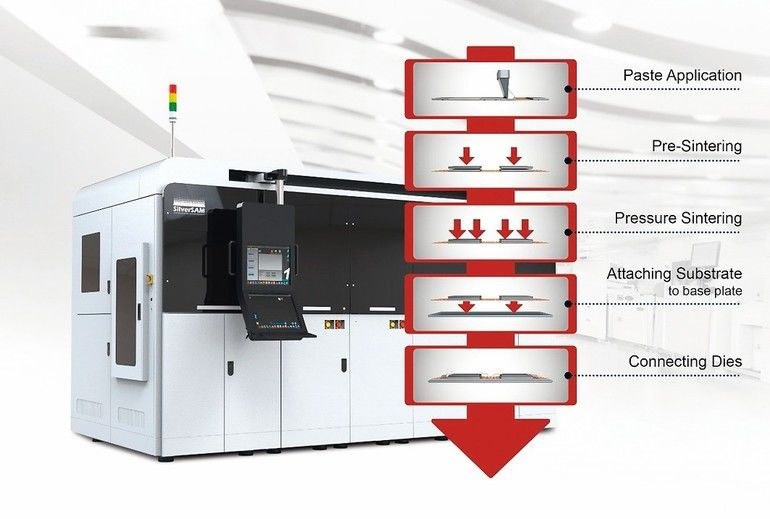
Nano-silver for more stable connections
One solution is to employ more temperature-resistant materials, such as SiC substrates and nano-silver pastes. The high melting point of silver, however, prohibits the use of a melting process to create the conductive connections, because the electrical components would not survive the high temperatures.