Challenge: Variability in production requires a tailored test strategy
Danfoss Power Electronics & Drives develops and produces state-of-the-art power electronics and drive systems for a wide range of industrial applications. These include variable-frequency drives for industrial automation, heating, ventilation, and air conditioning (HVAC), water and wastewater, power generation, and other market segments. PCB production is largely carried out in-house, with batch sizes varying from small series to mass production. This combination of high-volume/low-mix and low-volume/high-mix production places high demands on quality assurance and requires a flexible yet precise test strategy.
To identify failures as early as possible, the company decided to integrate functional testing at an early stage of production. This also resulted in the need to integrate Automated Optical Inspection (AOI) into the process at an early stage. This allows for monitoring of the manufacturing quality and for potential causes of failures to be detected before functional tests are applied, minimizing time-consuming reworking and reducing costs for troubleshooting and failure diagnosis.
Decision criteria: High repeatability, consistency, and efficient fault detection
At the beginning of the evaluation phase, the company defined clear requirements for the new AOI systems, namely:
- High repeatability of the tests to ensure consistent quality;
- maximum fault detection to avoid cost-intensive reworking
- seamless integration into the Manufacturing Execution System (MES); and
- future-proof technology to ensure long-term investment security.
On-site support is the deciding factor
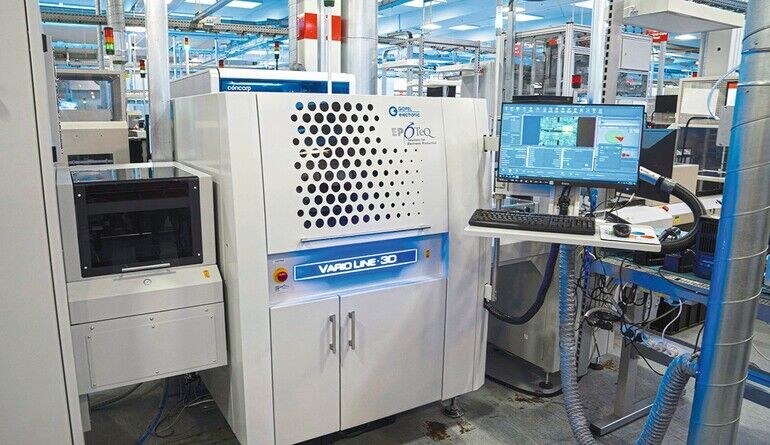
Through close cooperation with EP-TeQ A/S, Göpel electronic‘s long-standing distribution and service partner in Denmark, various latest generation AOI systems could be integrated into the SMD and THT manufacturing process. This local presence was a significant factor for Danfoss, as the company has been working with EP-TeQ A/S for over 30 years in various test areas – from flying-probe systems to boundary-scan tools and older generation THT inspection systems.
Increased efficiency through standardized system architecture
During the selection process, Danfoss tested various systems under real production conditions. Not only was the detection quality of the AOI systems tested, but the suppliers were also integrated into the company‘s specific test strategy. In the end, the systems from Göpel electronic were convincing in the significant categories of technological performance, optimum test speed, flexibility for different production batch sizes, and adaptability to existing production processes.
The ability to adapt hardware and software to meet individual production requirements was a particularly important advantage. This ensured that the AOI systems did not represent a bottleneck in production.
Simplified test program generation for higher productivity
Another significant advantage of the system homogenization was the optimization of test program generation. The standardization of the AOI platform led to more stable test programs with reduced false rejects, a significantly shorter programming time and reduced effort for debugging. Early fault detection, especially of soldering and polarity failures, further optimizes quality assurance at Danfoss. The AOI systems now are responsible for the complete inspection of component placement, positioning and polarity, soldering quality, and process indicators. This ensures consistent defect detection across all stages of the process, including solder paste printing, SMD and THT assembly, as well as reflow and wave soldering.