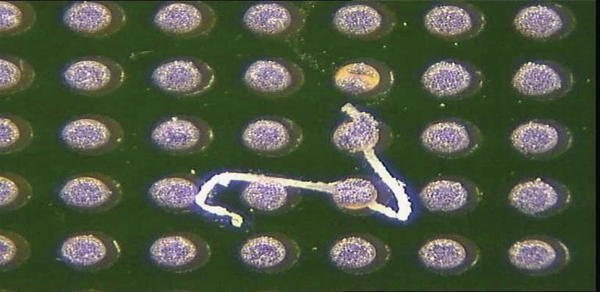
- Hair – the average hair loss for a person is 50 per day (~100 µm)
- Lint – cloths are typically used in production environments for wiping purposes. Although deemed to be lint free they can snag when wiped across pad areas or stencils, generating loose fibres. This can be avoided by using higher quality clean room cloths (~50 to 100 µm)
- Clothing fibres – fibres from garments can contaminate the production process (~50 to 100 µm)
- Dust –dust is mostly composed of human skin flakes. On average a person breathes 700,000 skin flakes per day and sheds one layer of skin every 24-hours (~20 to 50 µm)
- Production plant – the ceilings, floors, shelving and packaging materials are all sources of particles (100 to 200 µm)
- Epoxy dust – during the bare board manufacturing process contamination removal systems are used at every step in the process. However, after routing only the top surface can be cleaned. This means the edges will still have loose dust attached. This dust is disturbed during packing and transport and can be a potential contaminant (~20 to 100 µm)
- Glass splinters – PCBs are made from a fibrous substrate posing the risk of loose glass splinters from snap-outs or routing (~10 to 50 µm)
- Solder paste – misprinted boards are frequently wiped clean and sent down the line again – loose solder paste left on the board can cause problems such as solder balls (~10 to 50 µm)
- Solder resist – can flake away leading to contamination (~50 to 100 µm)
- Packing materials – boards which are individually wrapped in paper can produce paper fibres which attach themselves to the boards by static. Cardboard boxes, when handled, also release swarf into the environment and has been found to create defects (~50 to 200 µm)
- Components – falling onto the bare board.
- Stencil apertures can become blocked by contamination so the print is incomplete
- During reflow contamination in the solder paste can volatilize causing a crater in the solder
- Tombstoning can occur where the chip component stands on end with one end soldered to the board and the other end free
- Fibre from cloths used to clean stencils can become trapped between pads which could lead to short-circuiting
- Poor solder wetting
- Unreliable solder joints
- Dry solder joints